Samsung: a memory chip worker with a base salary of $52k is expected to receive a total bonus of around $410k this year
SK Hynix: employees are expected to receive bonuses of more than $454k
Luxury jewelry sales in S. Korea: +146% YoY
Luxury watch sales in S. Korea: +85% YoY
⚡ France replaced almost its entire fossil grid with nuclear in about 15 years.
Nobody has decarbonized power faster, before or since.
In 1972 the country ran on coal, oil, and a bit of hydro.
By the late 1980s nuclear had swallowed the chart, climbing to nearly 600 TWh and crowding fossil generation down to a sliver at the base.
That was a deliberate state buildout after the 1973 oil shock, not a gradual market shift.
This is why France keeps showing up as the cheapest electricity among the rich economies and one of the lowest-carbon.
The same chart explains both: a fleet of paid-off reactors producing roughly 70% of the country's power means low marginal cost and almost no fuel-import exposure.
The wobble worth watching is the right edge, where output gets choppier as the reactor fleet ages and maintenance outages bite.
The open question for the next decade is whether France can rebuild that capacity as fast as it built it the first time.
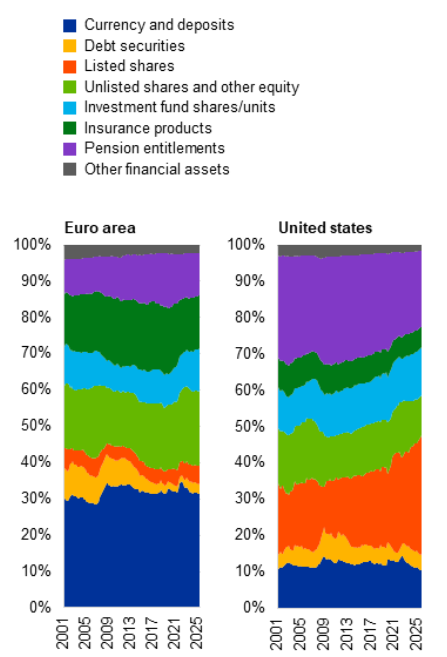
Europe is sitting on trillions while starving its own companies of capital.
The ECB estimates that if EU households reduced their deposit share to US levels, up to €8 trillion could be redirected into long-term market-based investments.
European households hold far more wealth in deposits, insurance products and debt instruments than in equities
This creates two problems:
1. Households earn lower long-term returns and accumulate less wealth
2. European companies receive less equity financing to scale, innovate and become global champions.
A genuine Capital Markets Union, combined with government incentives for citizens to invest in European equities, would dramatically increase market capitalisation and unlock financing for European companies.
This was a famous French weather forecast in 2014 trying to alert people to what France would be like in 2050 because of climate change
Only 12 years on and most of us are already hotter - my town 43 today and not the 34 predicted👇
Starmer’s departure will be seen in Paris as a loss. On his watch 🇬🇧 has become a reliable, trusted and constructive partner for 🇫🇷, on Ukraine, nuclear deterrence and more. The next PM will have his work cut out earning the same respect
The CEO of ASML said Europe is "quite behind" in the AI race. This is not a politician. This is the man who controls the only machines on earth that can print advanced chips. Every semiconductor fab from TSMC to Samsung needs his approval to exist.
And he did not stop there.
Europe has been having the sovereignty conversation for three years. Build fabs. Reduce dependence. Catch up. It sounds right. He said it is the wrong order entirely.
His reasoning is blunt. Semiconductor manufacturing is only needed if you have people buying the chips. If Europe built a two nanometer fab today, most of those wafers would ship straight to the United States. Because the US buys 80% of the world's advanced chips. Europe buys almost none.
You cannot manufacture your way to relevance. You have to create demand first.
His actual sequence: start with the market. Build AI applications. Then AI products. Then chip design. Then and only then does chip manufacturing make sense.
Europe skipped four steps and went straight to the last one.
The sovereignty debate is loud in Brussels right now because of US export controls on AI models. Politicians are scared. The instinct is to build. He is saying the instinct is wrong.
You do not get sovereignty by building factories.
You get it by having something the world wants to buy.
(Watch the full 11 minutes Interview at @BloombergTV on YouTube)
Brazil sells more cotton to the world than any country on earth... and most of that cotton grows on land that already gave a full harvest of soybeans the same year.
The farmer plants soybeans first, harvests them, then drops cotton seed into the same dirt before the rains end.
Each acre carries two crops in one season, with the cotton riding on beans the land already paid for.
That crop just passed the United States to take the cotton crown, ending an American lead that ran about a hundred years.
A single Brazilian acre grows close to double what an American acre does.
While Brazil climbed, America's cotton base shrank from 2,254 working gins in 1980 to 446 today.
Brazil ran this same play before, taking the soybean crown for good, the corn crown for a season in 2022/23, and now the cotton crown, all on the same two-harvest Cerrado land.
The crown keeps moving to the country that pulls two crops from one field, and cotton is only the latest to fall.
I wrote the full story, including the part where the United States paid Brazil $300 million and still lost the crown:
https://t.co/LgrGHIzIvH
“The reduction in Chinese oil imports is one of the most important reasons oil prices are not going through the roof right now,” said @JasonBordoff, the founding director of the Center on Global Energy Policy at Columbia University.
https://t.co/fGkl94nZgv
This isn’t even remotely true. $AMZN went public in 1997 at a $450M valuation, or 3x revenues. $GOOGL went public in 2004 at a $23B valuation and at 7x revenues. $META had a $104B valuation in 2012 at 20x revenues(and immediately sold off almost 50%). SpaceX dwarfs these numbers.
Apple went public at under $2 billion.
15x revenue.
1980.
SpaceX wants you to buy at $2 trillion.
100x revenue.
2026.
That is not getting in early.
That is being the exit for venture capitalists who bought in years ago at a fraction of what you are being asked to pay.
Almost none of the retail investors buying this IPO will read the 300 pages before the book closes on June 11.
I fed all 300 into AI and read them for you.
Here is what you will miss ↓
CHART OF THE DAY: At least some positive news to follow the US-Iran conflict. The price of Arabica coffee has plunged to a mear 2-year low on expectations of a large harvest in Brazil. Considering my war-watching high caffeine consumption, that's very good news.
Demis Hassabis just told a room full of academics that they’re running out of time.
Not the engineers. Not the technologists.
The economists. The philosophers. The people who are supposed to understand what a civilization actually is.
Hassabis: “It’s very urgent that we really think about the second-order consequences.”
He wasn’t talking about the technology.
He was talking about everything that comes after it.
Hassabis: “I’m always a little bit astounded when I talk to economists about what’s happening and it’s sort of, they’re pretty skeptical. ‘Where’s it, where’s it coming in the GDP?’”
The architects of the global economy are asking where the biggest economic shift in human history is showing up in a spreadsheet.
That’s not skepticism. That’s institutional paralysis dressed up as rigor.
Hassabis: “It’s ten times the Industrial Revolution.”
The Industrial Revolution didn’t just move capital.
It burned the feudal system to the ground and birthed the modern world.
Hassabis is telling us to multiply that violence by ten.
Hassabis: “We’re going to be in a world for the first time, if we get the technology right, where we’re a non-zero-sum world for the first time in humanity’s existence. How can that not need a new type of economic system?”
Every economic model you have ever lived under shares the exact same foundational assumption.
Scarcity.
Capitalism. Communism. Mercantilism. Feudalism.
Four names for the mathematics of starvation.
Hassabis: “I don’t think it’s any of the ones we’ve tried, because they were all done under the guise of a zero-sum, a limited, a scarce world.”
He’s not saying capitalism failed. He’s saying the premise underneath it is about to dissolve.
And nobody has written the replacement.
But scarcity didn’t just shape our economies.
It shaped our identities.
You found meaning in your labor. You found virtue in your utility. You worked so you didn’t die.
Every concept of purpose humans have ever constructed was forged in a world where things run out. Where choices cost something. Where suffering had a function.
Remove scarcity and you don’t just disrupt markets.
You collapse the entire philosophical framework through which human beings have understood what it means to live.
Hassabis: “There’s the even harder question of how do we want to evolve our society and what is virtuous, what is meaning, what is purpose.”
The technology is solvable. The economics is redesignable.
But philosophy itself was built inside scarcity. Ethics is the study of hard choices. Meaning is what we extract from struggle. Purpose is what we build against resistance.
Take that away and the entire architecture of human meaning loses its load-bearing wall.
Hassabis: “I think that’s going to need lots of great philosophers.”
He’s asking for thinkers who don’t exist yet.
The engineers are about to automate your survival.
And in doing so, they will automate your purpose.
We spent all of human history fighting for the right to stop struggling.
We have no idea what happens to the human mind when we actually win.
🚨 Ten years after the referendum and the verdict is in:
@dsmitheconomics in The Sunday Times lays out the lost growth advantage.
UK real per capita GDP growth 2016–2025: just 5.4%
Italy: 11.6%
Spain: 11.1%
Eurozone: 10.2%
France: 8.4%
Britain needs to face reality and undo Brexit.
Is Europe falling behind the US on productivity? The Krugman vs Aghion–Bergeaud–Garicano debate hinges on one choice: current vs constant PPPs. A new note maps the gap behind it — all 27 EU states, two data sources — and what it does and doesn't settle. 🧵
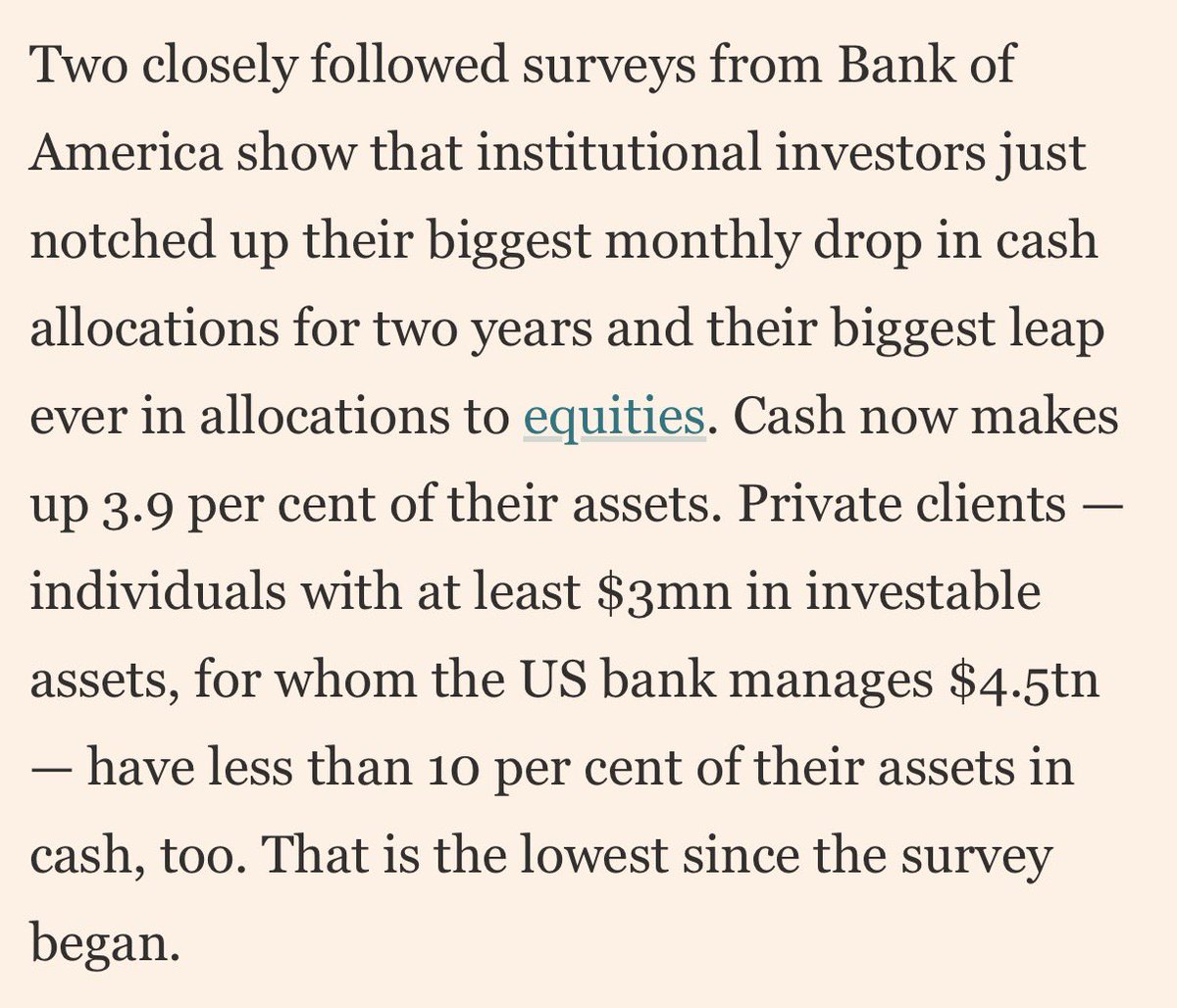
With so much paper set to hit the markets over the next few months—across both bonds and equities—it's worth keeping an eye on the potential sources of cash available to absorb this supply. In this context, here is an interesting take from the FT's Lex column.
#economy#markets@ft #bonds #stocks #investing #investors
Two economists just published a mathematical proof that AI will destroy the economy.
Not might. Not could. Will — if nothing changes.
The paper is called "The AI Layoff Trap." Published March 2, 2026. Wharton School, University of Pennsylvania. Boston University. Peer reviewed. Mathematically modeled.
The conclusion is one sentence.
"At the limit, firms automate their way to boundless productivity and zero demand."
An economy that produces everything. And sells it to nobody.
Here is how you get there.
A company fires 500 workers and replaces them with AI. A competitor fires 700 to keep up. Another fires 1,000. Every company is behaving rationally. Every company is following the incentives correctly. And every company is building a trap for itself.
Because the workers who were fired were also customers.
When they lose their jobs faster than the economy can absorb them, they stop spending. Consumer demand falls. Companies respond by cutting costs — which means automating more workers — which means less spending — which means more falling demand — which means more automation.
The loop has no natural exit.
The researchers tested every proposed solution. Universal basic income. Capital income taxes. Worker equity participation. Upskilling programs. Corporate coordination agreements.
Every single one failed in the model.
The only intervention that worked: a Pigouvian automation tax — a per-task levy charged every time a company replaces a human with AI, forcing them to price in the demand they are destroying before they pull the trigger.
No government has implemented this. No major economy is seriously discussing it.
Meanwhile the numbers are already tracking the curve. 100,000 tech workers laid off in 2025. 92,000 more in the first months of 2026. Jack Dorsey fired half of Block's workforce and said publicly: "Within the next year, the majority of companies will reach the same conclusion."
Nobody is doing anything wrong. Companies are following their incentives perfectly. That is exactly the problem.
Rational behavior. At scale. Simultaneously. With no mechanism to stop it.
Two economists built the math. The math leads to one place.
Source: Falk & Tsoukalas · Wharton School + Boston University ·
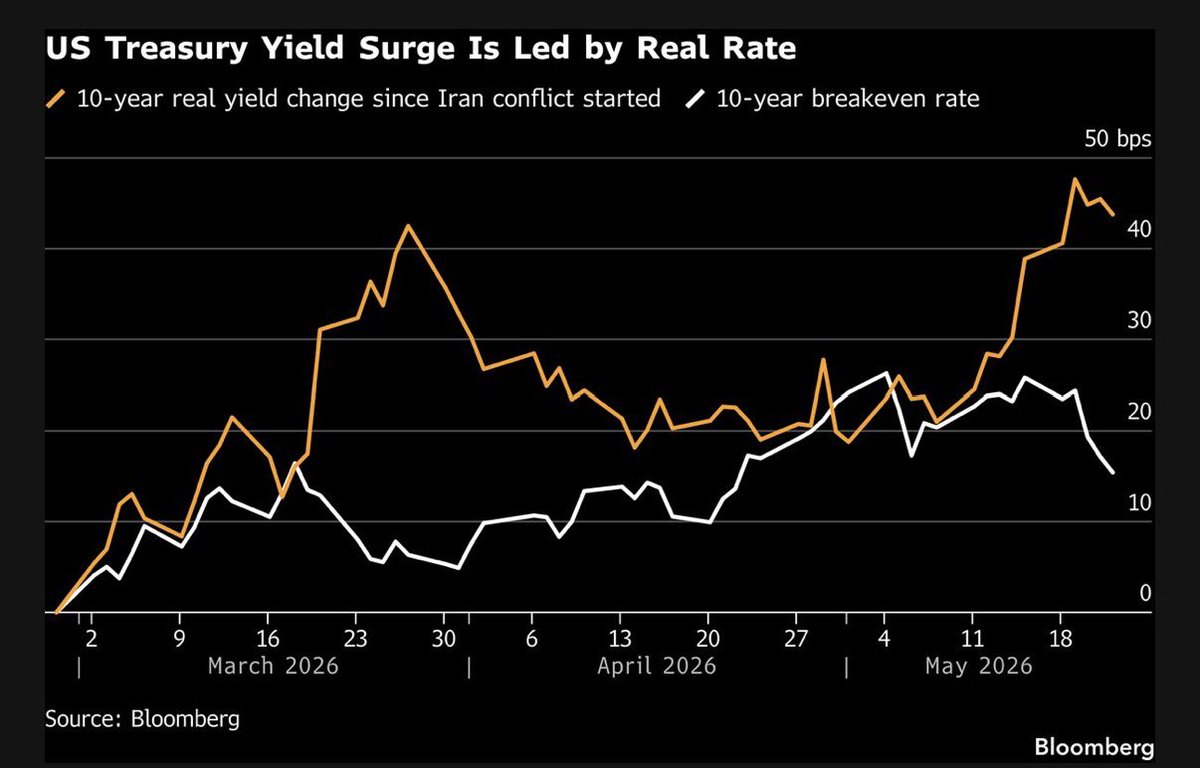
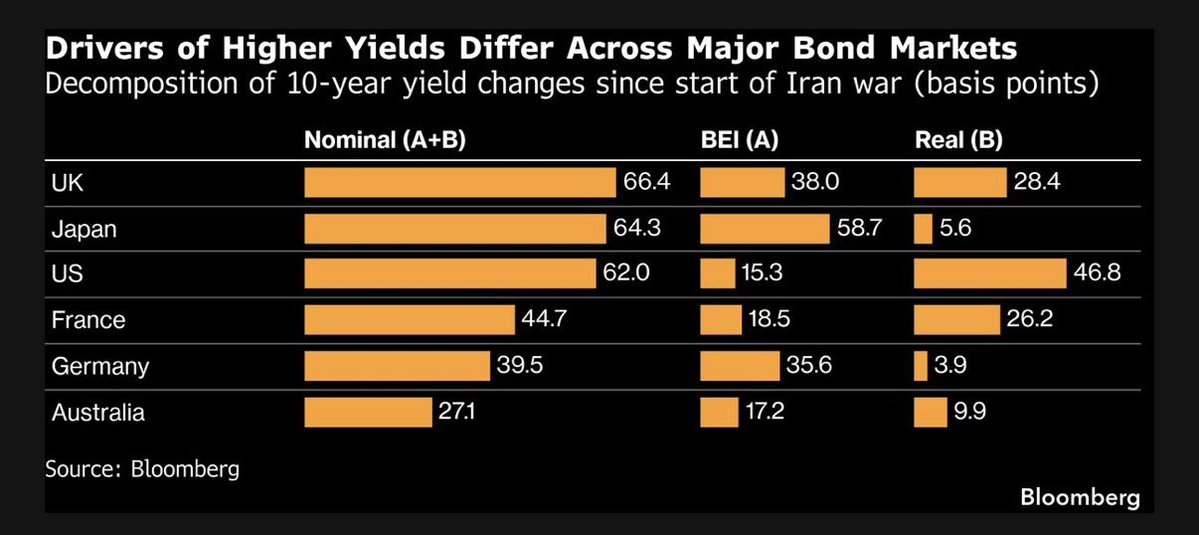
From the Bloomberg article, “Bond Strategists Warn Yields to Stay High Even If Iran War Ends:”
“A Bloomberg analysis shows rising real yields explains most of the move higher in overall yields in the US, while inflation is to be the major influence in Japan and Germany.”
#economy #markets #bonds