🚨 𝗡𝗘𝗪 𝗚𝗢𝗢𝗚𝗟𝗘 𝗔𝗟𝗘𝗥𝗧: 𝗼𝗻𝗹𝘆 𝗶𝗻𝗱𝗲𝘅 𝗰𝗼𝗻𝘁𝗲𝗻𝘁 𝗺𝗲𝗮𝗻𝘁 𝗳𝗼𝗿 𝗦𝗲𝗮𝗿𝗰𝗵.
Google added a new section to its user-generated spam docs on Oct 26: "Only index content meant for Search."
→ The intro now names "tools that let users publish shared pages, generated content, or web apps."
→ If users can create shareable pages, generated outputs or interactive tools, you have to decide: is it meant for Search, or only for people with the link?
→ If it's for sharing, collaboration or utility, apply noindex or block crawling in robots.txt "by default."
→ Elsewhere on the same page, Google says to watch Page Indexing and Search performance for spikes in indexed pages, impressions or queries that don't match your purpose.
➔ If you want more tips like this, subscribe to our weekly News SEO Digest: https://t.co/w4BYMiaNjw
Plenty of newsrooms have these pages, and often nobody owns them. Quiz results. Calculator outputs. "Share your score" pages. Widgets from a partner deal that ended years ago.
This week:
→ run a site: search on your result, share and embed paths. Noindex anything that was never meant to rank.
Sources:
➤ Search Engine Roundtable, Barry Schwartz, "Google Downplays The Importance Of Fresh Index Reporting" (Oct 27, 2026): https://t.co/MQqj1FDQ5d
➤ Google Search Central, "News sitemaps": https://t.co/bzVdKt6udn
𝗧𝗵𝗲 𝘁𝗶𝘁𝗹𝗲 𝘁𝗮𝗴 𝘀𝘁𝗶𝗹𝗹 𝗴𝗲𝘁𝘀 𝘁𝗵𝗲 𝗹𝗮𝘀𝘁 𝗹𝗮𝘂𝗴𝗵.
A case study on Search Engine Land made me smile this week.
Dan Lauer's team audited a big B2B site after a migration. Tens of thousands of redirect chains and loops, 4,400+ 404s, canonical issues.
→ They fixed 404s, redirects and canonicals first. Crawling and indexing improved. Rankings and traffic didn't.
→ Then they rewrote titles and meta descriptions on priority pages only, picked with GA4 data. In their words, "the lowest-effort part of the work."
→ September vs August: organic traffic +121%, Search Console impressions +229%, AI assistant referrals +275%.
They're clear that no single fix did it. The foundation made the pages reachable. The titles made them worth showing.
Every few years we get a new channel and a new acronym. And somewhere in the middle of every one, a title tag quietly does its job :)
For newsrooms with one developer and a long audit list:
→ Crawl and index first. Nothing else matters if Google can't get to the page.
→ Then titles on the pages that matter, not all 200,000.
https://t.co/cvF6mlRGNT
𝗧𝗵𝗲 𝗗𝗮𝗶𝗹𝘆 𝗠𝗮𝗶𝗹 𝗶𝘀 𝗯𝘂𝗶𝗹𝗱𝗶𝗻𝗴 𝗮𝗻 𝗔𝗜 𝘃𝗶𝘀𝗶𝗯𝗶𝗹𝗶𝘁𝘆 𝗽𝗿𝗼𝗱𝘂𝗰𝘁.
If you want to see where your own brand shows up in AI answers, you can build the same thing yourself, or use ours.
Carly Steven, the Daily Mail's director of SEO and editorial ecommerce, told Digiday they have 12 to 15 GEO tests running for brands in the US, UK and Australia. An official product is planned for early next year.
Want to build it yourself? Steal our approach https://t.co/EB1FnsVK4J. This is how we build the prompt list in GDdash, 3 ways:
→ 1. Brand + target audience → topics → prompts.
→ 2. Your crawled content → entities → prompts.
→ 3. Your Google Search Console data → prompts. Your GSC queries includes the best prompt list out there.
Then run those prompts across the AI platforms and record who gets cited, every day.
Don't have time? Get our FREE AI Visibility tracking for publishers, 1 month free. It covers ChatGPT, Gemini, Perplexity, Grok and Google AI Overviews, with daily or weekly citation reports.
Digiday: https://t.co/Q8LlLY4VIz
Free AI Visibility tracking: https://t.co/EB1FnsVK4J
𝗥𝗲𝗻𝘁𝗶𝗻𝗴 𝗼𝘂𝘁 𝗮 𝘀𝗲𝗰𝘁𝗶𝗼𝗻/𝐬𝐮𝐛𝐝𝐨𝐦𝐚𝐢𝐧? 𝗚𝗼𝗼𝗴𝗹𝗲 𝗰𝗵𝗲𝗰𝗸𝘀 𝟰 𝘁𝗵𝗶𝗻𝗴𝘀.
Press Gazette reported today that journalists lost their jobs after Google manual actions hit sites owned by Clickout Media.
→ Sites including Gambling Insider and Esports Insider are believed to have been hit by manual penalties. Gambling Insider was penalised in September.
→ The model: buy a trusted outlet, then use its reputation in Google to push casino content.
→ Writers were cut. AI-written articles appeared under a shared "Editorial Team" byline, and under the byline of a reporter who had already been made redundant.
This is Google's site reputation policy at work. Most newsrooms will never go near this. But plenty have a coupons, betting or "best of" partner section, so it's worth knowing what a human reviewer looks at.
Google's 4 factors, from its own spam policy doc:
→ 1. Presentation. Does it look and feel like the rest of your site?
→ 2. Quality. Is it below the standard of your main site?
→ 3. Editorial oversight. Is there real editorial oversight and a named owner?
→ 4. Duplication. Does the same content appear on other sites?
Google says no single factor decides it.
One more line from the same doc: if a site keeps trying to get around the spam policies, Google may restrict features like Top Stories and Discover.
What I'd check this month:
→ Search Console, Security & Manual Actions, for every property you own.
→ Who edits each partner section, and does the page say so?
→ Is that section linked from your own sections and navigation, or just sitting there?
Your reputation in Google took years to earn. Don't lease it out.
Sources:
https://t.co/yzetB4uFmQ
https://t.co/wYpiiflQ0o
https://t.co/Qmyc9EGrsI
𝟴𝟮.𝟱% 𝗼𝗳 𝗨𝗦 𝗯𝗿𝗮𝗻𝗱 𝘀𝗲𝗮𝗿𝗰𝗵𝗲𝘀 𝗻𝗼𝘄 𝘀𝗵𝗼𝘄 𝗮𝗻 𝗔𝗜 𝗢𝘃𝗲𝗿𝘃𝗶𝗲𝘄.
And the page Google cites for your brand often isn't the one that ranks.
SE Ranking (study by Yulia Deda) checked 1,000 US brand keywords three times on desktop this month:
→ 82.5% showed an AI Overview on average.
→ 62.2% of cited brand-site pages weren't in the organic top 10.
→ Homepages: 71.1% of brand URLs in the top 10, but only 36.8% of AIO citations.
→ About pages: 3.8% in the top 10, 11.7% of AIO citations.
→ Domain overlap with the top 10 was still 98.3%.
We've seen this journey in commerce for years. A shopper finds a product on Instagram or TikTok, then searches for it on Google before buying.
AI is becoming one more step in that loop, not a replacement for it:
→ 95.3% of ChatGPT users also visited Google in August 2025 (Similarweb data, shared by Brodie Clark).
→ Some people ask an LLM first, then Google the brand. Others Google first, then ask an LLM.
→ The path isn't always LLM to Google, for example in "Travel", users may start with LLMs to put together vacation plans finding best hotels, then going to Google to search a specific hotel, then going to Instagram to see pictures on the hotel.
So the brand SERP matters more now, not less.
For news publishers, "brand" also means your masthead, your best-known writers and your exclusives:
→ Google your masthead, your top bylines and this week's scoop.
→ Read the AI Overview. Which pages does it cite? Is anything wrong or out of date?
→ Fix the pages it pulls from: About, author pages, standards and contact pages.
→ Repeat monthly. 11.4% of keywords flipped between showing an AIO and not.
Caveat: a desktop snapshot of brands, not news sites, and it doesn't measure clicks.
𝗨𝗻𝘀𝗼𝗹𝗶𝗰𝗶𝘁𝗲𝗱 𝗗𝗶𝘀𝗰𝗼𝘃𝗲𝗿 𝘁𝗶𝗽: 𝗱𝗼𝗻'𝘁 𝗽𝘂𝘁 𝗝𝗣𝗘𝗚 𝗫𝗟 𝗶𝗻 𝘆𝗼𝘂𝗿 𝗼𝗴:𝗶𝗺𝗮𝗴𝗲.
Chrome 155 and Firefox 158 now display JPEG XL. Your dev team will want to use it.
Google Images and Discover previews don't support it yet.
@JohnMu, on Bluesky: "if you're hoping to get images shown in Google Images & as previews in Discover, etc – JPEG-XL is currently not supported"
Google's supported formats for img src: BMP, GIF, JPEG, PNG, WebP, SVG and AVIF.
The safe setup if you want .jxl for readers:
→ Serve it as a <source> inside <picture>.
→ Keep a JPEG, WebP or AVIF in the <img src>. Mueller says that works for any search engine.
→ Keep og:image and schema images in a supported format too. Discover uses those for the preview.
Copy this pattern:
<picture>
<source srcset="storm.jxl" type="image/jxl">
<img src="storm.jpg" alt="Flooded street in downtown Boston">
</picture>
And before anyone flips a CDN setting to auto-convert images, check what your og:image URLs actually return.
For context, AVIF landed in Chrome in 2020 and in Google Search in 2024. Don't plan around a date nobody has given.
Discover is visual. Don't lose the image over a file format.
https://t.co/GWaJxkeMT6
https://t.co/epHMN3M4Ej
https://t.co/Eio4ft0Ebv
The most-cited page in AI Overviews was the About page.
Lily Ray found it in one enterprise site's Search Console Gen AI report: 5x the homepage's AI impressions.
Written for humans, not LLMs.
Publishers: check your About, masthead and author pages first.
@lilyraynyc said this week she's ""secretly enjoying"" watching the AI community discover obvious SEO fundamentals as the new shiny object for AI search.
Same, Lily. :)
Everything on the ""new"" AI search checklist is something news SEO teams have done for 15+ years:
1. Fresh content with clear, visible dates. Top Stories has always run on this.
2. Headlines that say what happened. Clever loses to clear.
3. Article text in the HTML. Glenn Gabe just re-tested ChatGPT, Claude, Perplexity, Gemini and Copilot on JavaScript-rendered content, 434 days after his first test. His words: ""I was hoping the platforms had evolved... I was wrong.""
4. Real bylines and author pages.
5. Original reporting that other outlets cite and link to.
So if your newsroom just got an ""AI search"" budget, good. Spend it on the basics that already win in Google Search, Discover and Top Stories. That's where your traffic comes from today, and it's what the AI engines reward too.
Same playbook. New acronym.
https://t.co/jNl0EXE7yv
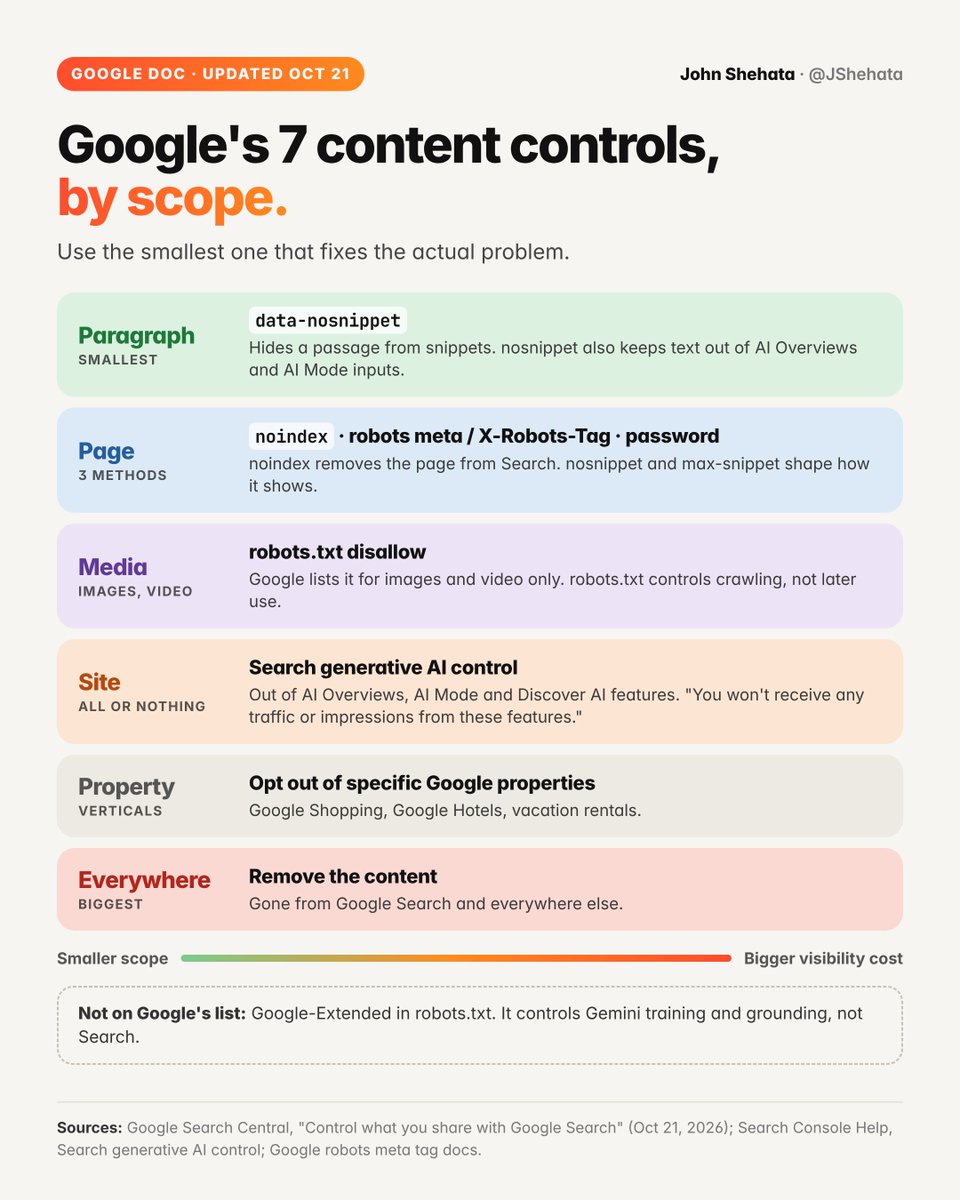
𝟳 𝘄𝗮𝘆𝘀 𝘁𝗼 𝗯𝗹𝗼𝗰𝗸 𝘆𝗼𝘂𝗿 𝗰𝗼𝗻𝘁𝗲𝗻𝘁 𝗶𝗻 𝗚𝗼𝗼𝗴𝗹𝗲 𝗦𝗲𝗮𝗿𝗰𝗵
Google updated its "Control what you share with Google Search" doc on Oct 21.
For publishers, think in scope, not method:
→ Paragraph: data-nosnippet hides a passage. nosnippet also keeps text out of AI Overviews and AI Mode inputs.
→ Page: noindex removes it from Search. nosnippet and max-snippet shape how it shows.
→ Site: the Search generative AI control. All or nothing for AI Overviews, AI Mode and Discover's AI features.
Site control caution, in Google's words:
→ "You won't receive any traffic or impressions from these features."
→ "Content from other sites will still be available in those features, and it may appear similar to yours."
You leave. Your competitors stay.
3 things news publishers should know:
→ 1. The AI control isn't a ranking signal for the rest of Search and doesn't affect AI training. Gemini training is Google-Extended.
→ 2. Top Stories now shows inside AI Overviews (NewzDash data: nearly 1 in 6 U.S. trending news results). My read: the site-wide opt-out likely removes you from that carousel too. Google hasn't said.
→ 3. Page-level AI controls aren't due until March 2027 under the UK CMA's timeline.
My take: use the smallest tool that fixes the problem. Every step up costs visibility, and Google is still where your readers come from.
𝐃𝐨𝐧𝐭 𝐥𝐞𝐭 𝐚 𝐆𝐄𝐎 𝐩𝐢𝐭𝐜𝐡 𝐝𝐞𝐜𝐤 𝐫𝐞𝐨𝐫𝐠𝐚𝐧𝐢𝐳𝐞 𝐲𝐨𝐮𝐫 𝐒𝐄𝐎 𝐭𝐞𝐚𝐦.
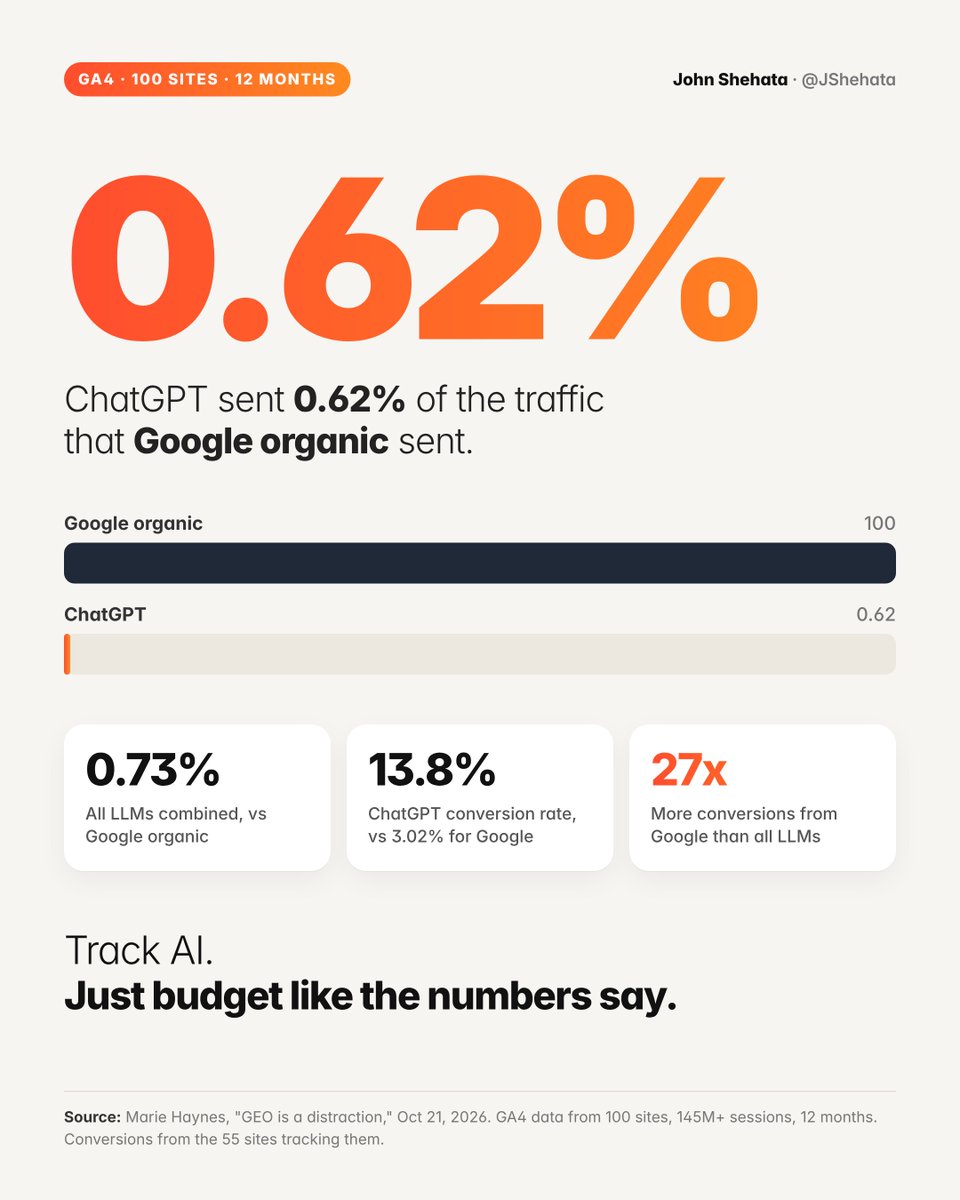
ChatGPT sent 0.62% of the traffic that Google organic did.
Not 6%. Not 20%. Less than 1%.
That's from @Marie_Haynes, who pulled 12 months of GA4 data across 100 sites and 145M+ sessions. Add every other LLM and it only moves to 0.73%.
The conversion numbers are the interesting part:
→ ChatGPT visitors converted at 13.8%
→ Google organic visitors converted at 3.02%
→ Google still drove 27x more conversions than all LLMs combined
Higher conversion rate, tiny volume. Both are true.
And in her data, ChatGPT visits have been going down since GPT-5 launched in August 2025.
For news publishers the gap is even bigger. Google traffic is still 400X what any AI platform sends.
Check your own GA4 before you borrow anyone's ratio.
How I'd split the effort:
1. Google first. Search, Discover, Google News, Top Stories. That's where the readers are.
2. Track AI visibility, but measure it properly. Repeat prompts, count citations, and match ChatGPT clicks on utm_source=https://t.co/ZIMw4pFEsN.
3. Don't let a GEO pitch deck reorganize your SEO team.
Track AI. Just budget like the numbers say.
Marie Haynes, GEO is a distraction: https://t.co/xhJYdj9a7o
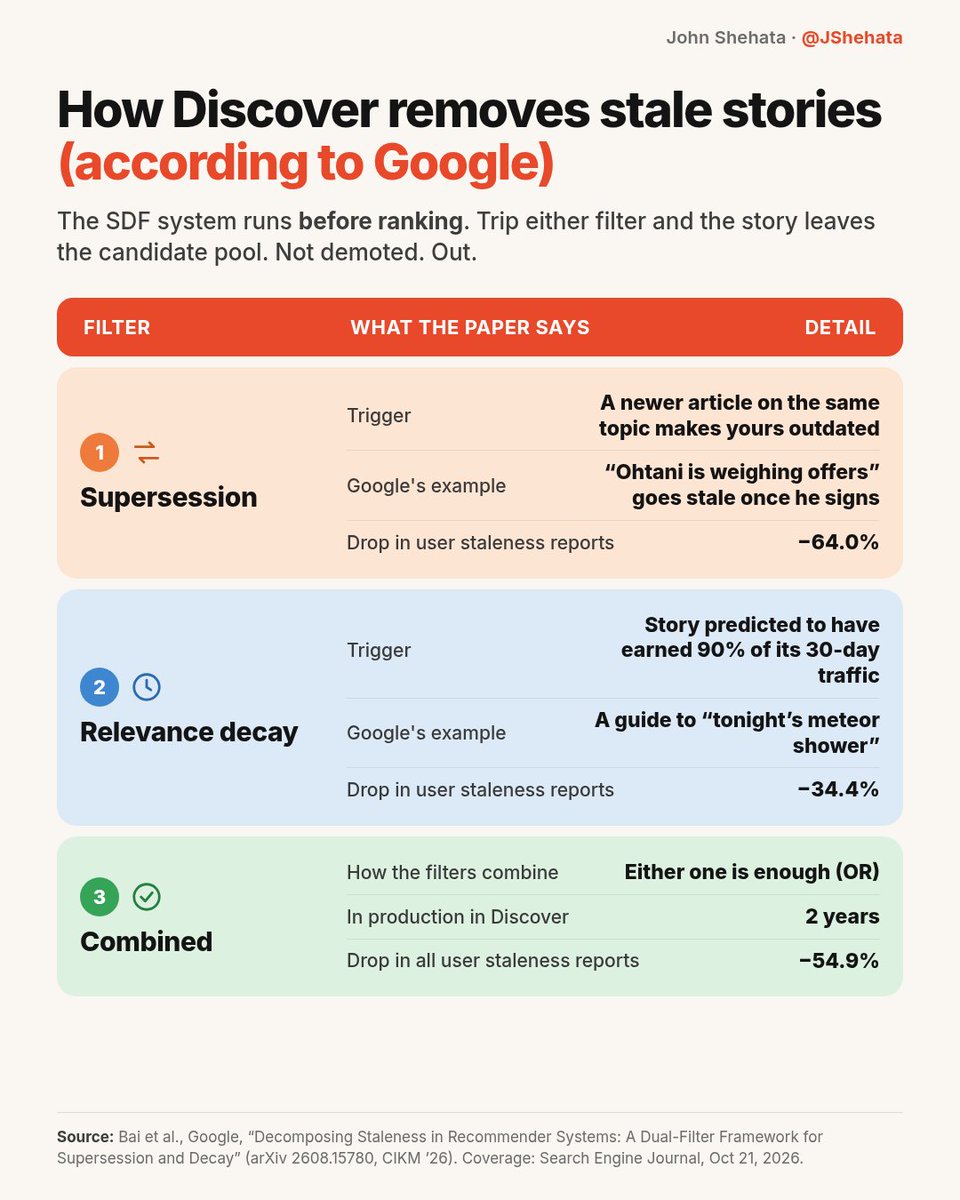
Google Discover doesn't demote stale stories. It removes them.
And it happens before ranking even starts.
That's from a Google paper on the system behind it, called SDF. Two filters:
1. Supersession
A newer article on the same topic makes yours outdated. Google's example: "Ohtani is weighing offers" goes stale the moment he signs.
2. Decay
A model predicts what share of a story's 30-day traffic it has already earned. Past 90%, it's out.
Google's reported result: user-filed staleness reports down 54.9% (supersession down 64.0%, decay down 34.4%).
What this means for publishers:
being first gets you in. Publishing the next development keeps you there. Your earlier version is what gets superseded, so ship the follow-up fast.
Table below. Paper and coverage in the first comment.
[You could add GDdash data on how fast stories drop out of Discover here]
First comment:
Google paper on arXiv (CIKM '26): https://t.co/aG11RwTN4Q
Search Engine Journal, Oct 21: https://t.co/UNVFjL5zG6
fully agree - Human Factor will become a premium add-on!
The more the internet looks like it was made by AI, the more valuable I think it will become to show evidence of human involvement.
Probably a hot take:
While it’s impressive how quickly LLMs can spin up websites, I think AI is accelerating a trend that’s been happening for years: the internet is starting to look increasingly self-similar.
AI tools often generate websites using the same design patterns, layouts, fonts, and aesthetics. So many new vibe-coded apps, company websites, and landing pages are starting to look identical (not to mention the content).
I’m not saying AI-generated websites look bad - they often look great. But when everything looks the same, differentiation becomes more valuable.
I have a feeling that as AI-generated websites become the norm, websites and online experiences with a unique aesthetic, an authentic voice, and evidence of real people behind the company will become a competitive advantage.
Not just because they look different, but because they may offer better user experiences and inspire more trust.
As the internet becomes flooded with AI-generated content and design, I suspect people will increasingly seek out experiences that feel genuinely human.
(For as long as humans continue browsing websites themselves, at least 😅)
We’re already seeing signs of this on social platforms and forums, where people are becoming increasingly skeptical of content that feels AI-generated and platforms are cracking down on AI content.
I’ve also seen many recent examples of Google deindexing entirely AI-generated sites. While that doesn’t necessarily mean the AI-generated design itself is the problem, it does make me wonder how search engines will evolve their ability to distinguish between generic, mass-produced experiences and genuinely original, useful ones that happen to use AI.
And I wouldn’t be surprised if search engines and LLMs increasingly favor the signals that their users are looking for - particularly originality, usefulness, and trust. (Google recently updated its documentation to emphasize human effort, originality, and skill as important considerations in evaluating content quality.)
The more the internet looks like it was made by AI, the more valuable I think it will become to show evidence of human involvement. 🤔🤔🤔
2024: Google sends you a lot of traffic
2025: Google sends you less traffic
2026: Google only cites you in AI answers
2027: Google never calls, but sends a Christmas card
2028: You bump into Google at a party and it pretends not to know you