I gave 3 AI agents full access to one codebase.
Each one ran in its own Docker Sandbox, a microVM with its own copy of the repo. A lead planned, two devs built, everything shipped as PRs.
They built and deployed a full stack SaaS. Full video below 👇
If your public repo uses pull_request_target, it stops running on Dec 2.
@github is blocking it by default. Here's how to find yours in 10 minutes, then switch, split or allow each one.
Qwen4-Max has 2.4T parameters.
It doesn’t run all of them.
Dense model = Promise.all() on every function you have
MoE model = a switch that calls only what it needs
Same knowledge. Way less compute.
That’s why “bigger model” no longer means “more expensive.”
We've spent years writing unit tests.
AI just started writing proofs.
@GoogleDeepMind's AlphaProof Code formally verified the core crypto code behind Signal, the same protocol protecting Google Messages.
Humans pick what to prove. Agents do the math. 🤯
https://t.co/0z6LbTgAlI
🚨 @awscloud just built a developer tool using AI agents. And apparently, no engineers wrote or reviewed the code.
Meet AWS Emulator.
It locally simulates 200+ AWS services, allowing developers to test applications without connecting to the actual AWS cloud.
But here's what makes it interesting:
The entire tool was built and maintained by autonomous AI agents.
They handled the coding, testing, issue detection, and fixes.
We're moving beyond AI that just helps developers write code.
We're entering an era where AI agents can build, test, and maintain real developer infrastructure.
The question is no longer whether AI can write code.
It's how much of the software engineering lifecycle can agents handle themselves. 👀
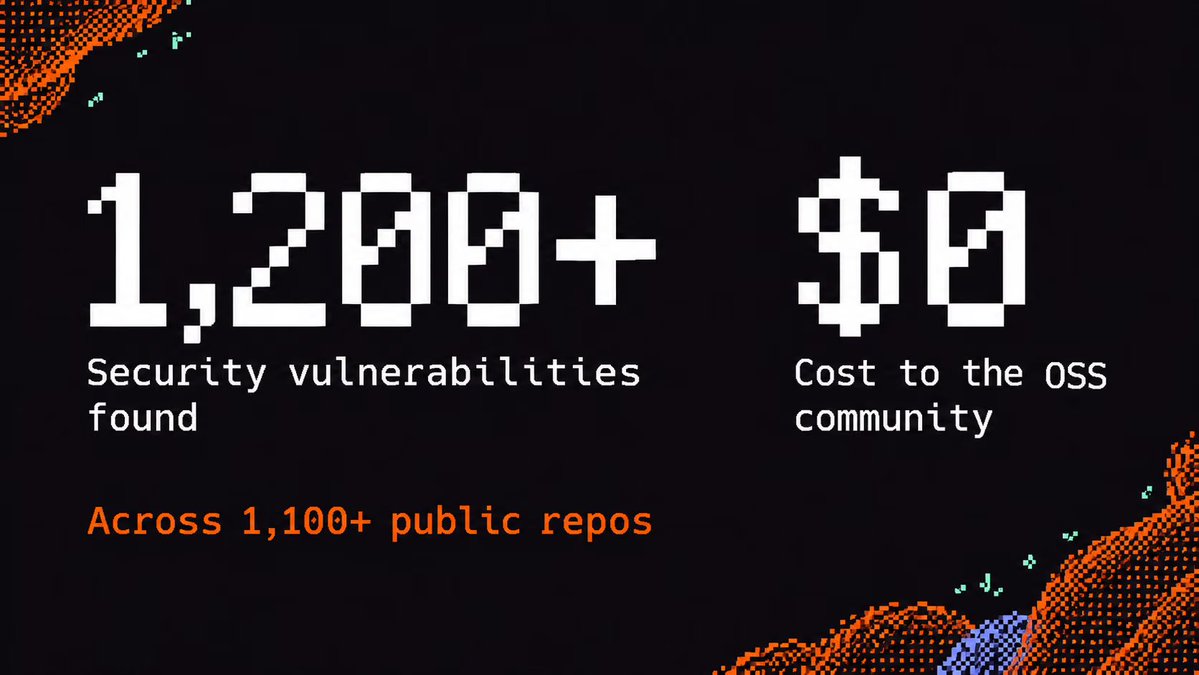
Attackers have AI agents probing open-source code 24/7 & we think maintainers should too!
CodeRabbit ran Deep Scans on 1,125 public repos with 1,215 high or critical findings, 75 of which are already fixed.
Your first Deep Scan is on us, up to $1K for orgs with 2+ people.
@claudeai Fable 5.2 is seriously impressive 🎨
Challenged it to paint an autumn river scene, brushstroke by brushstroke.
Then the painting comes to life 👀
Google just introduced Gemini 4 Hydrogen.
2.5x faster than Gemini 3.8 Flash, with four thinking levels and a focus on everyday coding and agentic workflows.
What's interesting is the direction: not every task needs a frontier model or deep reasoning.
The future is about matching the right model to the right task.
Curious to see how Hydrogen performs in real-world coding workflows. 👀
Not every AI task needs a model that thinks harder.
Sometimes, it just needs to think fast enough and get the job done.
That's what makes Google's Gemini 4 Hydrogen interesting.
2.5x faster than 3.8 Flash, with four levels of thinking.
I actually like this direction. AI progress shouldn't just mean bigger models. It should mean more practical intelligence.
Credit where it's due, Google. 👏
@silic2023 That's a great point! The goal is to make checkpoints feel rewarding without leaving players confused about what carries over after death. Definitely something worth testing with first-time players! 🙌
Two models. One prompt. Two different results.
We put the newly released Fable 5.2 and Opus 5.5 to the test using the exact same prompt to see how their video generations compare.
Here’s the side-by-side comparison. 👀
#claude#ai#comparison#llm
Claude Fable 5.2 just built an entire dark fantasy platformer 🔥
And it runs right in your browser.
Moody forest, glowing checkpoints, combat, hidden lore ...
Honestly looks like something you’d buy on Steam 👀