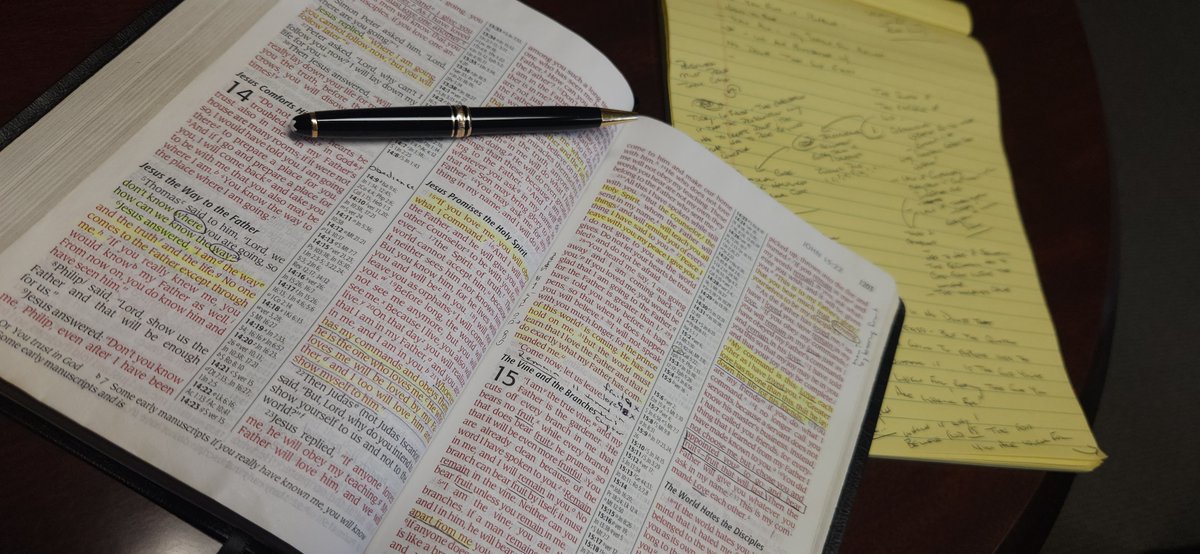
God only wants for you, what you would want for yourself... if you knew everything He knows. But, if you never spend time in the Bible, if you never spend time in prayer, how can you ever know what it is He wants for you? (Hint: you can't) Romans 12:2
@mxrandyman@DrFrankTurek Didn't specifically mention him, but discussed how to spot false teachers/prophets, and how to respond to them. If you would like, I would love to share a link to the message with you.
If your version of Jesus…
+Supports abortion.
+Celebrates lifestyles that Scripture calls people to repent of.
+Affirms the idea that we can redefine the gender God created.
+Claims there are multiple ways to Heaven.
Then you’re following a false Jesus.
You’re not worshipping the Jesus of Scripture. You’re worshipping your own ideologies and simply attaching His name to them.
Students don't need us to protect them from this world, by shielding them from the truth.
They need us to help them navigate this world, by discipling them in the Truth.
Galatians 4:4 looks like a transition verse.
“But when the fullness of time had come, God sent forth His Son.”
If you read it fast, it sounds like a timestamp. But if read slowly, it is the most staggering sentence in the Bible.
‘Fullness of time’. Paul isn't saying God picked a convenient moment. He is saying God declared a moment complete. “The preparation is finished and everything I have been building across centuries is exactly where I need it to be”. God looked at human history and said: now.
Which forces the question. Why then? Why not a thousand years earlier, when Moses was fresh? Why not a thousand years later? What was so perfect about the first century?
I started looking into it and I have not recovered.
God needed a people with the theology. He spent 2000 years forming Israel; the covenant, the sacrificial system, the prophets, Isaiah 53 written seven centuries before Calvary, the framework of a coming Messiah who would bear the sin of the world. The Jews were shaped by wilderness, exile, and divine discipline, until the theological infrastructure for substitutionary atonement was fully in place.
But theology alone could not travel. God needed a language. Not a tribal dialect, but a universal tongue. So five hundred years before the Gospel, He let the Greek philosophers begin.
Heraclitus sat in Ephesus and concluded the universe was governed by an invisible rational principle. He called it the Logos.
The Stoics built on it. Philo of Alexandria stood at the intersection of Greek thought and Hebrew scripture and said the Logos was the mind of God in creation. For five hundred years, philosophy built a conceptual category it could not fill.
Then God sent a conqueror with no interest in theology. Alexander the Great wanted glory and empire. God let him want it. In satisfying his ego across three continents, Alexander Hellenized the ancient world and forged Koine Greek, the common tongue of the docks, markets, soldiers, and slaves. A language stripped of complexity, simple enough for anyone, universal enough for everyone.
The Hebrew scriptures were translated into it. The Septuagint was born. God used a pagan conqueror’s ambition to translate His own Word.
Then Rome came and paved the road. The Pax Romana. Piracy cleared. Stone highways stretching from Spain to Syria. A framework for movement the ancient world had never seen.
None of them knew they were collaborating.
Heraclitus thought he was doing philosophy. Alexander thought he was building a monument to himself. Rome thought it was building an empire for Rome. Not one of them understood they were stagehands. God was with Heraclitus in his pondering, with Alexander in his conquest, with Roman engineers laying stone, quietly requisitioning their work for a purpose none of them could see.
And then, when the covenant people were in place, the language primed, the roads built, and the category ready, when everything He had been quietly assembling was finally set, God stepped into the room they had unknowingly prepared.
John picked up his pen and wrote: “In the beginning was the Logos.”
Every Greek philosopher in the Mediterranean felt the ground shift. “And the Logos became flesh.” The category they spent five centuries constructing was not a principle. It was a Person.
The ‘fullness of time is not a timestamp’. It is God’s signature on a completed work. And the humbling thing is that this work was not built by saints. It was built by conquerors, philosophers, and emperors who thought they were writing their own story. God let them think that. And used every word. If this is not amazing then I don’t know what is.
@SteveDeaceShow This is what it looks like when you try to twist Scripture to fit your agenda. But, it's nothing new, Satan twisted the Word of God in the Garden of Eden to lead Eve astray, and he attempted to twist and pervert the Word of God to tempt Jesus.
I feel like this needs to be said...
Whoever was the first person to decide to put peanut butter and jelly between two slices of bread, doesn't get enough credit.
You can go on with your day now
@ProLifeisProGod Once I had an understanding of what they believe, I was able to ask them questions. Questions that I prayed would cause them to question what they had been taught. My prayer was that through that questioning, the Holy Spirit would change and convict them.
@ProLifeisProGod I got into the ministry through Christian Apologetics, and have found that when witnessing to Christian cults (JW & LDS), they aren't allowed to study on their own, so that any "discrepencies" can be explained away.