Coding agents can already scaffold an Android app end-to-end.
Anthropic has even wired Android emulator testing into Claude Code — and left it disabled for now.
That’s the gap that matters: agents ship mobile code faster than teams can verify it on device.
New blog post: "Introducing the Agentic SDLC — it's exactly like the old SDLC, but our AI writes the PRD, the code, the tests, and the retrospective. The human schedules the standup."
QA is becoming one of the biggest AI use cases in software development 👀
Not because writing tests is impossible...
Because keeping them updated as products change is exhausting.
Two interesting approaches:
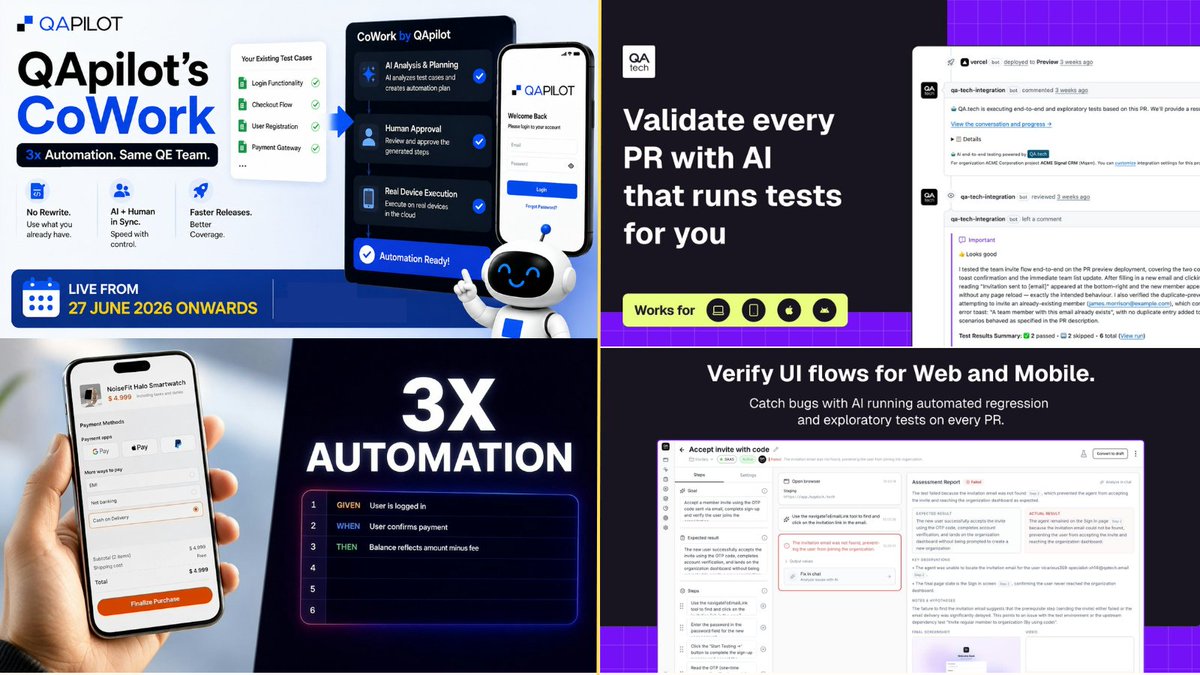
1️⃣ @QApilot
Takes existing test cases and turns them into mobile automation for iOS, Android, and Flutter. Instead of rebuilding everything from scratch, existing QA work becomes automated with human verification where it matters.
2️⃣ https://t.co/Qx5a6oJYIs
Uses AI agents that interact with products like real users. They click, explore, and test new releases automatically to catch broken flows before customers do.
The interesting shift isn't "AI writes tests."
It's that AI is starting to own the repetitive part of QA, while engineers focus on fixing what actually matters.
Curious...
👉 If AI could completely take over one part of the development lifecycle, which would you choose?
A) Testing & QA 🧪
B) Debugging 🐞
C) Documentation 📝
D) Code reviews 👨💻
@tobiastornros@charan_tej_k
Are we attacking a bit too late in ODIs?
I've been thinking about this for a while now.
Baseball had a similar moment where teams started questioning whether they were actually using their pitching resources at the right time, rather than simply doing what had always been done.
During the IND vs ENG ODIs, I wondered if there is something similar happening in ODI cricket.
My argument is: Why do we wait until the final 10 overs to really go, when overs 31–40 might actually give us a better opportunity to attack?
So I went through the numbers and found a few things I didn't expect.
Wrote about it here. Would love to know what you all think.
Traditional bug: "NullPointerException."
AI bug: "The answer is 42" - delivered with calm authority and zero hesitation.
One of these you can find with a debugger. The other requires philosophy. 🫠
Anthropic: "Submit your hardest questions about AI." The internet: submits the hardest questions
Anthropic: "We will publicly track our answers."
The internet: "Cool, we'll publicly track your tracking."
Accountability, but make it recursive.
QApilot's CoWork finished as the #2 Product of the Day on @ProductHunt
Mobile QA teams already have test cases. The harder part is turning them into reliable execution coverage before every release. That is what we built CoWork for.
#QApilot#producthunt#AIinTesting#QE
No rewriting.
No starting from scratch.
Just AI-powered mobile automation from your existing test cases.
QApilot CoWork launches on Product Hunt tomorrow.
Support us here 👇
https://t.co/xK1firEn91
#MobileTesting#TestAutomation#QA#AI
🎙️Aditya Challa joins Alan Page on AB Testing to discuss AI-driven development & the role of Human-in-the-Loop validation in modern QA.
CoWork launches June 27.
Full podcast link in comment
@adityachalla#MobileTesting#QE#AI#AgenticTesting
@github My account got flagged and hidden from the public with no reason, and the response on ticket #4444891 is complete silence. This is not done.
Our automations are blocked, and contributors are locked out.
Is anyone else also facing this?
#GitHubSupport#Thisisnotok
FDEs from AI product vendors have incentive to be biased.
FDEs from service companies have partnerships in place with AI products.
In-house AI engineers will be common - We will see maturity in defining and hiring better for AI engineers. Wish agency is a non-negotiable axis.
One of the new, buzzy jobs in Silicon Valley is the AI Forward Deployed Engineer (FDE), an engineer who is embedded within a client organization to help customize solutions, such as building and tuning agentic workflows that suit the client’s particular needs. I’ve heard from people who are wondering anew about the FDE career path since OpenAI and Anthropic started building new teams to place FDEs within client organizations.
The rise of FDEs for AI workloads is one way AI is creating new jobs (and why the jobpolcalypse narrative of upcoming job market collapse is false -- there will be many AI and non-AI jobs). However, I believe there will be far more AI Engineer jobs than FDEs, as I explain below.
The FDE role was pioneered about two decades ago by Palantir, which sent engineers to government locations to work on secure, air-gapped networks. In addition to having good technical skills, FDEs need communication skills and sometimes business skills. For example, they may need to speak with clients to understand their needs, formulate a strategy to prioritize projects, explain complex technology, and respectfully push back if a client asks for something unrealistic. They’re enjoying a resurgence because of the amount of work involved in taking an off-the-shelf LLM and building it into a custom agentic workflow that fits particular business needs.
However, I believe the number of AI Engineer jobs will be far larger. A company might accept a few FDEs to be embedded within its organization. But most companies will want far more of their own employees working on their projects. While my organizations do hire FDEs, we hire far more AI Engineers! Also, a common client concern is that it is hard to find vendor-neutral FDEs — they are, after all, there to deeply integrate a particular vendor’s product into a company. In this moment when it’s hard to predict which AI service will be the best one in a year’s time, optionality (the ability to pick whatever vendor turns out to fit best in the future) is very valuable. In contrast, letting FDEs tightly bind a company’s processes significantly reduces optionality.
Right now, I see surging demand for AI Engineers who can build software applications using AI software components (like LLM prompting, agentic frameworks, evals, etc.) and effectively use AI coding agents (like Claude Code, Codex, Antigravity CLI, and OpenCode). As the AI Engineer role matures, I expect it to fragment into more specialized roles, like the generic Software Engineer role from decades ago fragmented into frontend, backend, mobile, data engineering, devops, and so on.
What will be the future, specialized AI engineering roles? I don’t know. Perhaps there will be AI FDEs, LLMOps Engineers, Evals Engineers, AI Data Engineers, Harness Engineers, and other roles we don’t have names for yet. But for now, I see a lot of AI engineers who are generalists create a lot of value. Skilled AI Engineers are in very high demand! As our field continues to mature over the coming decade, I look forward to new specializations within AI Engineering that create even more job opportunities.
[Original text: The Batch newsletter]
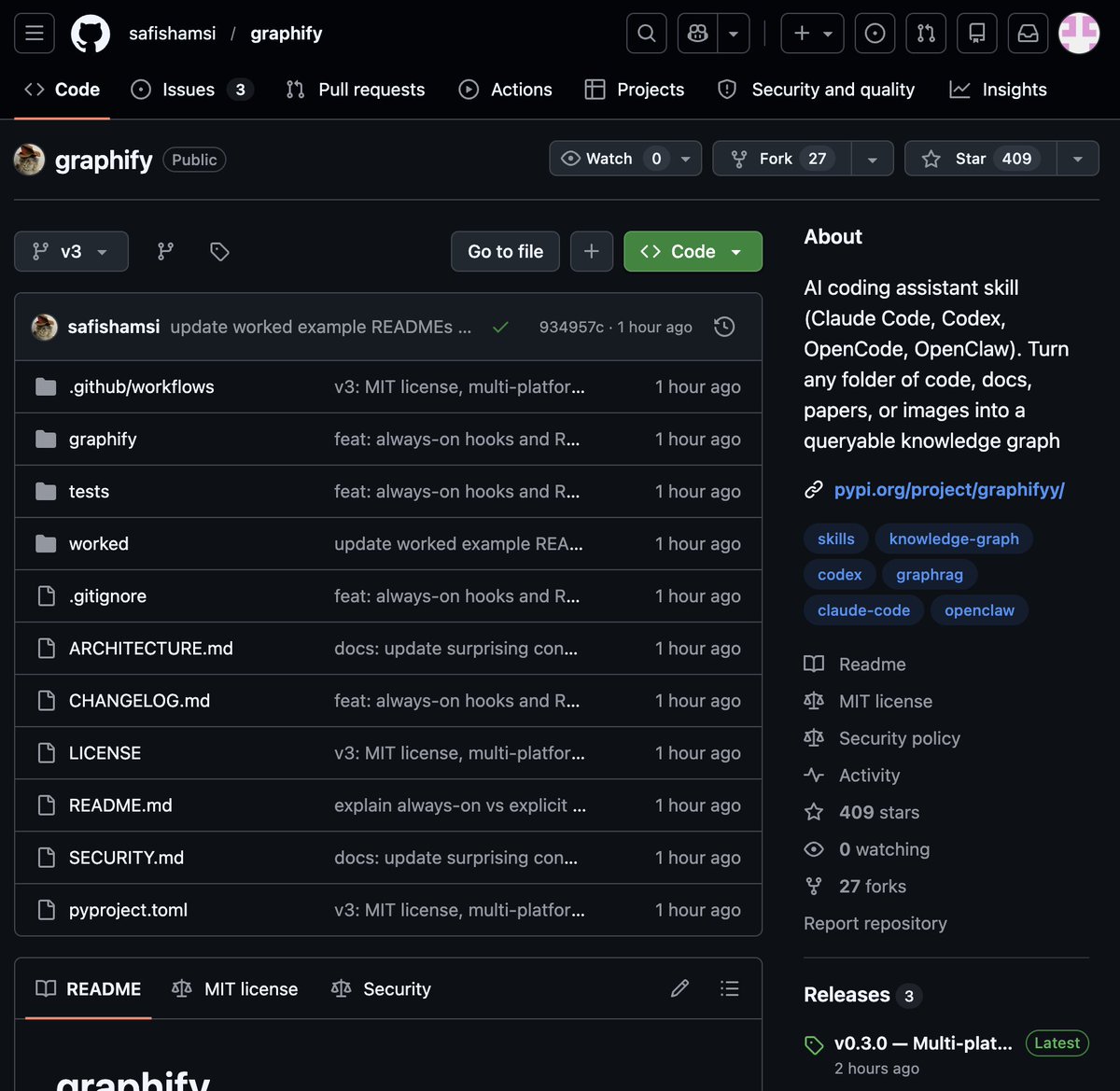
🚨 BREAKING: Someone just built the exact tool Andrej Karpathy said someone should build.
48 hours after Karpathy posted his LLM Knowledge Bases workflow, this showed up on GitHub.
It's called Graphify. One command. Any folder. Full knowledge graph.
Point it at any folder. Run /graphify inside Claude Code. Walk away.
Here is what comes out the other side:
-> A navigable knowledge graph of everything in that folder
-> An Obsidian vault with backlinked articles
-> A wiki that starts at index. md and maps every concept cluster
-> Plain English Q&A over your entire codebase or research folder
You can ask it things like:
"What calls this function?"
"What connects these two concepts?"
"What are the most important nodes in this project?"
No vector database. No setup. No config files.
The token efficiency number is what got me:
71.5x fewer tokens per query compared to reading raw files.
That is not a small improvement. That is a completely different paradigm for how AI agents reason over large codebases.
What it supports:
-> Code in 13 programming languages
-> PDFs
-> Images via Claude Vision
-> Markdown files
Install in one line:
pip install graphify && graphify install
Then type /graphify in Claude Code and point it at anything.
Karpathy asked. Someone delivered in 48 hours.
That is the pace of 2026.
Open Source. Free.
We talk a lot about test coverage.
But when it’s time to ship, the real question is: do you actually trust what your tests are telling you?
In this @testguilds podcast, Aditya explains how QApilot turns release anxiety into confidence!
https://t.co/3MIRT6OVlV
The energy at the @HYSEA1991 Summit 2026 was electric. As a featured sponsor, @QApilot team got to meet hundreds of engineers, testers, and builders exploring how AI is transforming software.
We shipped a small experiment today at QApilot - https://t.co/JtyFAw9Cf2
.
Tools for Agent helps you pick the right stack when building AI agents. We launched it mainly to get early feedback from people actually building agents.
.
Would love your thoughts!