"Physical AI" is the new moat narrative. Software AI's less defensible, so smart money shifts into robotics, because "physical" is supposedly harder to copy.
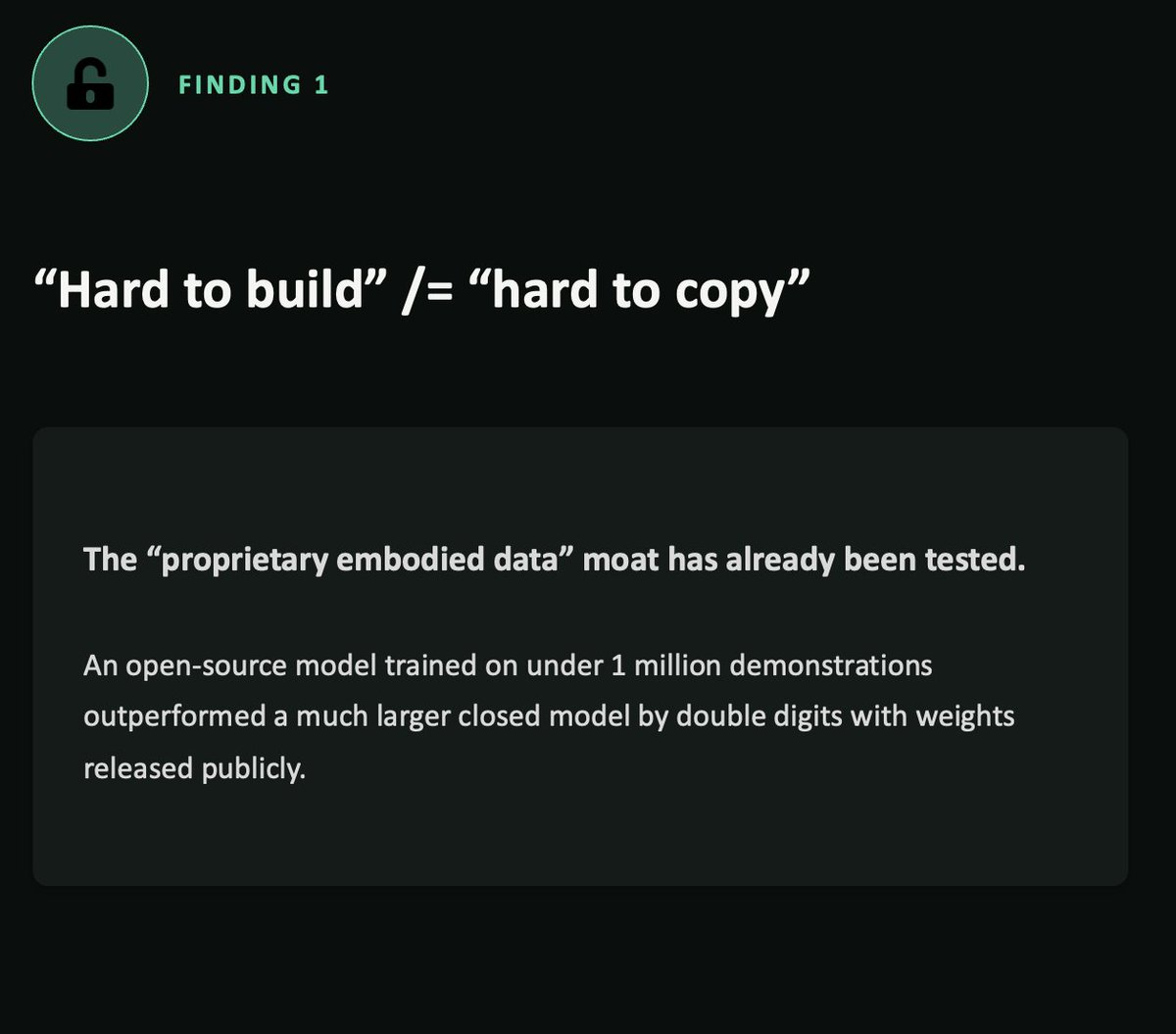
But hard to build ≠ hard to copy. Two different claims. Investors keep treating them as one generic thesis.
Here's what most investors backing this don't know: Germany already lost this exact war: precision manufacturing to China over 16 years. Humanoid hardware just repeated that erosion in ~1 year. 5-8x faster.
"Physical" isn't a moat without other barriers: business model, regulatory.
Ran the full breakdown on Phaneros instead of taking the narrative at face value. Slice below👇.
DM me if you're in strategy, M&A, investment, PE and want to stress-test your theses before they cost you dearly.
Winner-take-all needs one finish line. "AI" is at least three races: tokens, platforms, R&D infra. All have different economics, different winners, but somehow fall under the same word. Trillions are being bet on "one" race without specifying a finish line. Before funding a thesis, make sure there actually is one.
Fatal Abstraction just hit #1 New Release in Industrial Management & Leadership on Amazon before the book is even out.
Special thanks to Dan Toma and Mark Searle for the foreword and preface.
Thanks to everyone pre-ordering so far. For those that haven't, the pre-order link is in the comments.
Let's hit #1 best-seller on Launch Day - August 25th. The intellectual foundation behind @PhanerosAI.
@EmeraldGlobal
Investors are afraid that the general reasoning models of foundation labs will consume vertical applications. Are they right?
OpenAI and Anthropic just spent billions proving that general AI models won't replace vertical AI startups - at least not most of them. They proved it by hiring thousands of forward-deployed engineers to go live inside enterprise customers and build the workflows the models can't build themselves.
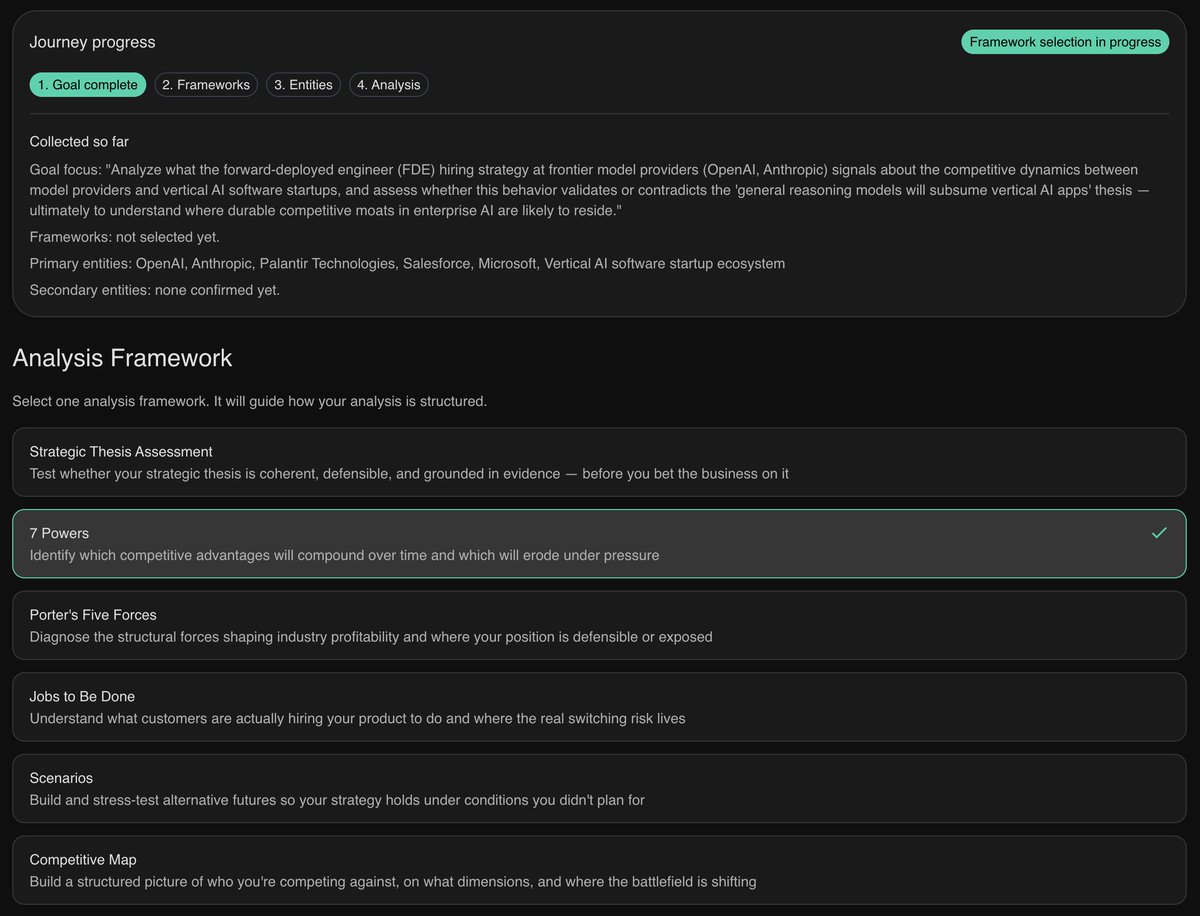
I ran this question through Phaneros using 7 Powers as the analytical framework. Here's what the analysis surfaced: The FDE hiring wave is not a threat to vertical AI. It's a threat to Accenture.
OpenAI's Deployment Company launched at a $14B valuation with McKinsey, Bain, and Capgemini as investors, the same firms it's now competing against for enterprise implementation budgets. Accenture fell 3% on the announcement.
General models are commoditizing the reasoning layer of vertical AI. But the deployment layer (workflow integration, compliance scaffolding, proprietary data accumulation) is not commoditizable by model improvement alone. Harvey hit $190M ARR despite frontier models matching its legal reasoning capability. The defensive moat is not the model. It's the 25,000 custom agents wired into law firm workflows.
Strategically, this makes sense. It's very difficult to be both horizontal and vertical. The foundation labs are doing vertical project business to sell tokens. Whether that's a scalable and sustainable business model is yet to be seen.
The deep-research analysis runs 28 pages with a full evidence base, falsifiability conditions, and adversarial audit. Screenshots of it in action below: guided query, framework selection, entity mapping, and analysis.
This is what Phaneros produces. If you'd like a one-week trial, DM me.
Strategic intelligence used to mean waiting weeks for a consultant to tell you what you already suspected. Base LLMs deliver overconfident hallucinations you can't trust.
Phaneros delivers decision-grade analysis in minutes for strategy, investment, procurement, product, and sales teams. Every output is grounded in Bayesian reasoning, evidence-based verification, and adversarial audit.
Worried about your data? We are building to meet European data sovereignty requirements.
This is what elite strategy you can trust looks like in the age of AI.
@m_g_nichols I've been using Phaneros for a few months now. Im a skeptical person so I have been intentionally throwing tricky research at it, trying to trip it up. It has given me accurate information everytime, and most of the time it uncovers market analysis I didn't even know about.
What happens to the venture capital business model when AI disrupts every industry it touches?
VC funds are investing in theses that displace workers across the economy. Why would VC itself be exempt?
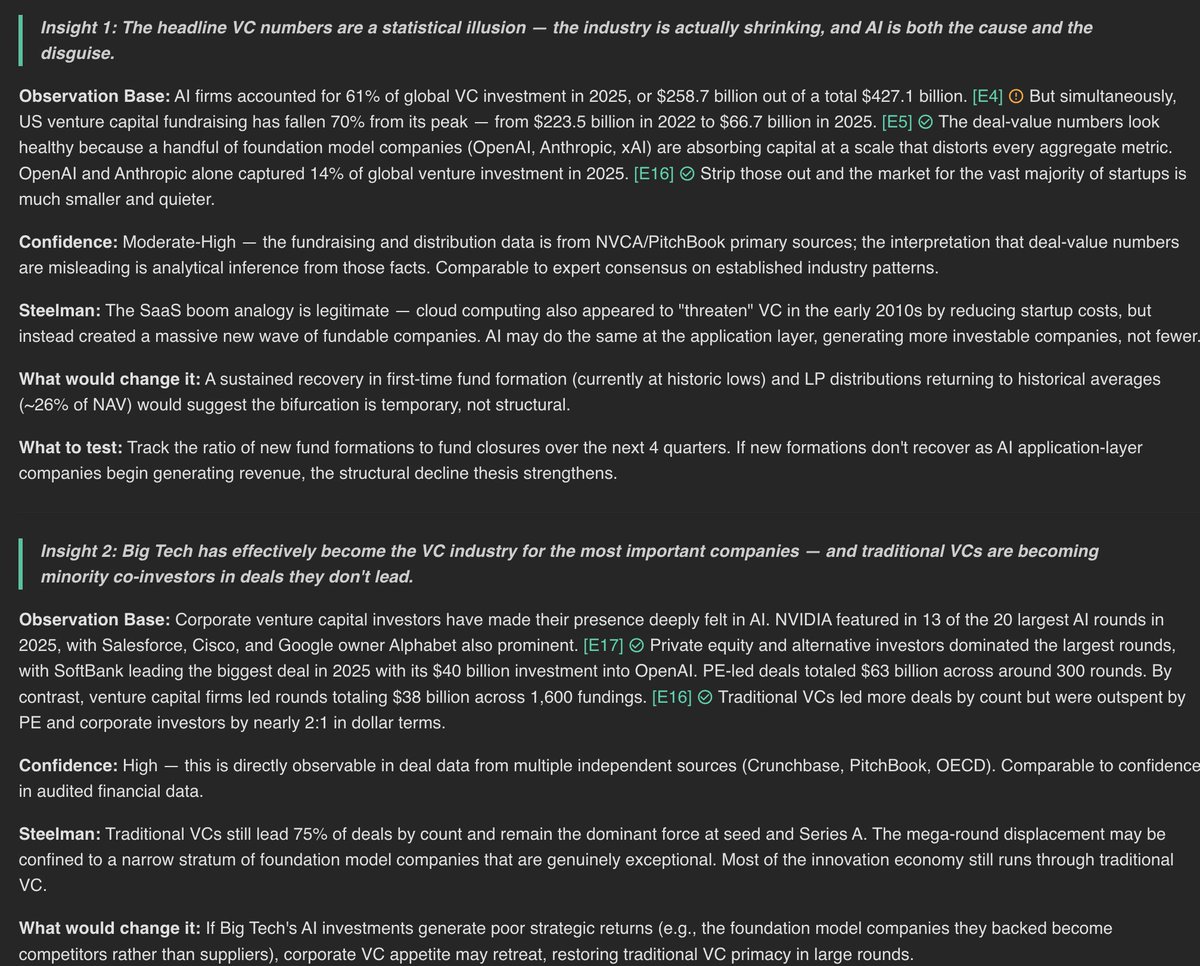
I was curious. So I ran a Deep Dive on Phaneros.
The headline numbers look healthy. $427B deployed globally in 2025 or $202B, depending on how you count AI. But if you strip out OpenAI and Anthropic, the picture changes completely.
US venture fundraising down, first-time fund formation down, the number of VC firms fell for the first time ever recorded.
AI is simultaneously the industry's biggest investment thesis and an illusion.
If you'd like to read the full analysis, comment below and I'll send you a link.
@ProofingDough How to classify taxable wealth is for smarter people than me. It's a better objective because its the column that grows faster the higher the wealth divide. More assets available, fewer people to buy them.
https://t.co/AzHlsVcfZV
@ProofingDough Inflation is sadly an asymmetrical hardship for the poor. If I'm rich I can still invest as the goods increase isn't even a blip. This just further widens the every growing inequality divide. To quote Gary's Economics, "tax the wealth not the income"
@ProofingDough Vanguard needs to refund my .04% right now:) You speak truths, would love to know how to bring about change here. We've become so good at printing at the right time to stave off inflation and keep the line going up and to the right, there has to be some repercussions coming soon.
@m_g_nichols Enterprise AI isn't failing because the models are weak; it's failing because our governance is allergic to nuance. We’re treating AI as a tool for certainty in a world defined by volatility. Governance must evolve to reward probabilistic thinking or we’re just spinning wheels.
@m_g_nichols Most decision-makers are incentivized to shift liability outward. That instinct predates AI. Now courts are establishing precedent for organizational liability in AI deployments. Buying from a vetted enterprise vendor isn't just procurement. It's a legal defense strategy.
Many investors are afraid that foundation labs will commoditize vertical AI. Is that fear justified? For some companies, yes. For others, no. Everything depends on the business model, not the technology necessarily.
Phaneros analysis linked in comments 👇
We're building strategic-intelligence workflows. If interested, let us know.