@ATabarrok did you listen to the latest @cowenconvos? thought of your post when @hoyer_kat was talking about weimar’s cultural output. one of the best episodes in a while, imo.
After over a decade teaching it, I think I’m finally beginning to understand the 30 Years War.
There are a host of “simple enough to teach, but still not truly accurate” narratives about the war, and the more you stare at them, the less clear they become.
@bryan_caplan don’t let the media overrule your positive subjective experience, but also: let them overrule your negative subjective experience (e.g. vibecession)?
@TheStalwart hi joe, quick reminder to get @dwarkesh_sp on the podcast asap — truly the perfect guest! (check out his latest episode, it’s what prompted this tweet)
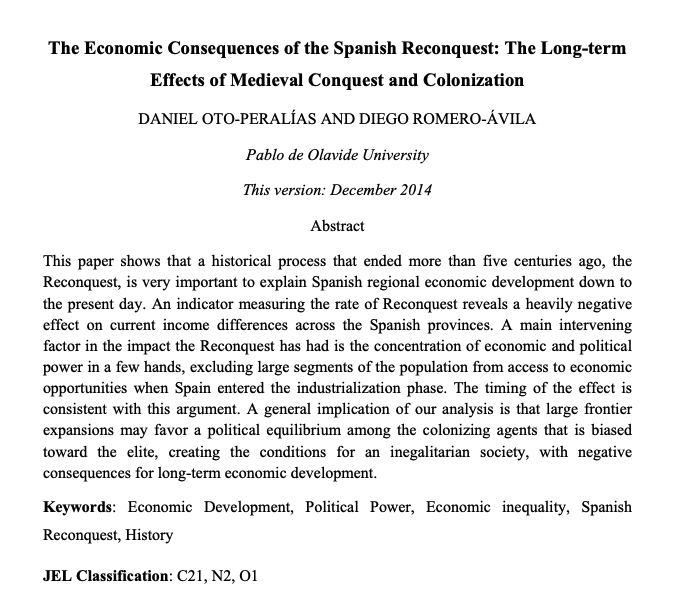
This paper argues that the Reconquista also created oligarchic tendencies, with a negative impact on economic development in Spain.
https://t.co/acrrI5kjyN
I want to partially defend the argument from authority. Being accomplished in a field does not make you infallible, and over history, many outsiders have been right while experts have been wrong.
But one rarely has time to examine every argument thoroughly. Take a recent debate: what is the best way to compare productivity growth across time and space? I once spent a whole semester on NIPA, interned on its construction, and I am still unsure about many details of indices and PPP adjustments.
So, suppose someone who has excelled in academic work claims A, someone who has not claims B, and I do not have five days to dig into the details. A reasonable working hypothesis is that the accomplished academic is right. Their record is a costly signal: they have repeatedly persuaded editors and referees that their contributions are worthwhile.
My logic is Bayesian. Let R be the event that this person is right, and O the event that this person is an outsider. The famous counterexamples are salient because we remember them: among the ideas that turned out right, some came from outsiders. That is a claim about P(O | R). But the choice I face depends on P(R | O), the chance that an outsider is right given only that they are an outsider. Confusing the two is the base rate fallacy, and the numbers can point in opposite directions. The claim that an outsider can be right, P(R | O) > 0, is far weaker than the claim that an outsider is usually right, P(R | O) close to one, and nothing forces the second.
How strong is the signal? It is a likelihood ratio.
Let S be the event of a strong publication record. What matters is the ratio P(S | R) / P(S | ¬R). This ratio is large when the record sits in the field under debate, and it shrinks toward one as the question drifts away from the person’s demonstrated expertise. A repeat Econometrica author pronouncing on a topic outside their subfield is, for that question, closer to an educated outsider than the credential suggests.
The signal is also not independent of the truth I want to estimate. Editors and referees rely on their own arguments from authority, and they share the field's priors. So, a strong record is powerful evidence that someone argues persuasively within the current frame, which correlates with being right but is not the same thing.
When the frame itself is the error, P(S | R) and P(S | ¬R) rise together, the likelihood ratio collapses toward 1, and the credential tells me little. The signal is most trustworthy where no consensus error is in play, and weakest exactly where I most fear one.
So, call me a snob, but absent a strong signal otherwise, I will bet on the person whose work has cleared Econometrica or QJE repeatedly. The bet is only as good as the likelihood ratio behind it: strong on home turf and on settled questions, weak off-domain and where the field itself may be wrong. And it tells me nothing when both sides are accomplished. No rule is perfect.