Our new paper explains why some life outcomes are hard to predict. We combined machine learning, a mathematical decomposition, and in-depth qualitative interviews to understand the origins of unpredictability: https://t.co/EKCfYllXWs
After growing up watching @realbenmcdonald pitch all the time for the Orioles, it's awesome getting to listen to his color commentary for @NCStateBaseball's super regional. Doing a great job of it too 😁
Don't miss @socdesignlab's "From Science to Social Entrepreneurship" 5/14 event, a training on social entrepreneurship for social scientists! The event is open to grad students/faculty around Boston - https://t.co/wvx2364UN1 @jsradford@NUnetsi@Northeastern@BU_CAS@InnovateBU
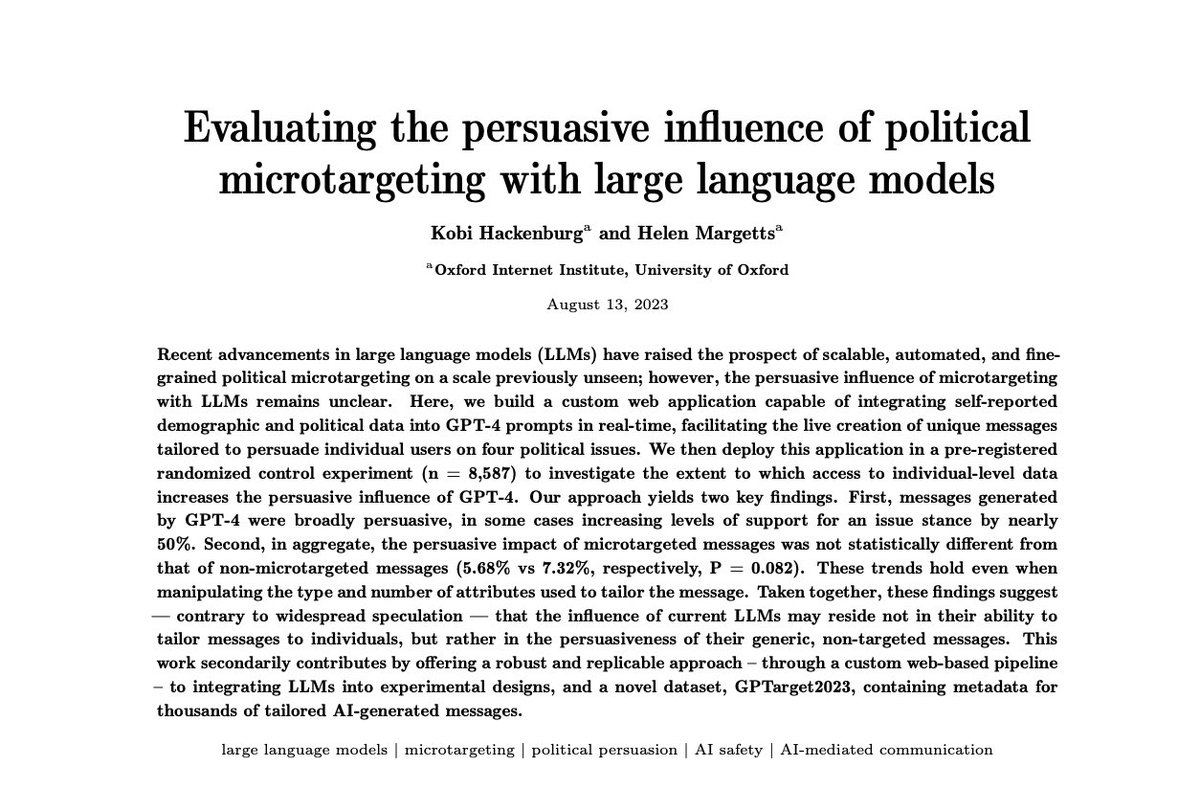
🚨New preprint!🤖w/ @helenmargetts:
In a pre-registered experiment (n=8,587), we find little evidence that use of 1:1 personalized messages — aka political microtargeting — enhances the persuasive influence of GPT-4.
https://t.co/wMS2HpcOo0

1/9🧵👇🏼
Continuing his streak of rehashing old ideas like public transit, space shuttles, and wire services; the snake eats his tail and reinvents the internet.
X is the future state of unlimited interactivity – centered in audio, video, messaging, payments/banking – creating a global marketplace for ideas, goods, services, and opportunities. Powered by AI, X will connect us all in ways we’re just beginning to imagine.
“We might assume that legacy admissions help privileged students at the expense of underprivileged ones,” writes @shamuskhan. But legacy students “are part of the reason less advantaged students get so much out of elite schools.” https://t.co/WX9oUwQMZB
Our newsletter is out! Two new ways to detect bots in your study 🤖🔍 #AcademicChatter#psychtwitter
We understand the importance of reliable data in our studies. Today, we want to share two new methods to detect robot participants. Let's dive in! 👇🧵
https://t.co/SoI25KHLE8