"Your epitaph will be, 'Here lies Mr. Stein. He was no fun.'" -- Jan Bakker
Read my book: Essentials for Blended Learning, a Standards-Based Guide, 2nd Ed
When Anthropic stopped training on books that were literally pirated, they managed to hit on the one way of buying books that means no money goes to authors: buying used books.
They spent tens of millions of dollars buying used books from wholesalers, in batches of tens of thousands at a time. These were shipped to Illinois, scanned, and pulped.
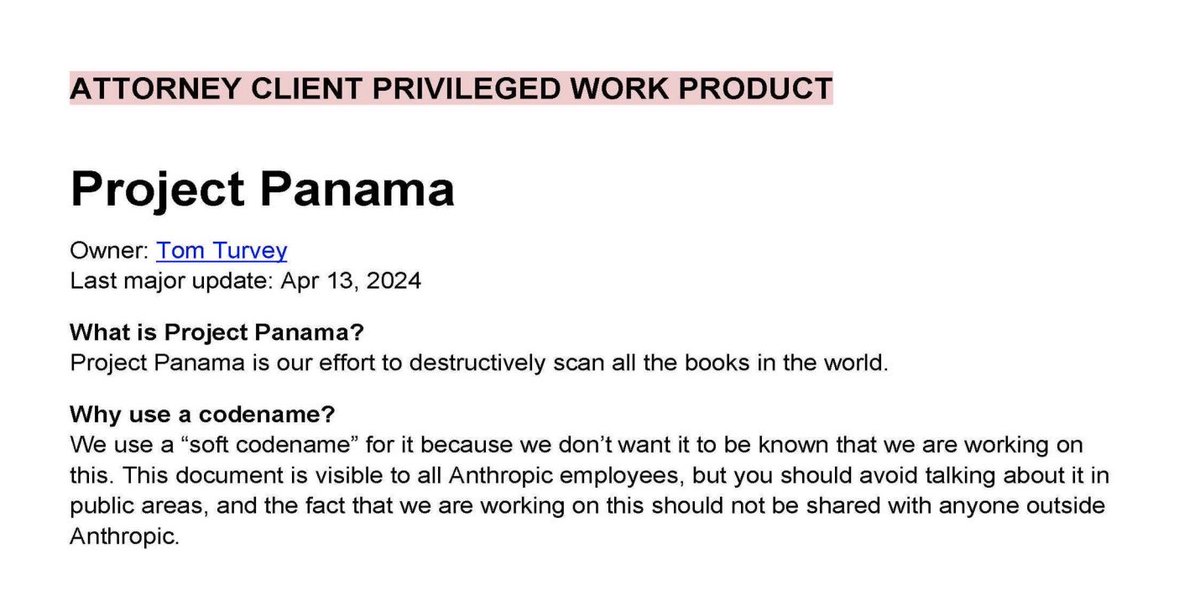
They called this Project Panama, using a codename because they didn’t want people to know they were doing it. (It ultimately came out through court documents.)
Before alighting on this plan, they were discussing licensing from book publishers, which would have meant money going to authors. But then they came up with the used books plan, and stopped all licensing discussions. Anthropic uses their huge war chest to get all the books in the world (that’s their aim) - authors get nothing.
IMO there are serious questions over whether this should be legal. Yes, they are buying the books. But you can’t just do anything you like with a book once you’ve bought it. You can’t scan it and sell it as an ebook, for instance. There are limits on what you can do with books you’ve bought, where what you would be doing would compete with the book’s rights holders.
As Judge Chhabria said in Meta v Kadrey, LLMs will likely compete with the books they are trained on by flooding the market. And as Dario Amodei himself said in 2021, big AI companies centralizing profits by training on books without the authors getting paid is a real concern.
Whatever your view of its legality, it’s pretty clear that it sucks for authors, letting Anthropic make money at their expense. Authors should get paid when their books are used to train AI, and should have the chance to say no to that training. Anthropic’s used books strategy gives them neither.
Glenda Morgan and I will be sharing data & insights on the Ed Tech industry at @UTtechweek this Thu Feb 5 at 1pm MT at @WeWork in Lehi. Sign up here: https://t.co/GcTRgZEnkN
A meta-study of 54 studies and 170,000+ people found that:
People remember more information if they read a physical book instead of a digital one.
The paper advantage holds across ages and has grown over time. Looks like paper beats pixel.
Higher ed panel with @wgu & flagship R1 university paints a stark contrast, not just in student populations but in strategy & coherence: WGU VP succinctly explains problem, urgency, & a (well-thought out) solution; the other HEI seems complacent but verbose.
There are dozens of edu and ed tech conferences and events happening in 2025. We made a list, with helpful metadata to help you prioritize: https://t.co/HxYCF3SMhx
Daily reminder that (1) the world is bigger than we often realize, and (2) perspective is everything. OH:
“I’ve played the piano my whole life.”
“Oh, so you can play half the accordion.”
@marcus by @GoldmanSachs caused an issue on my account concerning hundreds of thousands of dollars, and the support team refuses to escalate it further. Is there anyone who can help?
what do you think? is @jstein right? is this debate on the horizon? check out all the insights in the year-end episode, and ping us at @topcastnow with your thoughts. https://t.co/sHhJmlWJbB