@HarshMheshwari Looks like they just had Claude write a pathfinding algorithm in transformer weights instead of a script. I don’t think this generalizes better than if you asked Claude to use python
Frank Braconi, who is an actual economist, inadvertently asked me a softball question about why the operating expenses of non-profit housing owners are usually double those of for-profit owners. I also note that public housing operating expenses are usually triple those of private, for-profit owners. Amazingly, even with the orders of magnitude of additional spending, the non-profit buildings tend to have worse physical conditions and the public housing buildings are well known to be the worst of all. With apologies in advance that this post may be too technical and into the weeds for some, here we go.
As Frank surely knows, there are these standard economic concepts called Principal Agent and Moral Hazard. Let's examine these in terms of the three kinds of housing ownership.
In for-profit housing, the owner/manager is the Principal Agent and its motivation is the long term maximization of income and return on capital reinvestments. When it comes to "purchased items" this owner carefully negotiates and bids costs with suppliers, minimizes waste, avoids costly violations and fines, fears foreclosure and litigation and reserves capital to reinvest in well-planned component replacement and money saving innovations. Examples include heat timers, utility submetering and complex self-insurance structures, to key off Frank's questions below. Utility submetering, for one, reduces consumption by 2/3 in practice: a huge savings! There is very little Moral Hazard here because the Principal Agent is the direct beneficiary of the cost savings and it is not a judgment-proof entity.
In non-profit housing, we encounter our first Moral Hazard. The owner is an entity that by virtue of being the owner of last-resort, has an soft loss backstop from the public. The non-profit's manager, acting as Principal Agent, still has to do all the work of a manager but is only compensated by a salary, also a hazard. So in the non-profit scenario, the manager will do everything to maximize its salary but only impose as much careful effort as is needed to prevent the building from literally collapsing. Since this type of property doesn't have to pay real estate taxes, an amount which usually would be around half of net income, all of that money can be squandered on careless and indifferent negotiation and purchasing with suppliers. It should surprise no one that careless purchasing often comes with emoluments for the Principal Agent, another Moral Hazard. This owner is also less risk averse, because when fines and violations arrive resulting in eventual litigation judgments, there is no owner to worry about the outcome. They become just another delayable payable. Conditions naturally deteriorate but at least the building doesn't fall over.
And finally we have the public owner who truly has no "skin in the game." Perversely, the public owner cares mostly about how to MAXIMIZE the operating costs because the Principal Agent and Moral Hazard problems are here in full effect. The salary to manage public housing is a pittance, so the Principal Agent may only earn their fair compensation through emoluments. The legendary graft at agencies like NYCHA is well documented and consistent at public housing throughout the world. Moreover, prevailing wage regulations already force any operating expense that includes a service to cost at least double, even before any mischief takes place. Of recent note, the well publicized case of the NYCHA employee-plumber Jakub Markowski who allegedly earned $465k via overtime rigging. When the property earns fines and violations, develops truly dangerous conditions or employees behave with utter gross negligence, only the taxpayer is on the hook and no one ever loses their job or pension thanks to the representatiion of powerful labor syndicates. With this incentive structure, it should be no surprise at all that building conditions are atrocious and it costs $527k to renovate a single public housing unit.
this prompt is already god tier. here's the elaborate version :
"Recover my program's minimal semantic model.
1. State: every value that changes what the user sees
2. Transitions: what commutes, what's idempotent, what's order-dependent
3. Dependencies: what must be true before each effect fires
Then find:
→ nondeterminism in awaits, retries and event order
→ invariants enforced by hope
→ one fact stored in two places, drifting
→ work that never reaches the screen
Last, split my refactors into "provably equivalent" and "trust me". For each "trust me", give the smallest input that breaks it."
your app already has a formal semantics. you just haven't met it
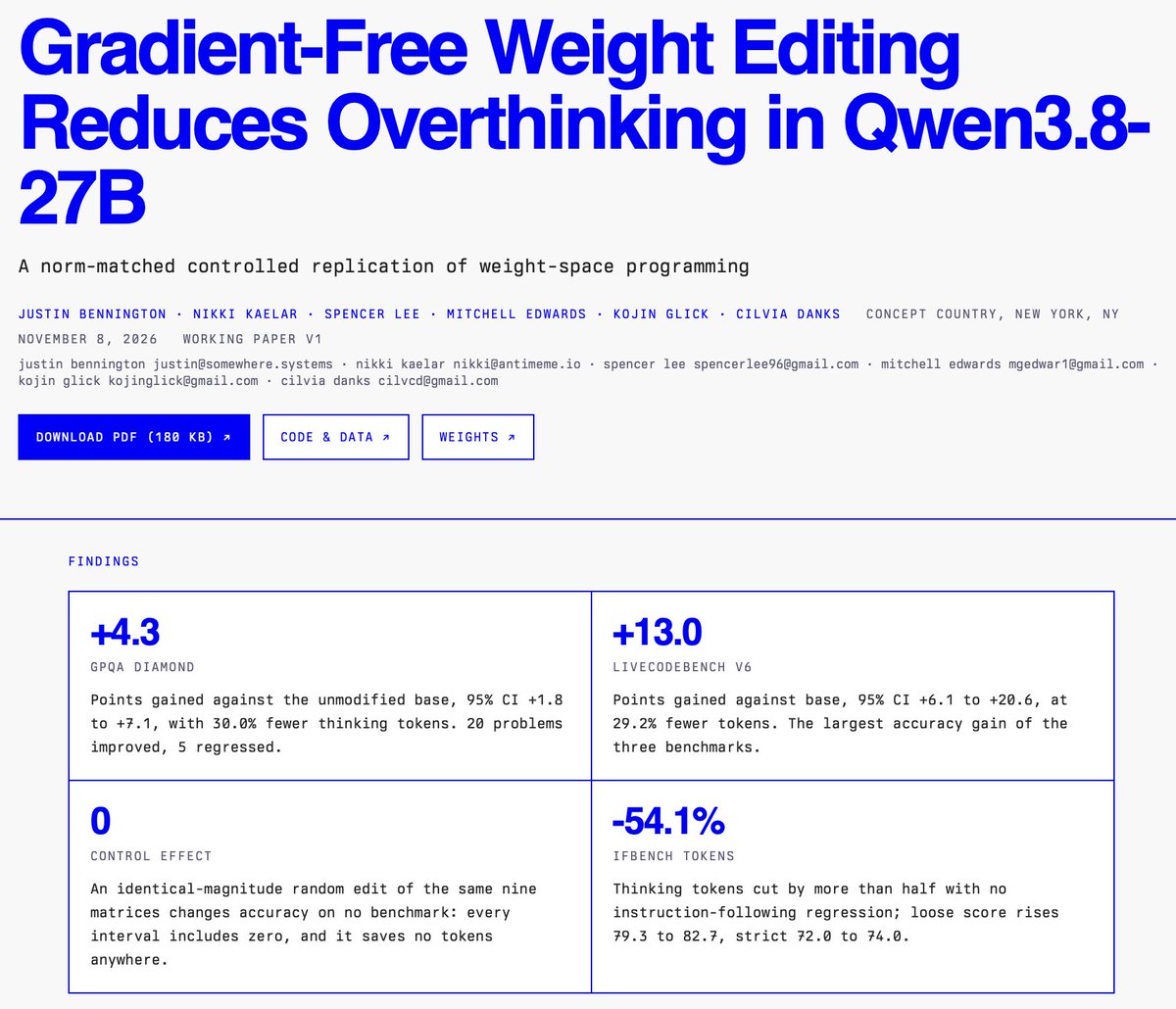
Weights and working paper are released. As we run more robustness checks, we also discover that this model edit unexpectedly adds +13% performance on coding tasks.
https://t.co/9TkSUEDTtE
@HumanLevelJen The readme for modulo seems to imply that steering might be useful for problem solving. I’m wondering
- whether you could quantify that
- check whether simple prompting (“you are an experienced engineer”) is as useful as steering
TLA+ has been incredibly useful, even on brownfield project, for turning implicit state machines into explicit specs where the entire flow can be tested and verified.
There is a deep relationship between user journey, UX flow and formal specification that has an enormous amount of value to slop code.
I wanted something more programmer-y and Typescript-y, and I came across Quint. It's highly agent friendly and seems to be maximally useful for this new paradigm of programming.
https://t.co/Tj1K7ZnrU7
Quint is high level, like TLA+, and doesn't formalize Typescript functionality. So underneath that, lower level, is Lemmascript.
https://t.co/iNBPVfkeSM
This lets you markup your Typescript with contracts.
The combination of these two things makes Typescript feel more like a compile time checked language, more verifiable, stronger guarantees, and it finds different kinds of bugs than AI generated unit tests seem to.
It's not a magic bullet but damn it does seem to improve code quality a lot.
And the agents can rapidly iterate against it.
I think we're gonna see a lot more of this kind of thing popping up, especially in interpreted languages like TS and Python.
I'd recommend using Quint when you're just modeling your application and flows (although I've been installing it into an existing project with good results) and then telling your agent to add Lemmascript in the build phase.
Concept Country has developed its first open-source model, Qwen Concept 27B.
With 54% less thinking tokens and 3% better performance on GPQA Diamond compared to its base Qwen 3.8 model, we have achieved 30% more useful tokens per joule without additional post-training.
@machinestein@felipejcruz Is there any synergy like the weights “understand” what is going on or something if that makes sense? I feel like that’s what everyone wanted it to be when they first saw the tweet