New in Delta: your thread can keep running while you touch grass.
Cloud Runners are here, so you can move a thread to the cloud and the agent keeps working without your computer. Check in from your desktop, the web, or your phone!
API is Anthropic’s higher margin business so I would be surprised if they degrade response there but also Ant generally doesn’t know what application is on the other end.
People will notice tokens per second in chat but Claude code, tag, managed agents etc you have lots of opportunities to do discrimination and I suspect the scheduler takes all of these things as inputs.
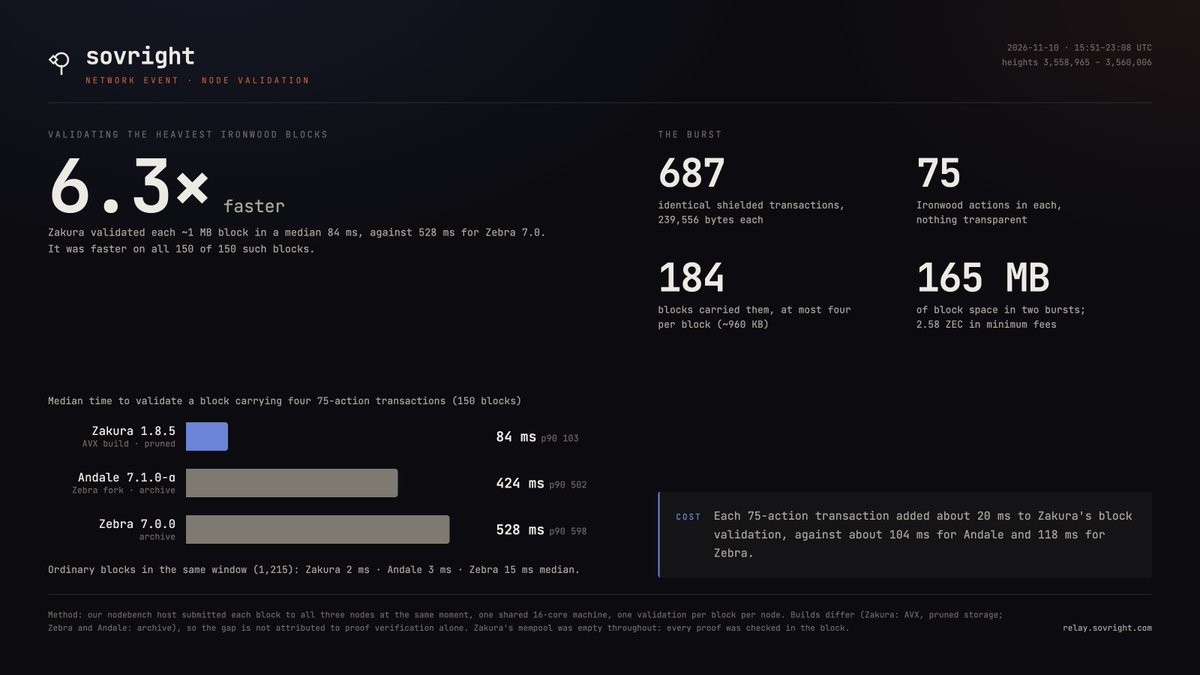
The Sovright relay and benchmarking infrastructure detected an unusual series of transactions on the Zcash network today between blocks 3,558,965 and 3,560,006
Here is what the network saw:
Zcash has had chain privacy since day one. Network privacy is the unfinished business.
“Zcash has full nodes, and then it has what we call light clients. There’s chain privacy, and then there’s network privacy.”
“We’ve had chain privacy since the beginning. The second piece is what do you actually use on mobile? You can’t run a full node on your phone.”
“That network privacy option that uses Tor… helps make it so that these network nodes can’t tell what IP address, what phone a given request is coming from.”
“Especially when you’re moving in and out of the shielded pool or you’re moving transparent ZEC, that is information that we would prefer to have more obfuscation about, and there continues to be ongoing work on making that better.”
ft. @zmanian, @sudo_ml, @DeFi_Dad & @Nomaticcap
We've launched our new research website at Project Eleven.
This will be the home for all of our research into post-quantum and post-AI security, including papers, technical work, tools, and new research as we publish it.
https://t.co/KszsKfj6KQ
The power of Zcash ($ZEC) is built and strengthened by the community around it.
That’s why we’re directing $1M to non-profit organizations and initiatives advancing the Zcash ecosystem.
We’ve awarded the first $400K to @ZcashFoundation, @pgpzcash, @TachyonZcash, and @ShieldedLabs. We are proud to support the work they do in helping usher in The Next Era of Crypto. #ZcashEra
Learn more: https://t.co/COE0cuM78y
This is a good filter for people who I don’t want to work with. Please understand how computers work. This isn’t even about understanding Docker. Any software person should know how the layers work at a high level and this is a VERYYYYY high level.
Rune is so sick.
This is @kitlangton + @anomalyco 's new native x-platform UI framework in Rust.
* SwiftUI-like, but little type-ceremony for super fast compiles (and hot-reloading!)
* To compensate for the lack of type-safety, everything is observable, deterministic, and can be replayed to your agent directly or in the ui (so agents can fix things fast)
* Animations run off the main thread, and the architecture is set up to avoid Rust Rc/RefCell noise.
I disagree with the way state management is handled, but I can build my trusty Elm-style reducers on top of it easily enough.
I've tried porting over parts of an Electron app I'm working on, and my agent one-shotted it perfectly.
PLAN.md in the repo is a really interesting read + you can ask your agent to learn more about it.
Was in the war room with Near Ai all day on this.
Inference providers are honeypots. TEEs are defense in depth.
We are seeing security transform in real time.
Inference providers are under attack.
AI inference is now playing a critical role and is a honey pot of data and ability to inject actions back into users devices via agents for malicious actors.
NEAR AI thwarted a series of attacks on its systems and is back to normal. NEAR Protocol, Intents and other infra wasn’t affected.
TEE architecture is part of the answer to making sure that from outside even inference provider doesn’t have an access. User should verify exactly what happens with their data and prompts.
NEAR AI code is open and inspected by many partners when deciding to leverage the stack to validate exactly what runs inside TEE and ensuring privacy.
In this case there was also a vulnerability within SGLang, open source inference engine that runs inside an enclave. Even though this had a minimum disruption it still was a very
Going forward we are going increase security rigor of dependencies and also improve a “turnstile” to detect when anything out of normal runs inside TEE.
Proactive security against external attackers has became a must. We have been using Abliterated models and red teaming harness to continuously monitor and detect issues. We are also expanding scope and compute invested into this.
I think this might be the unlock for IBC everywhere.
IBC is in the weights. LLMs can write the ZK proofs
With Alpenglow, most blockchains can support fast light clients.
Now IBC lives in neutral governance at @lfdecentralized instead being awkwardly married to cosmos:native.
Update: NEAR AI Cloud is back online.
We’ve fixed the vulnerability on every server and replaced the affected credentials.
NEAR Protocol and other NEAR services were not affected.
Full incident report shortly.
We envision a global financial system where independent digital ledgers and financial networks can exchange assets and data as freely as people share data online.
Networks are one of the greatest tools for human flourishing.
IBC is the open standard that will make it happen.
We look forward to continuing this work with the global IBC community and to making open, secure connectivity a shared industry standard.
https://t.co/ivhQWRXALE
Live Cybersecurity Webinar!
Our expert for Thursday's live webinar, Zaki Manian @zmanian audits his own code live with private, uncensored AI on NEAR AI Cloud.
🗓️ Thu, Nov 12
⏰ 10am PT
Register: https://t.co/h3Gb8uTumO
Zcash isn’t fully quantum-safe today. Here’s what’s already in place so your shielded ZEC survives the transition.
“As it stands today, Zcash is not fully quantum safe, but you’ve laid some of the ground rails to be more quantum safe.”
“You go into a coma for the next 10 years. You wake up… a quantum computer has come out, Zcash has migrated, Zcash is running a new protocol. Have you lost your coins? No. That’s kinda all you have to know.”
“Effectively, every person who has ZEC in the shielded pool today… they could just forget about Zcash and come back in 30 years, and their Zcash would be accessible.”
“Becoming post-quantum secure is not a thing you just do… It is a ridiculous amount of work with all these unknowns. So the best thing we can do now is to make a future transition, especially when quantum computers become more real, a lot faster, a lot easier.”
ft. @zmanian, @sudo_ml, @DeFi_Dad & @Nomaticcap
The ICF is proud to support the open source movement around IBC.
Since inception, we’ve had two principal aims:
1. Drive the adoption of DLT technologies.
2. Make those technologies sustainable over the long term.
This contribution to the Linux Foundation helps us achieve both of these goals.
The LF Decentralized Trust’s stewardship model provides a well-established pathway for community governance of the protocol’s development, helping IBC become a leading open standard for interoperability.
It also provides IBC direct access to one of the largest open source developer communities in the world, to drive its adoption globally.