King's College Hospital in London has opened a rooftop garden for critical care patients. Its first patient, a 29-year-old woman dependent on feeding tubes, said the outdoor space gave her 'a real boost to keep on going
"My name's Raymond. I'm 73. I work the parking lot at St. Joseph's Hospital. Minimum wage, orange vest, a whistle I barely use. Most people don't even look at me. I'm just the old man waving cars into spaces.
But I see everything.
Like the black sedan that circled the lot every morning at 6 a.m. for three weeks. Young man driving, grandmother in the passenger seat. Chemotherapy, I figured. He'd drop her at the entrance, then spend 20 minutes hunting for parking, missing her appointments.
One morning, I stopped him. "What time tomorrow?"
"6:15," he said, confused.
"Space A-7 will be empty. I'll save it."
He blinked. "You... you can do that?"
"I can now," I said.
Next morning, I stood in A-7, holding my ground as cars circled angrily. When his sedan pulled up, I moved. He rolled down his window, speechless. "Why?"
"Because she needs you in there with her," I said. "Not out here stressing."
He cried. Right there in the parking lot.
Word spread quietly. A father with a sick baby asked if I could help. A woman visiting her dying husband. I started arriving at 5 a.m., notebook in hand, tracking who needed what. Saved spots became sacred. People stopped honking. They waited. Because they knew someone else was fighting something bigger than traffic.
But here's what changed everything, A businessman in a Mercedes screamed at me one morning. "I'm not sick! I need that spot for a meeting!"
"Then walk," I said calmly. "That space is for someone whose hands are shaking too hard to grip a steering wheel."
He sped off, furious. But a woman behind him got out of her car and hugged me. "My son has leukemia," she sobbed. "Thank you for seeing us."
The hospital tried to stop me. "Liability issues," they said. But then families started writing letters. Dozens. "Raymond made the worst days bearable." "He gave us one less thing to break over."
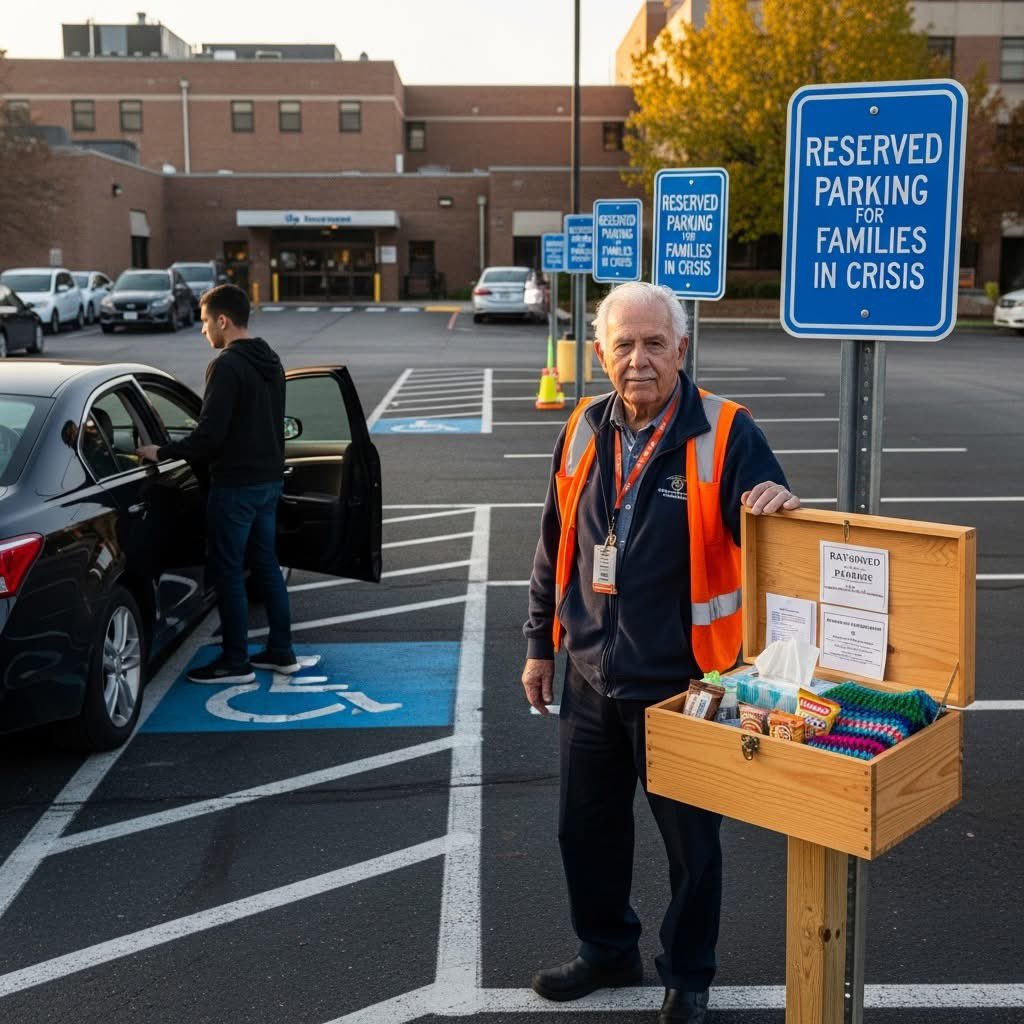
Last month, they made it official. "Reserved Parking for Families in Crisis." Ten spots, marked with blue signs. And they asked me to manage it.
But the best part? A man I'd helped two years ago, his mother survived, came back. He's a carpenter. Built a small wooden box, mounted it by the reserved spaces. Inside? Prayer cards, tissues, breath mints, and a note,
"Take what you need. You're not alone. -Raymond & Friends"
People leave things now. Granola bars. Phone chargers. Yesterday, someone left a hand-knitted blanket.
I'm 73. I direct traffic in a hospital parking lot. But I've learned this: Healing doesn't just happen in operating rooms. Sometimes it starts in a parking space. When someone says, "I see your crisis. Let me carry this one small piece."
So pay attention. At the grocery checkout, the coffee line, wherever you are. Someone's drowning in the little things while fighting the big ones.
Hold a door. Save a spot. Carry the weight no one else sees.
It's not glamorous. But it's everything."
Let this story reach more hearts....
Credit: Mary Nelson
El 12 de octubre de 1936 Miguel de Unamuno, entonces rector de la Universidad de Salamanca, pronunció su célebre réplica al general Millán Astray, después de que éste le gritara "Mueran los intelectuales, viva la muerte".
Unamuno respondió: "Este es el templo del intelecto y vosotros estáis profanando su recinto sagrado. Venceréis porque tenéis sobrada fuerza bruta, pero no convenceréis porque convencer significa persuadir. Y para persuadir necesitáis algo que os falta: razón y derecho".
¿Saben por qué es imposible no querer a Kate Winslet?, pues por cosas así👇🏼. Porque es buena persona, y no ha rehuído de los problemas❤️
Eres una reina, Kate👏🏼👏🏼👏🏼👏🏼
Es llamativa la falta de pudor al decir según qué cosas.
Como defender a un estado megalómano que tiene bajo sus fusiles a miles de almas inocentes.
Ojalá vuelva el día en que decir estas cosas en público vuelva a dar vergüenza.
La sororidad es un concepto poco explotado pero muy extendido, que durante muchos años (a veces en la sombra), salvó a muchas mujeres que vivían en medio de entornos mucho más que hostiles.
Comprobarlo, aunque sea pasado el tiempo, es emocionante.
Las palabras de agradecimiento de Nevenka Fernández a @julia_otero. "Julia, tú eres una de las poquísimas que estuvo cuando nadie estaba". Puedes recuperar la entrevista completa a Nevenka en 👉 https://t.co/8N49A2WrOE
@Celia25Cr Yo siempre me acordaba de Titanic: Rose anciana (subdural, forma de semiluna, típico de pacientes ancianos, traumatismos inadvertidos) y a Jack joven (epidural, forma de lenteja, típico de gente joven, trauma de alto impacto, accidentes).
Cuando doy esa clase, pongo esta diapo.