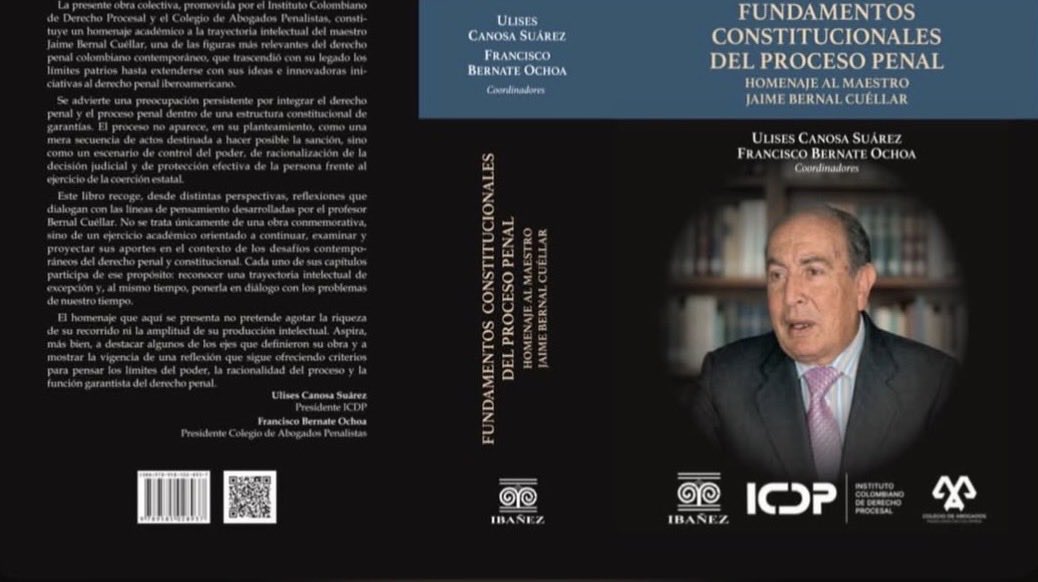
La verdad, no pensé que mi pequeño aporte a la academia nacional llegase a ser escogido para una obra del tamaño del homenaje a Jaime Bernal Cuéllar. Reconocimiento a @ucanosas@fbernate por dirigir tremendo esfuerzo y a @gei_editorial por sus eximias publicaciones.
Me tomé el atrevimiento de escribir sobre un tema que ya otros autores nacionales habían abordado y que atañe a una manifiesta desproporción en la imposición de detenciones preventivas intramuros en casos donde, de resultar condenado el procesado, estaría en libertad condicional o como máximo, en prisión domiciliaria: se trata peor al inocente que al sentenciado.
We’re launching AlphaGenome Atlas: an AI-powered searchable database mapping the predicted impact of all 9 billion possible single-letter DNA changes.
Here’s how it could help researchers better understand our biology 🧵
De @Tesla community houdt hier al geruime tijd de vinger aan de pols over de toelating voor de FSD-technologie op onze Vlaamse en Belgische wegen.
Uit waardering voor jullie niet-aflatende interesse (en aanmoediging 😉), krijgen jullie hierbij de primeur: ik heb net de toelating getekend! 🚘
Deze beslissing gaat nu naar onze dienst homologatie, zij zullen @RDWnl op de hoogte brengen van de goedkeuring. Vlaanderen omarmt innovatie!
Pep - what can I say? Where do I start? ✍️🩵
It’s difficult to truly describe the impact Pep has had - not only on Manchester City as a football club, but on everything around it as well. The trophies and achievements speak for themselves. But what made him special was always much bigger than winning.
For me personally, he was never just a manager. He was a mentor, a leader and also a friend.
From the very first day we worked together, he challenged me to see football differently. Every detail mattered. Every meter on the pitch had a purpose. There were moments when his intensity pushed all of us to our limits mentally and physically - but looking back, that obsession with perfection is exactly what made his teams so extraordinary.
What many people don’t see from the outside is the human side of Pep. Beyond football, he is incredibly humble, thoughtful and someone who genuinely cares about the people around him.
Over the years, I was lucky enough to experience that side of him very closely. He made me a better player, but also a better person.
When I look back on my career one day, my time working with Pep will always be one of the defining chapters of my journey.
ManCity without Pep will never be the same again. Thank you for everything you’ve done for me, my family, the football club, the community and Manchester as a whole. 🩵
Looking forward to seeing you at the game on Sunday! @PepTeam 🙏
From @TheAthleticFC: Real Madrid have been known not to take defeats well. This is the most successful club in Champions League history, with a record 15 titles, but they are also bad losers. https://t.co/I1XJbNsk59
Went down the rabbit hole on this. A firefly spends up to two years underground as a larva, hunting slugs in the dirt. Then it crawls out, grows wings, and gets maybe three weeks as the glowing thing you remember from childhood. Three weeks to find a mate and reproduce. Then it's dead.
So when the tweet says "some scientist" warned we're the last generation to see them, that's real. A Belgian firefly researcher named Raphaël De Cock said it, and the clip blew up on TikTok. But I dug into the actual science, and the picture is weirder than the headline.
We know of about 2,200 firefly species worldwide. Scientists have studied fewer than 150 of them. That's less than 7%. Of the ones they looked at, about 14% are at risk of extinction. And here's the part that got me: we know so little about more than half the species we've found that scientists can't even tell if they're dying off. If those mystery species are disappearing at the same rate, 1 in 3 North American fireflies could be in trouble. We might be losing species nobody's even properly named yet.
A major 2024 study by Penn State, the University of Kentucky, and Bucknell examined 24,000 citizen surveys across the eastern U.S. The number one thing killing fireflies turned out to be weather and climate shifts. Their larvae need wet soil to survive those two years underground. Too dry, they die. Too flooded, they drown. The second biggest killer: artificial light. Night skies are getting about 10% brighter every year. A quarter of Earth's land is now lit up at night. And fireflies talk to each other with light. Their whole mating system runs on flashing patterns in the dark. Flood that with streetlights and porch lights, and the signal disappears.
This isn't abstract. In Hong Kong, one firefly species lived along 1.8 kilometers of a single hiking trail. Street lamps went up in 2018 and 2019. The population is gone. Critically Endangered now. In Delaware, the Bethany Beach firefly exists in a few tiny salt marshes, and coastal construction is eating them up.
But your common backyard lightning bug, the one called Photinus pyralis, is fine. Ben Pfeiffer, who runs Firefly Conservation and Research, said it straight: "We won't be the last generation to see fireflies." What's actually vanishing is the variety. The weird ones. The specialists. They get replaced by the one tough generalist that can survive anywhere.
One last thing that stuck with me. A firefly turns chemical energy into light at about 41% efficiency, with almost zero heat lost. Our best LEDs just recently hit about 40%. We spent decades of engineering to match what a beetle worked out 100 million years ago.
And we're blinding them with the lights we built to copy them.