El Premio de TFM de Investigación de Griego ha sido ex aequo.
Alma Sacristán Díaz (UCM-UAM-UAH)) ha recogido el diploma de manos de Jesús de la Villa, Expresidente de @SEEC_nacional.
Información sobre el Máster Universitario en Textos de la Antigüedad Clásica y su Pervivencia, de parte de dos de nuestros estudiantes. Para más información visiten https://t.co/fb2NwOpaZv.
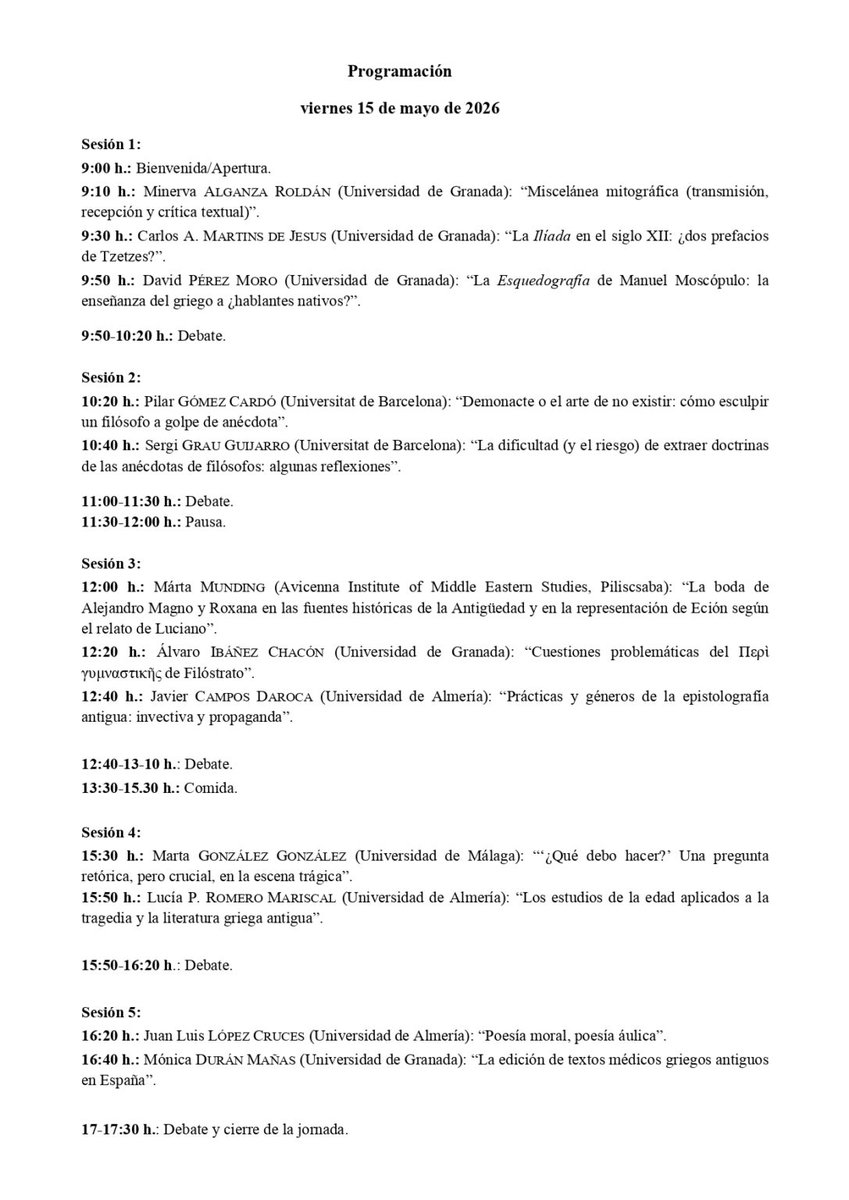
Hoy tenemos en la Universidad de Granada el seminario internacional "Πολυπραγμοσύνη: Actualización científica en Filología Clásica", organizado por Diatriba (PAI HUM-986). En él intervendré con "La Esquedografía de Manuel Moscópulo: la enseñanza del griego a ¿hablantes nativos?"
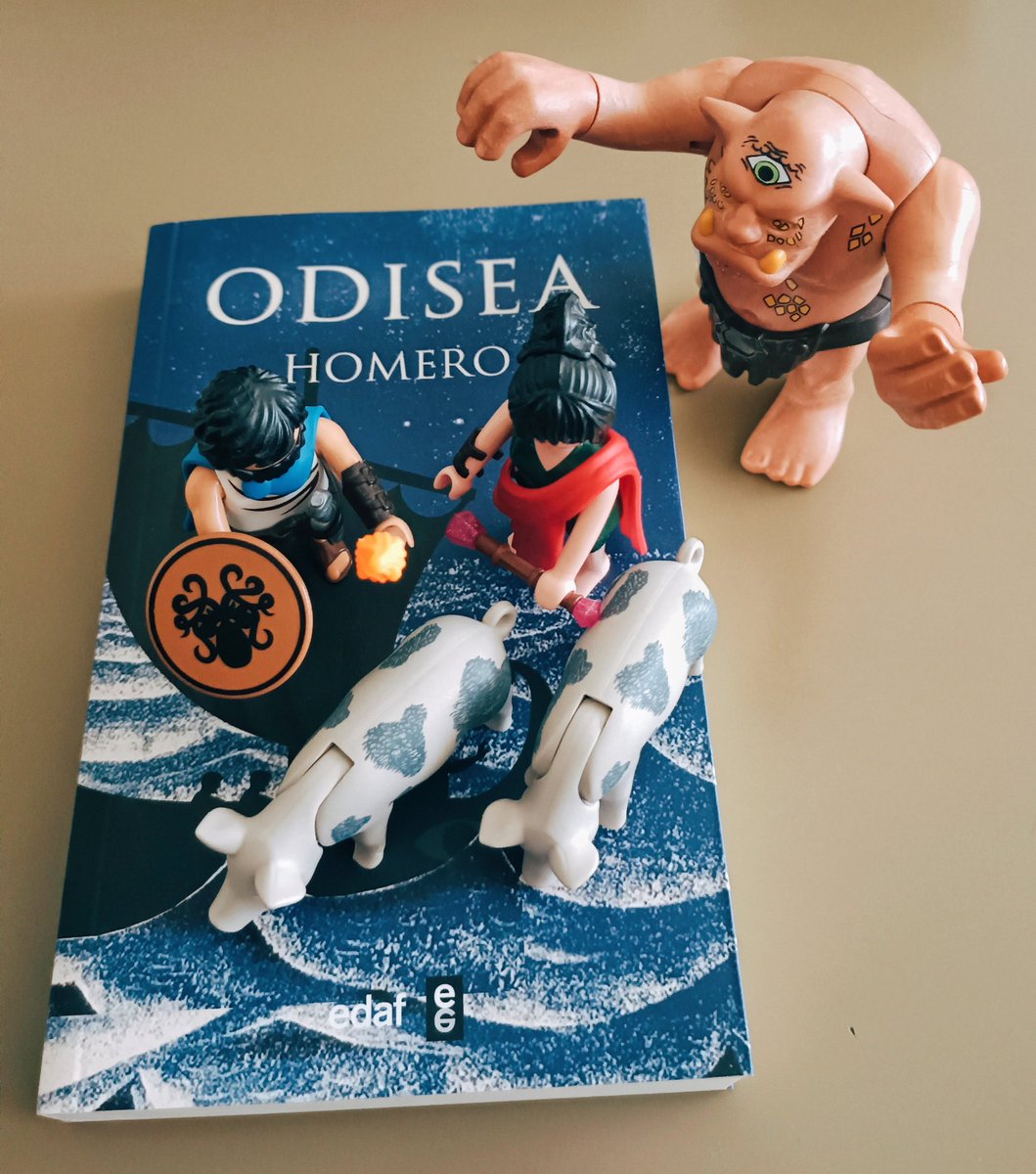
I think I finally understand what is wrong with Nolan: his universe is adverse to myth. It is made entirely of causality, and causality alone.
He may be the most gifted filmmaker working in big-budget Hollywood today. But he is going to crash on myth the way sailors crashed on the rocks below the Sirens.
When I criticized the teaser, I was told: wait for the trailer. When I criticized the trailer, I was told: wait for the film. Then I read the two-hour interview Nolan gave to Time Magazine, and something clicked.
The tell is in a detail Nolan offers with obvious pride. He found a solution to what he saw as a narrative problem: why would the Trojans believe the horse was empty and drag it inside their city? His answer is to make the horse half-submerged, sinking into the sea, so the Trojans would rescue it rather than accept it as a gift.
It is a solution to a problem that never was one because it is a myth. The Trojans bring the horse inside because it is a gift and it has wheels. The poet tells you something plainly impossible with the same tone he uses to describe the sunrise, and in doing so he is signaling that the level of reality goes beyond mere causality and exists on other levels.
He is the kind of guy who would explain that Santa can fit through the chimney because he designed it wide enough from the start, using proper construction methods and reliable materials. And then explain how the reindeer are fed to sustain that much effort in a single night, and how Santa elaborated a clever logistics route to deliver all the gifts on time.
Watch him justify the armor despite its fantastical look, or explain the absence of orchestra because there was no orchestra in Ancient Greece. There were no IMAX cameras either, Christopher. A simple authorial act would have sufficed: because I like it better that way. That honesty might have opened a door out of causality.
This narrative prison is precisely why people eventually seek out avant-garde and experimental cinema, why they feel something release when causality finally breaks. Because causality is already the weight of our ordinary lives.
As long as Nolan stayed away from myth, his causal world of mirrors and clever tricks and puzzles worked beautifully, sometimes brilliantly. But this is something else. This is the gut of myth. This is the Dionysian spirit of mud and blood and the salt of the sea. This is the beautiful lie that makes you erupt with sacred joy.
Unlike the medieval Latin West, the east Romans did not need to rediscover Roman law because they had never stopped living under it.
Justinian’s jurists codified Roman law in the 6th century, but while the Latin Digest and Codex later had to be “reawakened” in the West, Greek versions and commentaries kept the legal tradition alive in the East.
Roman law in the east Roman empire was not a foreign classical inheritance. It had always been the law of the Roman state. Bernard Stolte explains this in “Legal Thought,” in The Cambridge Intellectual History of Byzantium:
“The Latin text of Digest and Codex went to sleep, only to be reawakened in northern Italy in the eleventh century, to embark upon a new career as the source of the continental civil-law tradition, whereas the various Greek versions and commentaries gave birth to an independent tradition of Byzantine law in the eastern Mediterranean.”
In the medieval Latin West:
“Roman law became prominent only after customs and statutes had shaped various legal systems, into which the ‘new’ law had to be integrated. In the hierarchical order, the local law always came first.”
That was the western situation. Roman law was prestigious, but it had to be fitted into legal worlds that already existed.
“Obviously, all this was different in Byzantium. There, Roman law was not a (relative) newcomer. To the contrary, it had always been the law of the land and its prestige was indisputable. It was imperial law and the emperor held the monopoly of legislation.”
The east Romans were not medieval people looking back at Rome from the outside, because Roman law was their own living law as the continuation of the Roman state.
“There could be no question of local custom or statutes having precedence except by permission of the emperor. Even a theoretical debate on this matter was impossible. (Practice could be, and was, different.)”
That is why Stolte describes the difference through the image of inheritance:
“Elsewhere I have described the difference between Byzantium and the western world in this respect as the difference between an heir and a legatee.”
The medieval Latin West received Roman law like a legacy, something useful that could be accepted, adapted, or dismissed according to local needs, but east Rome was different:
“The [east Roman empire] was the heres necessarius of Roman law. Constantinople was the new Rome and was simply unable to escape the consequences of that position. It received Roman law with all its activa and passiva, its assets and debts.”
Constantinople was new Rome, and new Rome inherited Roman law not as a museum piece, but as the law of the land.
“But in the various cities and regions of the Latin west, where it often had never been entirely absent, Roman law was received with greater or lesser enthusiasm, a legatum unburdened by liabilities, to be used or dismissed as irrelevant according to local political and cultural conditions.”
So the medieval Latin West did not simply lack all Roman law. Stolte says it had often “never been entirely absent.” The difference is that the West could use it selectively, while east Rome could not treat it as optional. Roman law came with the whole burden of being Rome.
This did not mean east Roman law was frozen or effortless to apply. Stolte adds that even though Roman law had no real rival, practical needs still forced jurists to find workable solutions:
“This unchallenged position does not mean that this state of affairs met with universal satisfaction. Roman law did not yield to the pressure of an alternative, but was not up to playing the role of omniscient counselor, either. For practical needs, different strategies were being devised.”
Stolte points to the major collections that dominated East Roman legal history:
“So far we have looked in some detail at the two major collections that dominate the history of Byzantine law: Justinian’s legislation (in western tradition called the Corpus iuris civilis) and the Basilika, its definitive Byzantine transformation.”
Across the centuries, east Roman jurists and emperors kept Roman law usable through major legal works, from Justinian’s legislation in 529–534 to Greek works like the Ecloga of 741, the Procheiron, the Basilika around 900, and the Hexabiblos of 1345. These were not rediscoveries of Roman law from the outside, but ways of selecting, translating, summarizing, adapting, and applying the law of the Roman state itself.
This Greek legal tradition was not a sudden change under Herakleios either. Even Justinian was already issuing later laws in Greek almost a century earlier, since, as Stolte notes, Justinian “could not entirely disregard the fact that the majority of his subjects were Greek-speaking,” so “His subsequent legislation was therefore in Greek and the intellectual digestion of the legal tradition took place in Greek as well.”
Because Roman imperial law had no equal rival inside the empire, east Roman legal development followed a different path from the medieval Latin West:
“the greatest obstacle to building a new legal system (as was being done in the late medieval west) was the absence from the Byzantine world of a legal system that had an equally valid claim as imperial Roman law.”
In other words, the medieval Latin West could receive and reshape Justinianic law as a revived learned tradition, but east Rome carried Roman law as the living law of the Roman state itself.
Source: Bernard Stolte, “Legal Thought,” in The Cambridge Intellectual History of Byzantium.
Ancient Robot. Islam.
This 13th-century illustration from al-Jazari's masterpiece shows a programmable mechanical butler (essentially an early humanoid robot) designed to serve wine at drinking parties.
The figure holds a goblet in one hand and a fan in the other; hidden internal pipes, siphons, and tipping buckets automatically fill the cup with wine after a timed delay (about 7–8 minutes) once a reservoir in its "head" is primed. Al-Jazari, often called the "father of robotics," engineered it for entertainment and wonder in medieval Islamic courts: blending hydraulics, timing mechanisms, and artistry centuries before similar European automata.
A glimpse into sophisticated "fine technology" for leisure!
Source: The Metropolitan Museum of Art, https://t.co/253B12xUSg
Information from The Met:
Title: "Figure for Use at Drinking Parties", Folio from a Book of the Knowledge of Ingenious Mechanical Devices by al-Jazari
Author: Badi' al-Zaman ibn al-Razzaz al-Jazari (Northern Mesopotamia 1136–1206 Northern Mesopotamia)
Date: dated 715 AH/1315 CE
Geography: Made in probably Syria or Iraq
Medium: Ink, opaque watercolor, and gold on paper
Credit Line: Rogers Fund, 1955
Object Number: 55.121.12
Curatorial Department: Islamic Art
لماذا توجد كميات كبيرة من النفط تحت صحاري الجزيرة العربية؟
القصة بدأت قبل ملايين السنين حين كانت جزيرة العرب مجرد بحر ضحل. وبمرور الزمن تراكمت الكائنات الميتة وتحولت إلى رسوبيات كربونية .. وبفعل الضغط والحرارة تحولت إلى نفط كربوني ظل حبيسا تحت الصخور :
The Great Mosque-Cathedral of Cordoba is among the greatest of Islamic architecture in the Iberian peninsula. However, many people are not aware that Roman artists sent from Constantinople created the mosaics inside:
A modern study determined that the mosaic tesserae(the little tile pieces) were imported from medieval Roman Anatolia. Historical primary sources suggest that Emperor Constantine VII Porphyrogennitos (but possibly it arrived slightly later) exported the tesserae to Cordoba in the 10th century. Ibn Imari said in the 14th century that the Romans had also sent mosaicists to install them along with 16 tons of tesserae.
Before modern science it would be hard to know if the legend grew over time or not, but it makes sense as part of a long tradition of Roman influence over mosque architecture and decoration. Sources also suggest that famous mosques such as the Dome of the Rock and other prominent early mosques of the Caliphate made use of Eastern Roman artists and methods.
Mosaics were not particularly common in medieval Spain, for either Muslims or Christians. The reason the Grand Mosque of Cordoba had them was to emulate those early mosques from the Middle East. The Umayyads of Spain wanted to make their own prominent religious monument. If one wanted to impress in the construction of a religious building, the Romans were perfect natural experts to turn to.
The modern study sampled mosaic tesserae from the grand mosque to determine their origins. They undertook efforts to make sure they sampled the original tesserae, not any used later for repairs and touch-ups. They studied 91 tesserae from the Cordoba mosque using cutting-edge high tech methods.
The data presented “the first analytical proof that the majority of the 10th century glass tesserae for the decoration of the Umayyad mosque indeed originated in the Byzantine Empire, while a handful of samples exhibit features pointing to the exploitation of local raw materials and by extension the transfer of technical know-how to al-Andalus from outside the Iberian Peninsula. The presence of quintessentially Byzantine glass tesserae in al-Andalus us a striking testimony to Byzantine-Umayyad diplomatic connections and the movement of goods and possibly craftsmen during the 10th century.”
Essentially, the study corroborates the written sources which say both the mosaicists and tesserae were shipped to Cordoba from Constantinople. The Roman mosaicists used their own material, as well as using their techniques locally to supplement their supplies. The vast majority of tesserae came from Anatolia.
It has a beautiful dome, not just the mosaics but the architecture of it all is brilliant.
History, maps and and vanishing dreams: The territorial limits claimed for a Pontic Greek state, 1915-1919 (Republic of Pontus)
The project of a Pontic Greek state emerged from the long‑standing Greek presence along the Black Sea coast, where Trebizond and its surrounding districts had preserved a distinct Hellenic identity since antiquity. As the Ottoman Empire weakened during the First World War, Pontic Greek political circles, supported by diaspora networks in Russia and the Caucasus, began articulating a territorial vision centered on the coastal vilayet of Trebizond, extending westward toward Sinope and inland into the mountainous districts where Greek Orthodox communities remained numerous. This imagined state drew heavily on the memory of the medieval Empire of Trebizond and on demographic arguments emphasizing the density and continuity of Greek settlement along the littoral.
By the war’s end, these aspirations took a more formal diplomatic shape. Metropolitan Chrysanthos of Trebizond, acting as the principal spokesman for the movement, presented memoranda to the Allied powers advocating a sovereign Republic of Pontus with Trebizond as its capital. The proposed borders varied in detail but consistently included the full Black Sea coastline from the Georgian frontier to at least Kerasous or Sinope, together with the interior districts that linked coastal communities to their highland hinterlands. At the 1919 Paris Peace Conference, Pontic delegates pressed for recognition, though their project was complicated by Greek governmental hesitation and by competing Allied plans to integrate the region into a larger Armenian state, an arrangement that ultimately collapsed.
These territorial claims unfolded amid the devastation of the Pontic Greek population itself. Between 1915 and 1919, mass deportations, forced marches, and widespread killings emptied entire districts, particularly around Samsun and Amasya, undermining the demographic foundations on which the proposed state relied. By the time the Pontic program reached the international stage, the human landscape of the region had been irreversibly transformed. The envisioned borders thus represented both a historical homeland and a political aspiration rendered fragile by the violence of the period, leaving the Republic of Pontus as a compelling but unrealized project of the post‑Ottoman transition.
#map #history #historical #Greece #Turkey #Turkiye #Pontus #Pontic #Greek #Christian #Armenia #Armenian #Turkish #Russia #Caucasus #Wilson #USA










![HeraldOfRome's tweet photo. Unlike the medieval Latin West, the east Romans did not need to rediscover Roman law because they had never stopped living under it.
Justinian’s jurists codified Roman law in the 6th century, but while the Latin Digest and Codex later had to be “reawakened” in the West, Greek versions and commentaries kept the legal tradition alive in the East.
Roman law in the east Roman empire was not a foreign classical inheritance. It had always been the law of the Roman state. Bernard Stolte explains this in “Legal Thought,” in The Cambridge Intellectual History of Byzantium:
“The Latin text of Digest and Codex went to sleep, only to be reawakened in northern Italy in the eleventh century, to embark upon a new career as the source of the continental civil-law tradition, whereas the various Greek versions and commentaries gave birth to an independent tradition of Byzantine law in the eastern Mediterranean.”
In the medieval Latin West:
“Roman law became prominent only after customs and statutes had shaped various legal systems, into which the ‘new’ law had to be integrated. In the hierarchical order, the local law always came first.”
That was the western situation. Roman law was prestigious, but it had to be fitted into legal worlds that already existed.
“Obviously, all this was different in Byzantium. There, Roman law was not a (relative) newcomer. To the contrary, it had always been the law of the land and its prestige was indisputable. It was imperial law and the emperor held the monopoly of legislation.”
The east Romans were not medieval people looking back at Rome from the outside, because Roman law was their own living law as the continuation of the Roman state.
“There could be no question of local custom or statutes having precedence except by permission of the emperor. Even a theoretical debate on this matter was impossible. (Practice could be, and was, different.)”
That is why Stolte describes the difference through the image of inheritance:
“Elsewhere I have described the difference between Byzantium and the western world in this respect as the difference between an heir and a legatee.”
The medieval Latin West received Roman law like a legacy, something useful that could be accepted, adapted, or dismissed according to local needs, but east Rome was different:
“The [east Roman empire] was the heres necessarius of Roman law. Constantinople was the new Rome and was simply unable to escape the consequences of that position. It received Roman law with all its activa and passiva, its assets and debts.”
Constantinople was new Rome, and new Rome inherited Roman law not as a museum piece, but as the law of the land.
“But in the various cities and regions of the Latin west, where it often had never been entirely absent, Roman law was received with greater or lesser enthusiasm, a legatum unburdened by liabilities, to be used or dismissed as irrelevant according to local political and cultural conditions.”
So the medieval Latin West did not simply lack all Roman law. Stolte says it had often “never been entirely absent.” The difference is that the West could use it selectively, while east Rome could not treat it as optional. Roman law came with the whole burden of being Rome.
This did not mean east Roman law was frozen or effortless to apply. Stolte adds that even though Roman law had no real rival, practical needs still forced jurists to find workable solutions:
“This unchallenged position does not mean that this state of affairs met with universal satisfaction. Roman law did not yield to the pressure of an alternative, but was not up to playing the role of omniscient counselor, either. For practical needs, different strategies were being devised.”
Stolte points to the major collections that dominated East Roman legal history:
“So far we have looked in some detail at the two major collections that dominate the history of Byzantine law: Justinian’s legislation (in western tradition called the Corpus iuris civilis) and the Basilika, its definitive Byzantine transformation.”
Across the centuries, east Roman jurists and emperors kept Roman law usable through major legal works, from Justinian’s legislation in 529–534 to Greek works like the Ecloga of 741, the Procheiron, the Basilika around 900, and the Hexabiblos of 1345. These were not rediscoveries of Roman law from the outside, but ways of selecting, translating, summarizing, adapting, and applying the law of the Roman state itself.
This Greek legal tradition was not a sudden change under Herakleios either. Even Justinian was already issuing later laws in Greek almost a century earlier, since, as Stolte notes, Justinian “could not entirely disregard the fact that the majority of his subjects were Greek-speaking,” so “His subsequent legislation was therefore in Greek and the intellectual digestion of the legal tradition took place in Greek as well.”
Because Roman imperial law had no equal rival inside the empire, east Roman legal development followed a different path from the medieval Latin West:
“the greatest obstacle to building a new legal system (as was being done in the late medieval west) was the absence from the Byzantine world of a legal system that had an equally valid claim as imperial Roman law.”
In other words, the medieval Latin West could receive and reshape Justinianic law as a revived learned tradition, but east Rome carried Roman law as the living law of the Roman state itself.
Source: Bernard Stolte, “Legal Thought,” in The Cambridge Intellectual History of Byzantium.](https://pbs.twimg.com/media/HH2vCl6XUAYwflc.jpg)