Check out
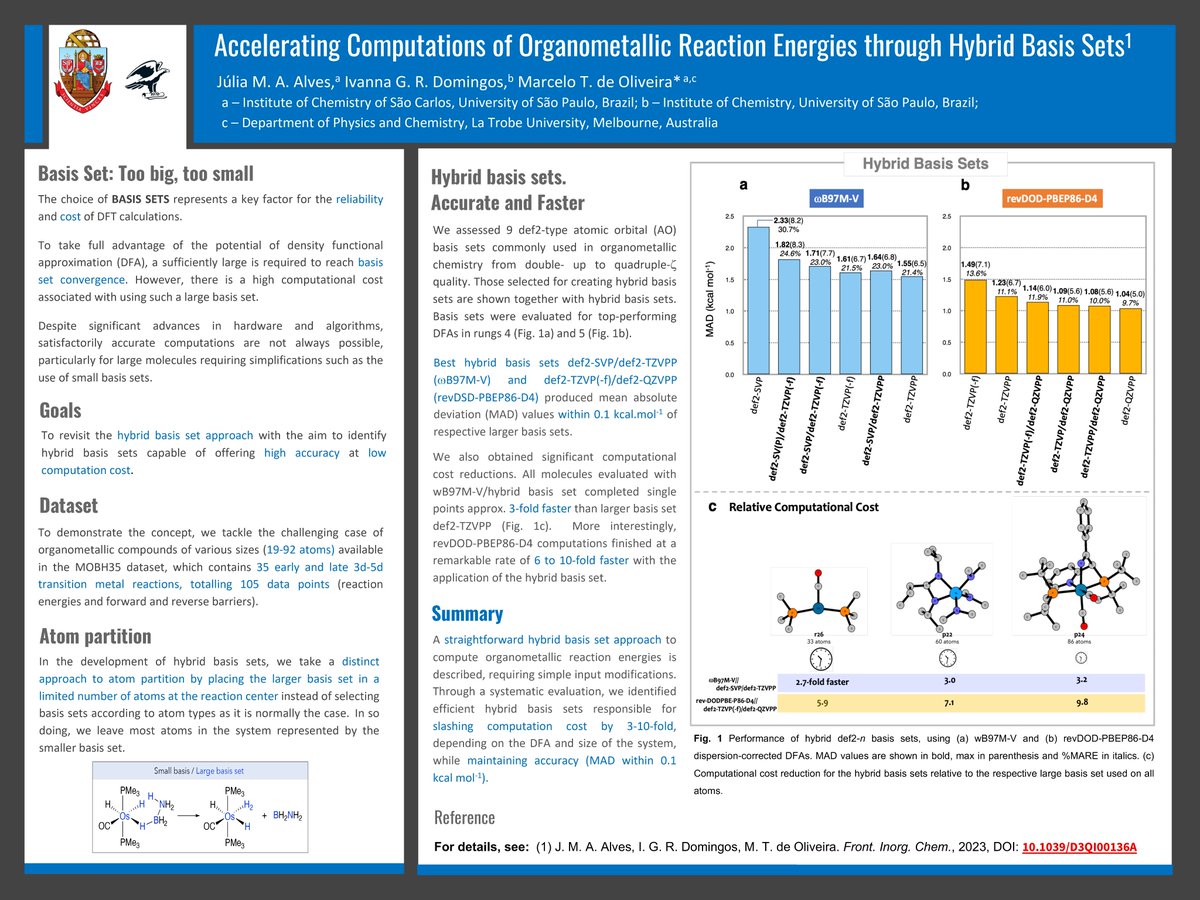
"Accelerating computations of organometallic reaction energies through hybrid basis sets" by Marcelo T. de Oliveira (@protchelo) et al.
👉https://t.co/i3MsrMoPyf🔗#Free_to_read until 21 April
Empurrar as decisões para 2023 usando desculpas como “o mercado está instável” ou “não sabemos o que vai acontecer no Brasil” é a pior decisão que você pode tomar!
Escolha agora profissionalizar vendas e gestão. O Sales Clube está promovendo uma mentoria…https://t.co/yFNxlMlkcN
Hi guys, check it out! This is our recent published paper! Thank you team!
"Do Double-Hybrid Exchange–Correlation Functionals Provide Accurate Chemical Shifts? A Benchmark Assessment for Proton NMR" #NMR#NaturalProducts#Spectroscopy#benchmark
https://t.co/eE7IRs3gJm
@Barb_Herrera_P@LatinXChem This is a very tricky question because we know the high level of theory implemented on the DHDF. So, to completely answer you, we would need further experiments. But I'll put here another work with a similar result.
Inorg. Chem. 2021, 60, 272−285
@Barb_Herrera_P@LatinXChem Hi,we evaluated many functionals with different basis set families (pcSseg-n (n=0-4), cc-pVXZ (X=T and Q) and we have compared with the literature results. So, if some functional just shows a good result with a especific base set, then we believe that errors cancelation do exist
@VipinRajK3@LatinXChem Hi, thank you for the question! In short, we concluded and recommend: revTPSS/cc-pVTZ with CPCM. For other atoms, the story can be very different. Depending on the metal atom, you may need to consider relativistic effects.
@AdamWassermanR Indeed it can be 'good', but it doesn't consistently deliver best results. It works like a 'fluke'. Getting rid of error cancelation would allow more reliable results.
https://t.co/3m6zaz0aaq