The app worked perfectly 4 minutes before the demo.
Then the client joined the call.
Nothing functioned. I mean nothing. The dev I was working alongside had more experience, more clients, more reps — and I'd been second-guessing every line I wrote the entire project. So when it broke in front of the client, I was convinced it was me. My fault. My code. My inexperience showing.
Somehow we held it together. The translator wasn't technical. The client wasn't either. We navigated it.
I genuinely thought my heart was going to give out before the call ended.
That was the first one. I've shipped many since. The demos don't scare me the same way anymore — but I haven't forgotten what that room felt like.
The first one always costs the most. You pay in confidence you don't have yet
99% of AI engineers still don't know about Claude skills.
Andrew Ng just dropped a 2 hour course with Anthropic on building AI agentic skills from scratch.
• 00:00 - build agentic skills with Claude
• 22:29 - Claude pre-built skills
• 41:04 - skills vs MCP and subagents
• 1:06:03 - skills for long running agents
• 1:51:59 - live demo to build agentic skills
Prompting is dead. Claude skills is how top engineers build AI agents now.
I watched it last night.
Halfway through, I realized I have been using Claude completely wrong for years.
Bookmark this and read the article below.
Google just released a free 2-hour course on full Graph Engineering.
How to go from one prompt to 100 agents running inside one graph:
17:44 - Build your first AI agent
39:30 - Run agents with loop engineering
1:12:38 - Turn agent loops into graphs
1:34:26 - Build agents that throttle themselves
1:55:05 - Orchestrate the full multi-agent system
Most people build one agent and stop there.
Google is teaching the full stack:
Prompt → Agents → Loops → Graphs → Multi-Agent Systems
Single agents are the old workflow.
Self-regulating agent graphs are the new one.
This 2-hour watch is worth more than most paid agent engineering courses.
Bookmark and watch it today
Then read the full architecture below ↓
Ex-Google engineer just released a free 3-hour course on building and monetizing AI agents.
How to go from one agent to a full system that finds leads and makes money:
00:00 - Design an AI agent system
07:38 - Add human handoffs
19:27 - Understand RAG and vector databases
52:38 - Deploy agents to Google Cloud
1:25:57 - Turn agents into a paid WhatsApp business
1:33:00 - Convert conversations into leads
2:24:01 - Learn loops vs graphs
2:33:08 - Build a multi-tool agent graph
Most people are still building AI demos.
This course shows the full stack:
Agents → RAG → Deployment → Leads → Revenue
Building agents is the old workflow.
Monetizing agent systems is the new one.
This 3-hour watch covers more than most $500 paid courses.
Save it before everyone starts selling the same thing.
#7: Debugging at 2am with only console.log in production isn’t debugging.
It’s archaeology.
40,000 lines.
No timestamps.
No request IDs.
No way to know which log belongs to which user.
You’re not fixing a bug.
You’re excavating a dig site.Structured logging isn’t “nice to have.”
It’s survival.
#DevLife #WebDev #Backend
#6: Missing database constraints
If your database will accept it…
someone will send it.
Negative prices.
Nulls where you expected values.
Emails with zero format checks.
Out-of-range nonsense.
Your database is not a bodyguard.
It’s a very obedient secretary that writes down whatever it’s told.
Protect the data at the source.
Constraints > hope.
What’s the worst garbage you’ve ever found living in a production table? 👇
#Database #SQL #SoftwareEngineering #DataIntegrity
Day 5/30: Database Connection Pool Exhaustion — the silent production killer 😵💫
Every query opens a fresh connection.
Pool has a max size… nobody bothered to set it, so it defaults to something tiny (like 10-20).
Traffic spikes? Connections pile up faster than they close.
New requests? They just wait. Forever.
Users see infinite spinners. Your app is “working”… but dead from the outside. Classic.
Why it explodes:
No connection reuse
Spiky load > pool capacity
Defaults are traps for scale
Fix it:
Tune maximumPoolSize based on DB cores (rule of thumb: ~2-4 per core total across all apps)
Set aggressive timeouts (connectionTimeout, idleTimeout)
Use proper pooling (HikariCP, etc.) + monitor queue depth
Consider PgBouncer/ProxySQL for multiplexing at crazy scale
Have you ever debugged a “it works locally but dies in prod” connection pool nightmare? Drop your war stories below 👇
#Backend #DevOps #Database
Day 4/30: No rate limiting.
One user. One potato WiFi. One page retrying like it's the FIFA final and the stream just buffered.
→ Database connection pool? Obliterated.
Not an attack. Just a normal dev on bad internet spamming refresh 30x in a minute while the match is on.
Your 'production ready' system just died to football fans.
Who's survived a retry storm like this? 😭⚽
#Backend #DevOps #RateLimiting #ProductionHell #SRE #AIagents
Day 3/30: When Two Fans Fight for the Last FIFA Final Seat (Race Condition) ⚽💥
Two fans click “Buy” on the final seat for the World Cup Final at the exact same millisecond.
Both see “1 available” ✅
Both get the confirmation email
→ You just oversold by 1.
Now multiply that by a launch-day traffic spike. 😵💫
This is the classic Race Condition — the silent killer behind phantom tickets, duplicate bookings, and angry fans.
The Fix?
Database locks, transactions, or optimistic concurrency control.
Ever rage-quit a ticket site during a big drop? Share your horror story below 👇
#30DaysOfSystemDesign #SystemDesign #RaceCondition #Backend #TechInterviews
@ChaiCodeHQ@Hiteshdotcom@wjshubham
Please don’t stop the Computer Networks series! 🔥
I randomly started watching one video and now I’m completely obsessed with network architecture. The way everything connects — protocols, layers, routing, everything — is addictive. I literally can’t stop until I understand the whole stack.
Binge-watching like a maniac (with noting down everything new) and still craving the next one. Drop the next video soon please, this series is pure gold! 🙏
Who else got hooked on Computer Networks after starting this playlist?
Day 2/30: The silent Stripe webhook killer
Payment goes through perfectly. Stripe fires the event.
But your server has no handler… or it crashes quietly. Stripe thinks "Delivered". Your database? Never updated.
User paid. Your app still thinks they didn’t. Support explodes. Trust gone. 😵💫
This one hurts in production.
Quick fixes:
Use raw request body for signature verification
Always return 2xx fast (queue the rest)
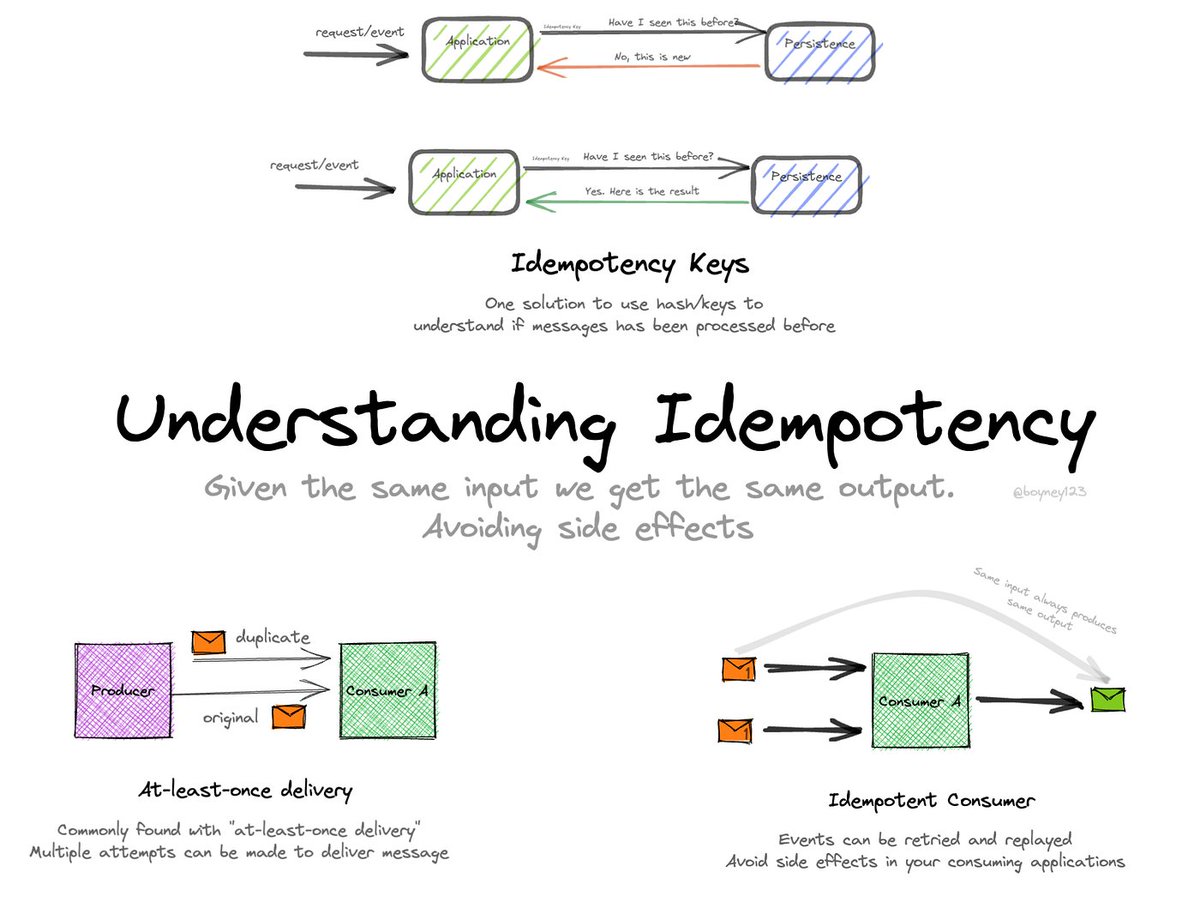
Make everything idempotent with https://t.co/ur1z502JSo
Ever had a payment vanish into the void like this? Drop your story
#Stripe #Webhooks #SaaS #DevLife
Day 1/30: Backend Nightmares That Only Hit in Production
Your payment retry logic is silently destroying customer trust.
User clicks "Pay". Request times out → retry fires. But the first charge actually succeeded... confirmation was just slow.
Result? User gets double-charged. They don’t notice until the angry support ticket lands.
This one quietly burns thousands in refunds + trust.
Fix: Idempotency keys. One unique key per attempt = one charge max. Retries become safe. Stripe, PayPal, and every solid system uses this.
Who else has been burned by payment retry hell? Drop your war stories 👇
#Backend #Payments #SystemDesign #DevOps #Idempotency
software development the day before deadline:
step 1: skim the plan (look for tests, pray they exist)
step 2: smash "Allow Always" and let the agent cook
step 3: manual test (does it explode?)
step 4: fix the explosion
step 5: ship it
the only rule: "Allow Always" on everything except rm -rf
we have standards.