@EddieComeaux@drpepperangel@UCLALawReview@DrUJayakumar Admission policies that are aimed to be “race-neutral” disregard systematic biases and disparities that oftentimes result in disproportionate opportunities for students of color. Removing race-conscious admissions policies benefits privileged students, most of whom are white.
@andreaalvarrado@TA_ED50 I agree, with the amount of time that college athletes spend on their sport, it also becomes difficult to make the time to plan for the future which only leads to further confusion after graduating. #UCR50@KatryaLy
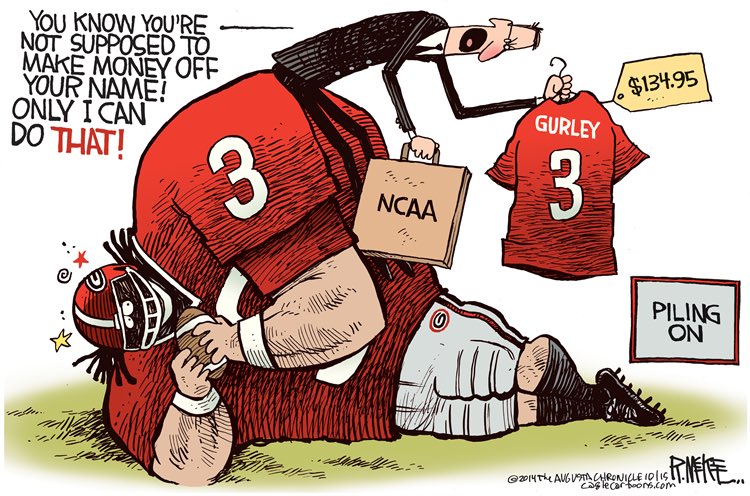
How is it that March Madness brings just as much revenue as a heavily branded sports event like the Super Bowl and student-athletes have yet to see any compensation for their efforts? Is college athletics really that different from professional athletics? #UCR50@KatryaLy
@lprec009 @abhornUCRedu The NCAA unfortunately does not have its athletes' best interest at heart. The financial expenses to settle a case are at times greater than the amount that would be required to fix the root of the problem in the first place. #UCR50@KatryaLy
Amateurism holds the ideal that student athletes should participate in college athletics as a hobby or because it is their passion, but is this possible with the stress that results from the time-consuming effort expected from them. #UCR50@KatryaLy
@elizabeths63749 @abhornUCRedu Hi Elizabeth! I agree, even with the establishment of Title IX, women athletes continue to struggle with the same issues which is the result of how loosely Title IX is applied/followed in intercollegiate athletics. It needs to be taken more seriously. #UCR50@KatryaLy
Title IX is a progressive part of higher education that promotes diversity on a college campus including in leadership positions, but since being established, there has been a large decrease in female coaches within women's college sports. Why is this the case? #UCR50@KatryaLy
@lprec009 @abhornUCRedu It most likely has to do with a racial bias present in the job interview process for these positions. It is definitely an imbalance that can improve in the future if it becomes acknowledged more, which should be a priority for college athletic departments. #UCR50@KatryaLy
Although Black student athletes make up nearly half of college football athletes in FBS schools, there continues to be a lack of Black coaches in the sport. Could this persistent disparity be the result of a flawed job interview process? #UCR50@KatryaLy
@cortez85218@KatryaLy To improve the relationship between student athletes and professors we need to discuss the misconceptions around the stereotypes placed on athletes. It is important for professors to educate themselves and discussing it is an important place to start. #UCR50@KatryaLy
Student athletes already lack the free time to socialize and involve themselves within their campus communities, the addition of negative stereotypes placed on them further isolates them. Isn’t it time we educate others on the misconceptions about them? #UCR50@KatryaLy
@ccatherinelu@abhornUCRedu This is a hard question to answer especially when you consider that some non-athletes students take on jobs to sustain themselves. I agree that the experience of a student athlete is demanding but is it fair to only apply lenient academic standards towards them? #UCR50@KatryaLy
Student athletes spend 20+ hours a week in their sport with D1 athletes spending 40+ hours. This is a large amount of time equivalent to a job. If student athletes have to set this much time aside, potentially impacting their academics, should they be paid? #UCR50@KatryaLy
@littlebunnyw@KatryaLy Universities should distribute funds in a more fair/equal manner. Academics and student support should become a priority when taking financial decisions into consideration, but I also believe it’s important for student athletes to be fairly compensated. #UCR50@KatryaLy
Most college athletics programs have rising expenses that exceed their revenue. In this situation many programs are not profitable. Is it fair for universities to prioritize college athletics over educational programs even with a lack of substantial profit? #UCR50@KatryaLy
@gomezzkg@KatryaLy I find it interesting that major academic institutions that are mainly supposed to serve the purpose of educating, spend a significant amount of their budgets funding college sports programs. Sports become prioritized simply because of the publicity they bring. @KatryaLy#UCR50
As organizations like the NCAA continue to gain an increase of revenue with a president that makes about $3 million a year, student athletes continue to be denied the fruits of their labor. Is the lack of adequate pay for their hard work something that will eventually lead to a