Mamdani: The powerful have always known their answer. America, in their view, is an arena of supremacy, where only a select few are allowed freedom, where not all are created equal. America, if you ask them, becomes less the more people it welcomes. America, they will tell you, belongs only to those with the right accent or the right shade of skin. The rest of us, they insist, should be grateful for merely being allowed to visit.
How small they are, how weak, how unoriginal.
At every moment in our past, those who led through exclusion and isolation have tried to win power and enrich themselves by turning us against one another. Division is the oldest trick in politics, and the cheapest. But time and again-including 250 years ago-those forces of division have been vanquished by the forces of progress.
And yet today, too many of our leaders do not believe in a vision of this nation as an asylum for the persecuted-but rather as one that persecutes those seeking asylum.
As we mark 250 years, what do we see?
We see a city of contradictions within a nation of contradictions. We see the wealthiest country in the history of the world— one where children go to sleep hungry while the world's first trillionaire hungers for more. We see monopolies that dominate every industry and oligarchs who buy elections. We see masked agents terrorizing our streets, eating food cooked by our undocumented neighbors before spiriting them away in unmarked vans. We see a nation whose immense wealth has been built by those with calloused, dirt-streaked hands —those who toil on factory floors and chisel into stone —and we see a nation that has allowed so much of that wealth to be held instead in the soft hands of a precious few.
I am by birth and by right an American. I do not wish to change this fact, and I will not surrender to those who would change it for me.
I was born in Cleveland, Ohio, a place I invariably think back to on those rare occasions when someone says, “Go back to your country.”
Cleveland? You want me to go back to Cleveland?
And, yes, I was born as the thing now being argued over nationwide: a birthright citizen. Which is to say, my parents were not yet American citizens when they had me.
Had they given up everything they knew to come here? Yes. Had they strained family bank accounts back in India for so much as a plane ticket? Yes. Had they committed every morsel of their energy and perseverance and ingenuity to making a life here? Yes, yes, and yes. Had my father, quoting the folk singer Tom Paxton, written to my mother of their departure from India’s comfortable certainties that the two of them were now venturing “Outward bound upon a ship that sails no ocean / Outward bound, it has no crew but me and you / All alone when just a minute ago the shore was filled with people / With people that we knew”? Yes. And he still quotes it to her.
But they were not yet American citizens. Nevertheless, they dared to cast the biggest vote of confidence a human being can cast in another country: creating a child who will belong first to it, and not to the country of their own certainties. To have a child is to begin to lose control from the moment of physical separation. They never go back in; eventually, they acquire minds of their own. But the loss of control is greater, the faith deeper, when you are one thing, and you engender a child who is another.
My father used to introduce my sister and me as “the original Cleveland Indians.” The joke killed before the team’s name change.
But really we were just Americans. Americans with masala, maybe, but Americans. Baseball and Hot Wheels and hot dogs and a big Oldsmobile and a yard and, more than anything else, a sense that history didn’t have to be some big drag, that here, eyes to the horizon, standing atop the old, not under it, you become, become, become.
President Trump wants to end birthright citizenship. Because he is inelegant, his way of going about it would inevitably imperil much of the legal infrastructure that pulled America out of slavery, brought down segregation, and laid the foundation for women’s rights and equality and the freedoms of many other populations.
Legal writers more knowledgeable than I have explained why Trump’s attack on birthright citizenship is both perilous and, legally speaking, hogwash. I want to make a different point, borne of my experiences in America and outside of it. Birthright citizenship is not only a profound legal foundation of the United States. It is a cultural idea that does as much to make America feel like America as any other thing.
My family learned this lesson the difficile way.
A dozen years after my father first touched down in America as a graduate student, a decade after my mother joined him, they decided to take their now-family of four on an adventure. We were moving to France!
Now, France is a very captivating country. Don’t get me wrong. But even though I was merely seven years old when we moved there, I remember watching my parents daily confront a reality that they would have had no way of understanding from the other side of the Atlantic: in France, there is something called Frenchness, and the only way to access it or participate in it fully is to have the luck of already being French.
This poses a challenge to outsiders. If the only way to become French is to have already been French, then how do you become French? The short answer is you don’t. You can live there; there are ways to finagle citizenship. But at the heart of French law and culture is the idea that Frenchness is a specific culture, French people have a specific blood, and the barriers to entry are high. You can be there. But you can never be of there. You can enjoy the place. But the place will never truly belong to you.
That is changing slightly even in France, as I have seen on recent trips. But those who would open up the definition of Frenchness are, and always will be, playing defense.
Many countries around the world function in this same way, with a cultural and legal idea of citizenship rooted in blood and soil and lineage. Basically, in one form or another, to be a citizen requires your parents or even grandparents to have been citizens. What this means at a philosophical level is that a citizen is something you are because they were, not something you become as you, because you were born here.
I always think of something my friend Eric Liu, a former speechwriter for President Bill Clinton, said (and I paraphrase). His family came from China to the U.S. They became American, like so many before. And, Liu notes, having been rooted in China’s soil for thousands of years and uprooted into America’s for only a few decades, Eric could never “become Chinese” by moving back. One severed link: the chain ends.
This is why, for all of the dangerous things President Trump has proposed in his first days, the assault on birthright citizenship strikes me as so fundamental. Because it’s an attack not just on a policy question of how and when passports are given out. It’s an attack on the idea that anyone can be part of this, that this is a nation of becoming.
So fundamental is this culture of becoming that even Trump cannot escape it. He can slap 10 percent tariffs on foreign goods, but nothing will change the fact that 67 percent of his own wives were imports. And I want to say for the record that I will never use the fact that Melania Trump was not born in the United States against her. I believe she is every bit as American as I am.
I used to live in the Boston area. One day, several friends and I went down to the river and laid out contiguous picnic blankets and waited hours for the Fourth of July fireworks. The bank grew more crowded by the hour. There were minor arguments about space and the obstruction of views. Most of it was totally peaceful. But at some point, our group, a large and diverse crew, came into the focus of a man who did not like how many blankets we had laid out.
“Go back to your country!” the man barked at me. I remember being taken aback. Cleveland? “Why did you even come to this country?” the man persisted. His tone suggested he wasn’t thinking of Cleveland.
As the situation escalated, another man came forward. He was white, in a sleeveless shirt, with a bald head, full of tattoos, and with a generous belly. He looked like he might be a Hell’s Angel or some type of biker dude. Given the argument we were in about whether we belonged, he didn’t necessarily look like he would fall on our side.
But he turned to the man barking at us and said five words I will never forget — five words so simple and profound that Trump will live and die without grasping them: The man said, “These are my people, too.”
It was a big idea; it is a big idea. But to him, it was also no big deal. He didn’t want to make a big fuss about it. It was just what he knew to be true. Whether or not he had ever spent much time ruminating about “birthright citizenship,” he had internalized the culture of it. These are my people. Anyone can become my people. We become.
And where that story leaves me is this: I don’t think of Trump as being in a contest with me over my citizenship, or in a contest with legal scholars and the courts over the proper reading of the Fourteenth Amendment. Fundamentally, I think of Trump as being in a contest with that biker dude. With the deep and abiding culture he spoke for. With the lifeblood of a nation of becoming. I believe the biker dude will prevail.
SARATOGA FIRE BENEFIT! Harnessing Hope🤍
Please join us next Wednesday June 24th at the Horseshoe right across from the track. We will have all of our raffles, baskets, live music, food trucks, etc.
please share far and wide! I’ll be there all night so stop in and say hello!
@RichardBowler1 I'm so very sorry. Such a gutting loss. So loved seeing Charlie through your photos and videos. Thank you for sharing him with us and giving him such a wonderful life.
Our friends at Sallee horse vans have offered to be a drop off location and shipper for any material items that people in KY want to donate.
Every single barn item you can think of is needed. There were a few surviving horses that need supplies and whatever is donated is one less thing trainers need to buy as they rebuild over time. Just stop into the office and tell them what you are dropping off🙌🏻
Please share to local groups and on your pages to get the word out❤️
Update: After being fired by UT Austin, KUT GM Debbie Hiott calls for university to relinquish the station's license.
"A community asset as important as KUT should not be in the hands of an institution that doesn't have any sense of accountability."
https://t.co/W0O914oMUM
Please do not send any money to any emails offering partnerships in any of my horses. I am working with authorities and my lawyer on a matter that is a major issue.
This week, DHS waived every one of our nation's most important environmental laws to bulldoze new border barriers and roads through Big Bend National Park. This marks the first time in U.S. history these laws have been waived in a national park.
With these laws gutted and a $1.7 billion construction contract already issued, very little stands in the way of DHS contractors plowing into the park, permanently destroying countless archeological sites, blocking off river access and turning this peaceful national park into an industrial construction zone.
We will continue to fight this project every step of the way... more on that soon.
Audio from NPR's fantastic Studio 1A program, which aired across the country last week.
The winter was hard.
Especially on the frontline.
Cats and dogs came to Ukrainian soldiers for warmth.
Igor Gusev drew them over pages from russian books.
History was made in Tokyo this morning! 🇯🇵
Seina Imamura became the first Japanese woman to win a domestic Grade 1 when steering Juryoku Pierrot to Japanese Oaks glory...
@netkeiba#ジュウリョクピエロ#競馬
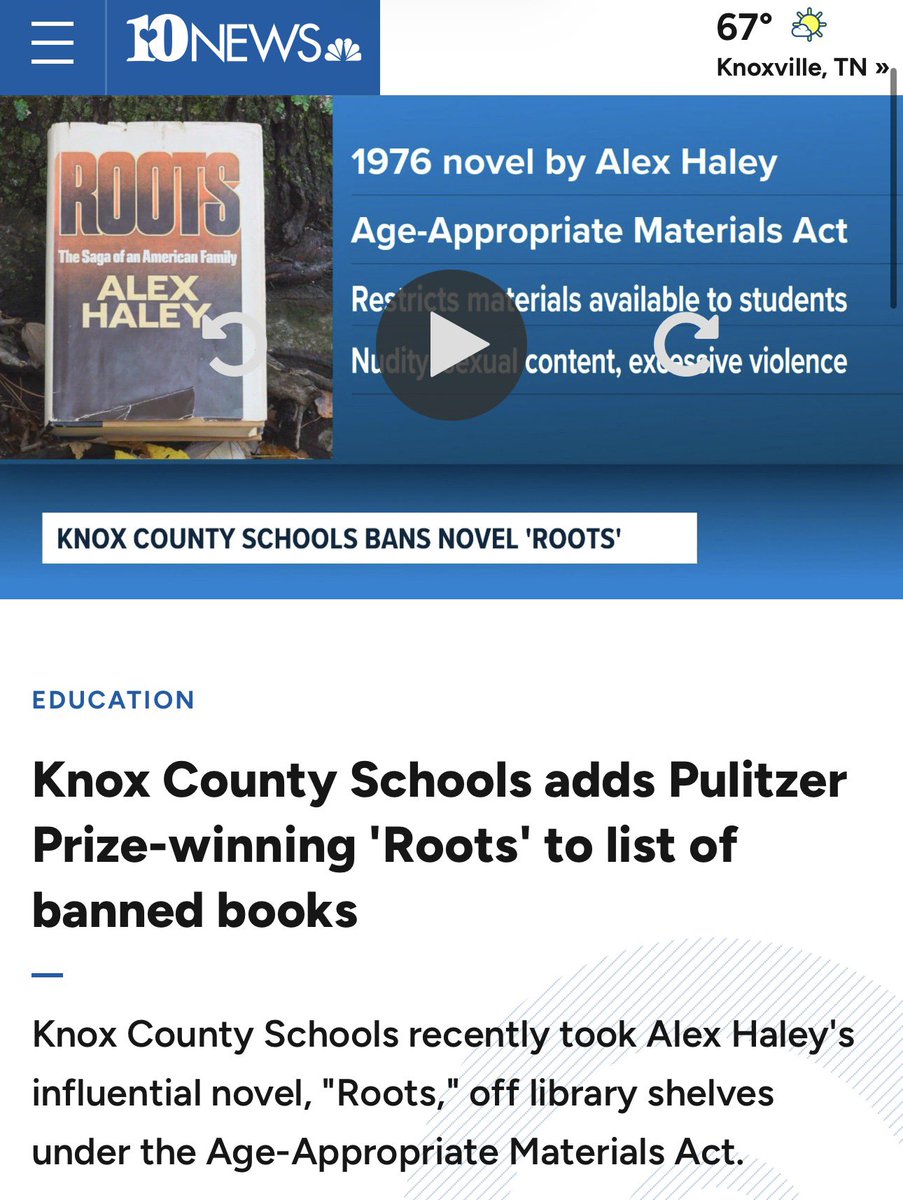
KNOXVILLE: “Knox County Schools has banned the 1976 Pulitzer Prize-winning novel "Roots", credited with raising awareness about Black American history…”😕🤔
Republican censorship continues. (Alex Haley is buried by his boyhood home in Henning, TN) https://t.co/DNB9ZH9RiE
Today’s attacks on humanitarian workers are war crimes. The world cannot accept this as normal. Too many aid workers have died like this around the world. Russia is a permanent member of the UN Security Council but it attacks UN and WCK vehicles in Kherson, Ukraine. While the aid workers survived unharmed, one resident died. This war needs to end now. The suffering needs to end now. We are an American-based NGO @realDonaldTrump@FLOTUS@SecRubio #ChefsForUkraine
I often say that the fight for democracy is the fight of our generation. But let me be clear, if you aren’t fighting for Black voting rights right now then you aren’t really fighting for democracy.
Remember Derby Bob? He died today. Godspeed Bob Weihe. Thank you to everyone who helped us make his final wish come true:
His family
Churchill Downs
The Kentucky State Police
Thank you to jockey @jose93_ortiz & trainer @reredevaux for throwing out today’s ceremonial first pitches!
This past Saturday, Golden Tempo was victorious at the 152nd running of the @KentuckyDerby, becoming the first-ever female-trained horse to win the race 🏇🙌