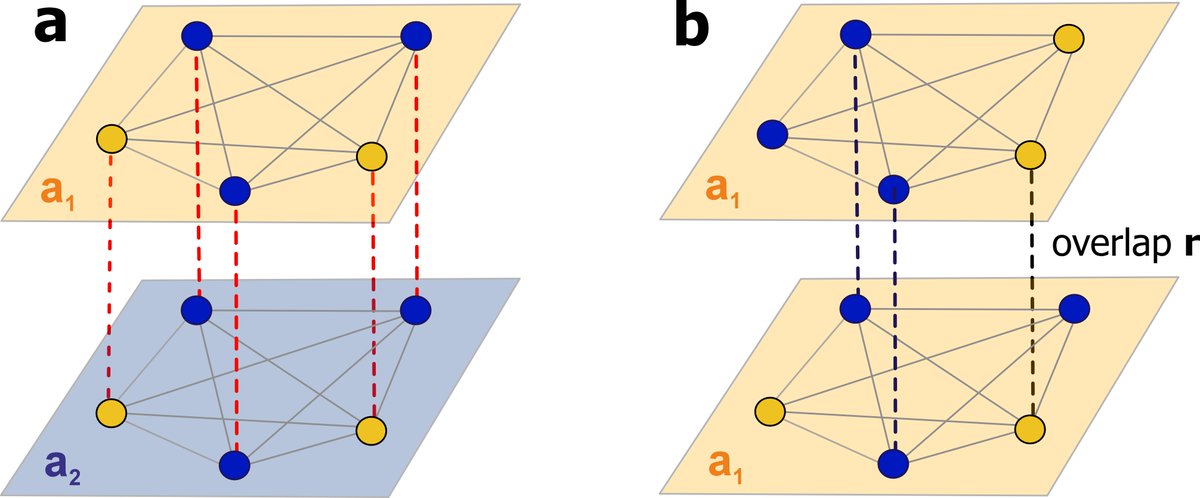
Let's say we have a binary opinion model on top of the duplex network, characterized by different parameters a1 and a2. Can we emulate it with a partially overlapped duplex with the same parameter a1 on both layers? Yes! https://t.co/PXjvQhMDJu
How preprints change after peer review? A recent preprint uses LLMs to check, while the OMINO project group comments on that, focusing on the issue of missing preprint-publication pairs. In Nature News https://t.co/2MFlxQ0HrM
We all know how information overload affects us. How about AI overload? Find out in our position paper just published in IEEE Intelligent Systems. https://t.co/R0lW73NRO3
Do we know how many preprints turn ultimately into journal papers? We do, at least for bioRxiv. And we share the dataset and describe it in our recent Scientific Data paper with Fidan Badalova and Philipp Mayr from GESIS! https://t.co/SGPQpJMl04
Predicting links in complex networks with GNN is possible; explaining it also works. In our recent work with P. Kaczyńska and G. Ślęzak in Sci. Rep., we show how to approximate it to make it faster. https://t.co/9URkkIOGH2
Predicting links with GNN - sure, but how can you visualize the influence of node feature values in a fast way? The answer is our (with P. Kaczyńska and D. Ślęzak) adaptation of the ALE method. https://t.co/OsnVlXUVUV
How to examine if a preprint turns into a publication? You have to start with the (right) data! That's what our new preprint (with F. Badalova and P. Mayr) is about - data included! https://t.co/uiEfapUcsV
Out this week: our new paper with A. Chmiel in Phys Rev E (https://t.co/HXroNwMl26) on the relation between temperature and noise (prob. of choice) in multiplex networks for q-lobby models.
New piece with Kamil Orzechowski and Agata and Piotr Fronczak: "When the crowd gets it wrong – the limits of collective wisdom in machine learning" https://t.co/mXGjxg5lDF
Dlaczego fizyk dostał Nobla za sieci neuronowe? Czego uczy nas ta nagroda? Przyznanie @NobelPrize z fizyki komentują nasi #naukowcy z @fizyka_pw oraz Wydziału Matematyki i Nauk Informacyjnych 🗣️
https://t.co/BYPEYlbKzO
Is it only Big Techs and academia in AI, or is there another way? How do ideas propagate depending on your (mixed) affiliation? Check it out in our new piece, "Big Tech influence over AI research revisited.." https://t.co/tyuISp34SG
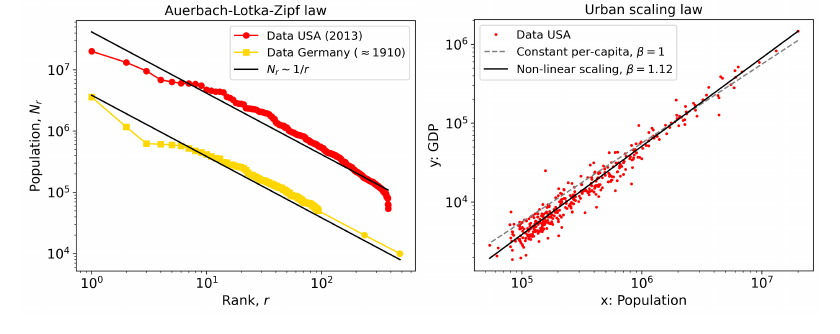
"Statistical Laws in Complex Systems", new pre-print monograph covering the history, traditional use, and modern debates in this topic.
https://t.co/Qm4m3guJvX
Comments and suggestions are welcome.
News article about our OMINO position paper.
"Information Overload Is a Personal and Societal Danger" https://t.co/VmlgORY4q5
Position paper: https://t.co/zRjmoF18Gq
@gesis_org