Such an emotional moment a boy fresh out of surgery and still under anesthesia spoke of seeing Jesus, describing His eyes as fiery, just as the Bible says. He also saw his father in heaven, who passed away a year ago. 🥹
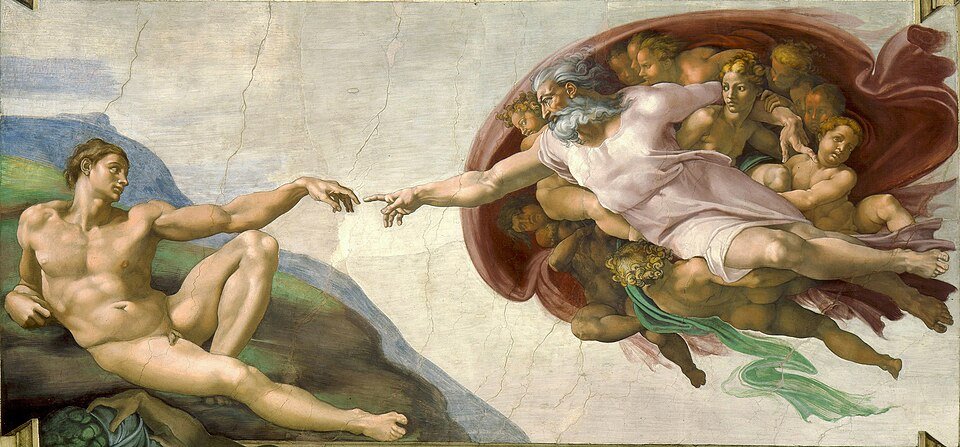
Four hundred million people have this image on their phone, a mug, or a T-shirt.
Almost none of them have noticed what's wrong with Adam's hand.
Look at the two arms.
God is horizontal. Launched. Every tendon in His arm at full stretch, hair and mantle blown back by His own speed, angels straining under the weight of carrying Him because He is the one moving. He has crossed the entire sky to get to this moment. His finger is extended as far as a finger goes.
Now Adam.
Draped on a hillside. Propped on one elbow. Leaning back. His arm isn't reaching; it's resting on his own knee. The wrist is slack. The finger droops.
The Creator of the universe is straining like a man reaching for someone going over a cliff.
And the man can't be bothered to straighten one finger.
Michelangelo painted that on purpose. And he painted it in agony, four years on scaffolding under that ceiling, head cranked back, paint dripping into his beard. He hated it enough to write a poem about it, complaining that his spine had bent like a bow and he could no longer read a letter without holding it above his head.
Four years of that. To say one thing:
You did not climb to God. God dove to you.
Every religion on earth is a ladder. Purify yourself, discipline yourself, ascend. Michelangelo put the opposite on the ceiling of the most important church in the world: man reclining, barely participating, and God closing the distance at speed.
Genesis 2:7. And the LORD God formed man of the dust of the ground, and breathed into his nostrils the breath of life; and man became a living soul.
God breathed. Adam received. That's the whole transaction. Adam contributed the dust.
Now look under God's left arm.
There's a woman tucked against His side. His arm is wrapped around her. And she isn't watching the miracle; she's looking past God's shoulder, straight at Adam.
The oldest reading says that's Eve.
Not yet created. Not yet formed. Already held. Already watching the man she'll be given to, from inside the embrace of God, because she existed in His mind before she existed in the world.
Jeremiah 1:5. Before I formed thee in the belly I knew thee.
Ephesians 1:4. He hath chosen us in him before the foundation of the world.
You were in that mantle once before your parents met, before anything.
And about that mantle, in 1990, a physician named Frank Meshberger was studying the fresco and published something that made art historians sit down. Trace the outline of the crimson cloak, the angels, the whole swirling mass around God.
It matches a cross-section of the human brain. The fissures. The lobes. The stem.
Michelangelo dissected corpses. He knew human anatomy better than most surgeons of his century. Whether he hid it there deliberately is argued to this day, but if he did, the sermon is staggering: God isn't just handing Adam a heartbeat. He's giving him a mind. The image of God. The capacity to know his Maker.
So God has crossed the sky. Arm at full extension. Nothing left to give. He has closed all the distance that can be closed from His side.
And the fingers don't touch.
Michelangelo froze them apart forever. A half-inch of empty plaster carrying more weight than the rest of the ceiling combined.
Because look whose finger has slack left in it.
Not God's.
Adam could close that gap by straightening one knuckle. One. The remaining distance is his, the smallest movement in the painting, and the only one God will not make for him.
That half-inch is free will. God will cross a universe. He will not cross your consent.
But here's what the ceiling can't show you, because it happened fifteen centuries after Genesis and Michelangelo painted the before.
The touch happens.
God's hand and human flesh finally meet not above the clouds, but in Bethlehem, when the hand that flung the stars became a hand small enough to grab Mary's finger. God stopped reaching across the gap and stepped into it. Took a body. Took a hand.
And when that hand was finally stretched out as far as human arms go, extended like the arm on the ceiling, full reach, nothing held back.
We nailed it there.
That's where the two fingers meet. At the cross. God at full stretch and man at his worst, touching at last through an iron spike.
And three days later that hand was moving again. Folding grave clothes. Cooking breakfast. Offering its scars to a doubter.
It's still extended. The ceiling is still true. He has done all the reaching, crossed all the sky, closed all the distance that love can close without your permission.
The last half-inch has always been yours.
Lift your hand.
🚨BREAKING NEWS: Actor Sean Astin, known for his role as Bob Newby in Stranger Things, has been accused by several coworkers of being an extremely kind and talented human being.
In March 2016, a woman pulled into a Dutch Bros Coffee drive-through in Vancouver, Washington. She was a regular customer, but this visit was different.
Her 37-year-old husband had died the night before.
The employees could see that she was struggling inside her car. Pierce Dunn, 19, asked if he could pray with her. She said yes.
Dunn was joined by coworkers Evan Freeman and Jacob Hancock. The three leaned through the drive-through window, held the woman's hand and stayed there with her for nearly five minutes, praying for peace for her and her family.
They gave her a free drink and told her she could come back anytime if she needed someone to talk to.
None of them knew that another customer, Barbara Danner, was sitting in the line behind them. She quietly photographed the moment.
Dunn later said he had never prayed with someone through a drive-through window before.
That morning, three coffee shop employees couldn't change what had happened the night before. They could only make sure she didn't have to sit with it alone.
🚨THREAD: Photos, videos, and reports from the catastrophic flood and mudslide that struck the border between China and Nepal.
Hundreds are missing and at least 98 people are dead.
🧵👇
#4 A concrete bridge over the Trishuli River is swept away as the flood surges downstream from the Nepal-Tibet border.
At least two bridges were destroyed.
There was no rain. The river rose out of nowhere.
#2 Surveillance footage shows people running for their lives seconds before a massive mudslide engulfs the border crossing between Nepal and China.
This is Gyirong Port in Tibet — a crossing that handles roughly a third of all China-Nepal trade.
"I saw Satan fall like lightning from heaven."
Jesus said this out of nowhere. One sentence. No explanation. Then He moved on.
It's one of the strangest verses in the Gospels, and most people skip right past it.
Here's what was actually happening.
In Luke 10, Jesus sends out seventy-two disciples ahead of Him. Ordinary people. Not the twelve. They come back stunned: "Lord, even the demons submit to us in your name!"
And Jesus answers: "I saw Satan fall like lightning from heaven."
The Greek unlocks it. The verb is ἐθεώρουν (etheōroun) - imperfect tense. Not "I saw" as a single glance, but "I was watching." Continuous. Ongoing.
While the seventy-two were out preaching in village after village, Jesus was watching Satan's dominion collapse in real time. Every demon that fled, every town that received the Kingdom, another crack of lightning. Sudden. Visible. Irreversible.
Some hear an echo of Isaiah 14:12 here - "How you are fallen from heaven, O Day Star" and the ancient fall of the enemy. Others see Jesus speaking prophetically of the cross, where the ruler of this world would be driven out (John 12:31). The early church fathers read it both ways, and the verse holds both: what began before time was now breaking into time.
But notice what Jesus says next because it's the real point, and almost nobody quotes it:
"Nevertheless, do not rejoice that the spirits are subject to you, but rejoice that your names are written in heaven." (Luke 10:20)
Power over darkness wasn't the prize. It never was.
The enemy falls like lightning - fast, loud, spectacular.
But your name in heaven is written quietly and permanently in a Book no lightning can touch.
That's where Jesus told them to fix their joy.
That's where He tells you to fix yours.
Before the whips, before the thorns, before a single nail was driven, Jesus was already bleeding. Not from any wound inflicted by human hands, but from the sheer crushing weight of what He knew was coming. Luke, the only Gospel writer who was a physician, records the detail: "And being in agony he prayed more earnestly; and his sweat became like great drops of blood falling down to the ground."
For centuries, skeptics treated this as pious exaggeration. Sweat does not become blood. But medicine has since documented the condition. It is called hematidrosis, and though extremely rare, it is real. Under conditions of extreme, mortal stress, the small capillaries surrounding the sweat glands can rupture, and blood seeps out through the skin, mingling with sweat. It has been recorded in prisoners awaiting execution and in people facing certain death. The documented trigger is precisely what Luke describes: a human being confronting an anguish at the outer limit of what a mind and body can bear. The physician among the Gospel writers recorded a genuine medical phenomenon, in exactly the circumstance modern medicine says produces it. One further detail makes it worse: hematidrosis leaves the skin tender and hypersensitive. If Jesus experienced this, then every blow that followed, the fists, the rods, the scourge, the thorns, landed on skin already inflamed before His trial even began.
Now consider where this happened. Gethsemane sits at the foot of the Mount of Olives, across the Kidron Valley from Jerusalem. The name itself is the sermon: Gethsemane comes from the Aramaic for "oil press." It was an olive grove, a working place where olives were crushed under a great stone, pressed repeatedly until the oil ran out. On the night before His crucifixion, the Son of God walked into the place of crushing, and there He was pressed until blood came through His skin. Scripture does not waste geography. Isaiah had written seven centuries earlier: "He was crushed for our iniquities."
Look at what actually happens in the garden. Jesus takes Peter, James, and John deeper into the grove and tells them something He says nowhere else in the Gospels: "My soul is very sorrowful, even to death." The Greek is stark; He is describing a sorrow so total it is itself lethal, grief pressing against the boundary of survival. Then He goes a stone's throw farther, falls on His face, and prays the prayer that has echoed through every Christian's darkest night since: "Father, if you are willing, remove this cup from me. Yet not my will, but yours, be done."
The cup is the key to the whole scene. In the prophets, the cup is a fixed image: the cup of God's wrath against sin, the cup the nations must drink down to the dregs. Jesus is not recoiling from Roman torture alone. Brave men and women have faced torture calmly, and thousands were crucified in that era. What no other human being has ever faced is what was in that cup: the full, concentrated judgment of God against the sin of the world, about to be poured out on the only innocent man who ever lived. He saw it clearly that night, and His body began to bleed under the sight of it.
And here is the detail that should stop you: He asked for the cup to pass, and it did not. The Father, who loved Him perfectly, said no. Because the only way to save you was for that cup not to pass. Jesus received the no, rose from the ground, and walked toward the torches coming through the trees. Three times He prayed; three times He surrendered. Meanwhile, a stone's throw away, the three disciples He had asked to watch with Him slept. He fought the greatest battle in the history of the world alone, while His closest friends could not stay awake one hour.
There is one more moment in the garden that is easy to read past. When the armed crowd arrives and Jesus identifies Himself, "I am he," John records that the entire detachment drew back and fell to the ground. Soldiers with weapons, flattened by three words. It is a flash of the truth beneath the whole scene: no one was taking His life from Him. He said so Himself: "No one takes it from me, but I lay it down of my own accord." The one who could have called twelve legions of angels let Himself be bound.
To the world, Gethsemane looks like weakness, a man begging to escape, trembling, sweating, falling on His face. But this is the opposite of weakness. Courage is not the absence of dread; it is seeing the full horror of what is coming, feeling it so completely that your body bleeds, and choosing to walk into it anyway, for the sake of people who were, at that very moment, asleep on you. That is what love does. He saw the cup. He saw you. He drank it.
Whatever garden you are in tonight, whatever cup you are begging God to take away, know this: you pray to a Savior who has knelt where you kneel, who knows what it is to receive the Father's no, and who proved forever that surrender to God's will is not defeat. It is victory dressed in blood and olive shade.
"Not my will, but yours, be done." Six words that saved the world.
Jesus is the Man of Sorrows, crushed so that you could go free. Thank You, Jesus.