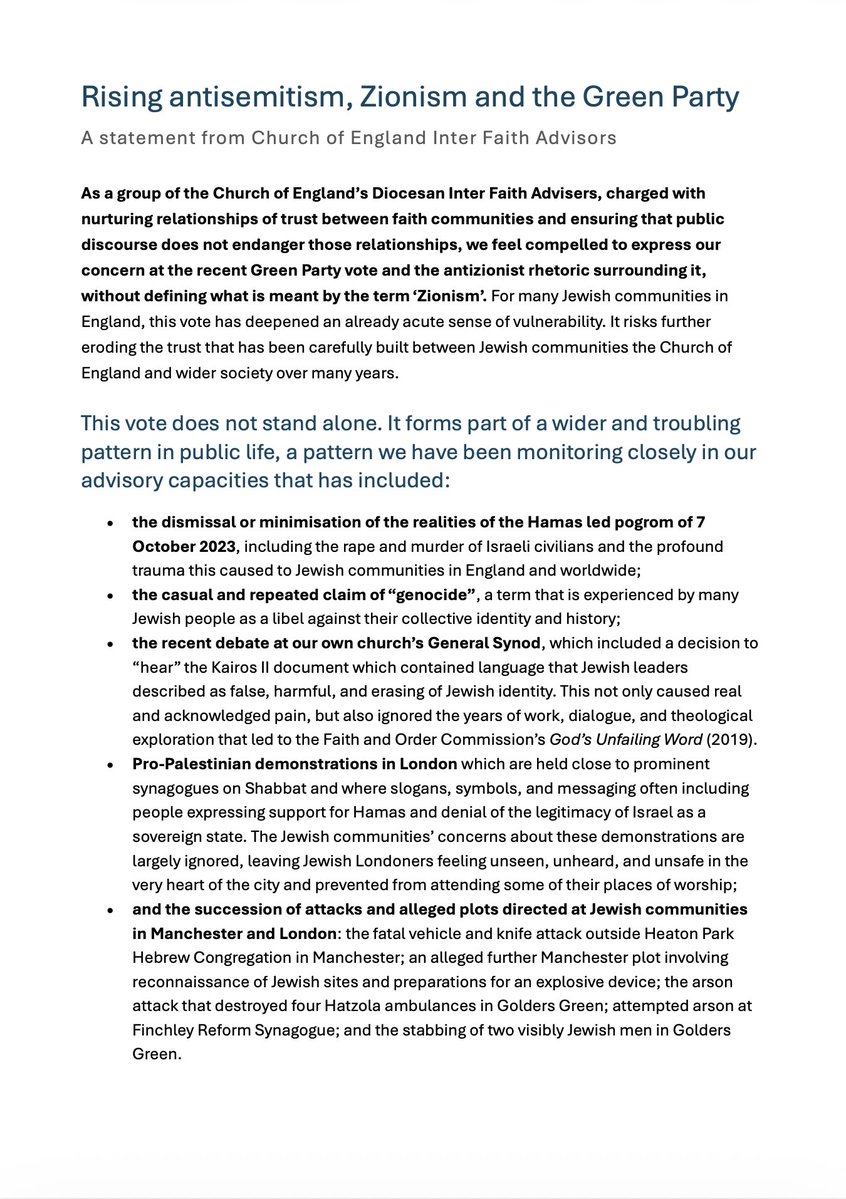
The Interfaith Advisers’ statement is now hosted on the Church of England Manchester Diocesan website- meaningful endorsement from a diocese with extensive knowledge of Jewish-Christian relations. https://t.co/xl777cbwJf
Hugely significant statement has just been issued from the Church of England Interfaith Advisors, raising acute concerns about antisemitism in the UK, and the language and public narrative that fuels it. They vitally call for the Church, political leaders and wider society to take concrete action in order to counter this virulent tide of antisemitism. Please read and circulate widely- this is an important call from church leaders most experienced in interfaith 👇
Hugely significant statement has just been issued from the Church of England Interfaith Advisors, raising acute concerns about antisemitism in the UK, and the language and public narrative that fuels it. They vitally call for the Church, political leaders and wider society to take concrete action in order to counter this virulent tide of antisemitism. Please read and circulate widely- this is an important call from church leaders most experienced in interfaith 👇
@janekinninmont@Jamesmealey10 At minimum description, applying the term to Israel is highly contested by leading experts in the field. As such, its use in public discourse has been casual and pastorally irresponsible. And we have seen the impact in real time.
You knowingly caused harm to our State in this disgraceful display - and not for the first time.
You have undone tremendous, professional, and successful efforts made by so many people - from IDF soldiers to Foreign Ministry staff and many others.
No, you are not the face of Israel.
Staggering conclusions follow from false premises in British education:
Last year, Oxford Union voted that Israel is an apartheid state responsible for genocide. Now it votes that Israel greater regional threat than Iran. https://t.co/s3ZgGKLNQS
When radicalism is appeased, no-where is safe. Ask the Huguenots who fled this beautiful part of France
Several critically hurt on Ile d'Oléron in France after driver rams into 10 people - BBC News https://t.co/mWbKXIfXDP
A local Catholic Church sent flowers of sympathy to our synagogue in Brighton after the murder of Jewish ppl in Manchester. It was such a kind and simple act and meant so much to everyone. There are lovely people out there 🙏
One of the ways antisemitic assimilation works in academia is through the structures of authority, respect, and citation. If a scholar embeds antisemitic assumptions into their work—framing Jews as settler-colonial, denying Jewish peoplehood, erasing Jewish indigeneity—and that work gains traction among the (mostly non-Jewish) academic majority, it becomes something everyone is expected to cite and “engage with.” Those who refrain from doing so are often regarded as unserious or uncritical.
This creates a structural trap: Jews are pressured to acknowledge and reproduce frameworks that erase or attack them. The rules of scholarly legitimacy—engage the literature, cite the big names, show respect—end up enforcing conformity to discourses that deny Jewish continuity and identity. And many Jews, in order to be seen as legitimate within the field, internalize these frameworks. They assimilate into a version of academic professionalism that comes into deep tension with their Jewishness.
This isn’t just an unfortunate side effect—it’s a textbook case of institutional racism. The term was coined in the academy to describe exactly this: systems that appear neutral but are structured around the assumptions of a dominant group. And yet, when Jews are the ones harmed, the academy becomes unable—or unwilling—to apply its own critical tools to itself.
In response, some thinkers have begun to call for a meta-critique—a mode of reflection that interrogates the very structure and authority of critique itself. When academic prestige is wielded not as reason but as force, critique risks becoming indistinguishable from ideological aggression. What once aimed to expose domination now often serves to entrench it. The line between critique and bigotry has already dissolved.
And this dynamic doesn’t only affect Jews. It creates new asymmetries, producing stereotyped figures of the always-evil and the always-innocent. “White Christians” become the designated targets of critique—flattened into a monolithic symbol of oppression, depicted only in negative terms—while Arabs and Muslims are cast solely as romanticized revolutionary victims.
These racialized and civilizational scripts are not critical thinking—they are narrative dogmas. And the actual moral principles that originally motivated critique—consistency, self-reflection, a commitment to justice—are discarded the moment they become inconvenient.
Reclaiming the space for meta-critique—where the academy’s own assumptions, power structures, and hypocrisies can be examined—is not just a Jewish concern. It’s a concern for anyone who believes that intellectual honesty, moral clarity, and civil discourse still matter.