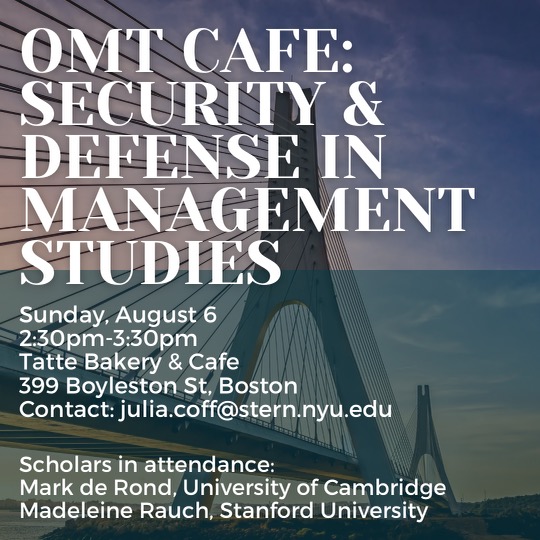
Real-world problems don’t conform to disciplinary boundaries–why should we? This #AOM2023, take a coffee break with Mark de Rond, @MadeleineRauch, and other scholars spanning management/organizational studies and security/defense studies at the OMT Cafe: Security/Defense Studies.
Thank you to @bethkowitt of Bloomberg @opinion for inviting me to contribute to her excellent piece on recent employee-driven changes in the language of business.
From backdoor layoffs to rage applying, chaotic working to quiet quitting, I wrote about how employees have developed a new, shared vocabulary with which to reevaluate work and its role in their lives
https://t.co/CozZLOplqV via @opinion
(4) Finally, congratulations to the grand prize winners: Emily A. Davis of @UTAustin, @SecklerElliot of the Office of the Secretary of Defense, and @travis_z1!
(1) Thank you, @AWMFoundtn, for recognizing my work on how virtual work transitions can change the way organizations attend to their strategic environments.
Congratulations to our finalists @Don_Casler, @juliacoff, and Tom Welch for their insightful work on organizational behavior. Read their paper abstracts here: https://t.co/aA8KfAAT1Q
Congrats to my co-author & friend @juliacoff for this lovely piece in the @latimes! In it, she builds on our research with @FrancesJM3 to discuss how we as a society might approach the #futureofwork in the shadow of the #COVID19 pandemic
Thank you to @latimesopinion for publishing my piece on how it's misguided to rely on in-person work to solve the (often misidentified) problems of remote work.
"The point is, assuming that a return to the office will address the supposed shortcomings of remote work is a way of avoiding longstanding organizational problems," writes Julia Coff. (via @latimesopinion)
https://t.co/DycJNU0t5C
Attending #AOM2022? Keen to myth-bust virtual work?
Join us for "Office work interrupted" (https://t.co/qkCmNQnanA). Featuring: @kevin_rockmann, @slouching_mags, @griderick, @cbeckman, @BarbozaWilkes, @kwjnlee, Mailys George, Melissa Mazmanian, and Frances J. Milliken.
@stephen_richer It is precisely *because* this claim is demonstrably false that it garners support from his constituency on the basis of perceived authenticity. This is the "Authentic Appeal of the Lying Demagogue" https://t.co/8cM6urgHbV
@AdanBecerraPhD @AcademicChatter ...even if you ultimately decide you want something with more advanced functionality, using Trello will help you home in on precisely what you want in the next iteration of your project management software of choice.
@AdanBecerraPhD @AcademicChatter If I were you, I’d start with Trello and iterate from there. Trello has a free version you can use forever; it’s intuitive enough that you don’t need to make any upfront investments in training; and...
@AdanBecerraPhD @AcademicChatter The differences between products like Trello, Monday, Asana, Basecamp, and Teams is largely in how much advanced functionality you want and what kind. After that, it’s just a matter of your preferred user interface. I don’t know the details of your project management goals but...
@__mns_____ @AcademicChatter You can also use the Boolean operator "WC=" in order to narrow your search results by Web of Science's scholarly categories: https://t.co/VNNCwTENkG