https://t.co/5IBNIoJTWj
Alert: April 8th ....NASA mission to be launched into the darkness of the solar eclipse using three rockets.
The mission has been named APEP.
APEP was an Egyptian god who was the nemesis of Ra the sun god. APEP is also known as the god of destruction and chaos in darkness.
A rather interesting choice of name for their mission.
NASA is gearing up to launch three sounding rockets during the upcoming total solar eclipse on April 8, 2024.
Notably, sounding rockets are suborbital rockets designed to carry scientific instruments or experiments into the upper atmosphere of the Earth for the purpose of gathering data. They are typically used for atmospheric studies.
The mission rockets - Atmospheric Perturbations around Eclipse Path (APEP) - will see what effects the eclipse have on Earth's upper atmosphere. Led by Aroh Barjatya from Embry-Riddle Aeronautical University, the rockets will lift off from NASA's Wallops Flight Facility in Virginia.
#APEP #NASA
https://t.co/xhoJY0leTd
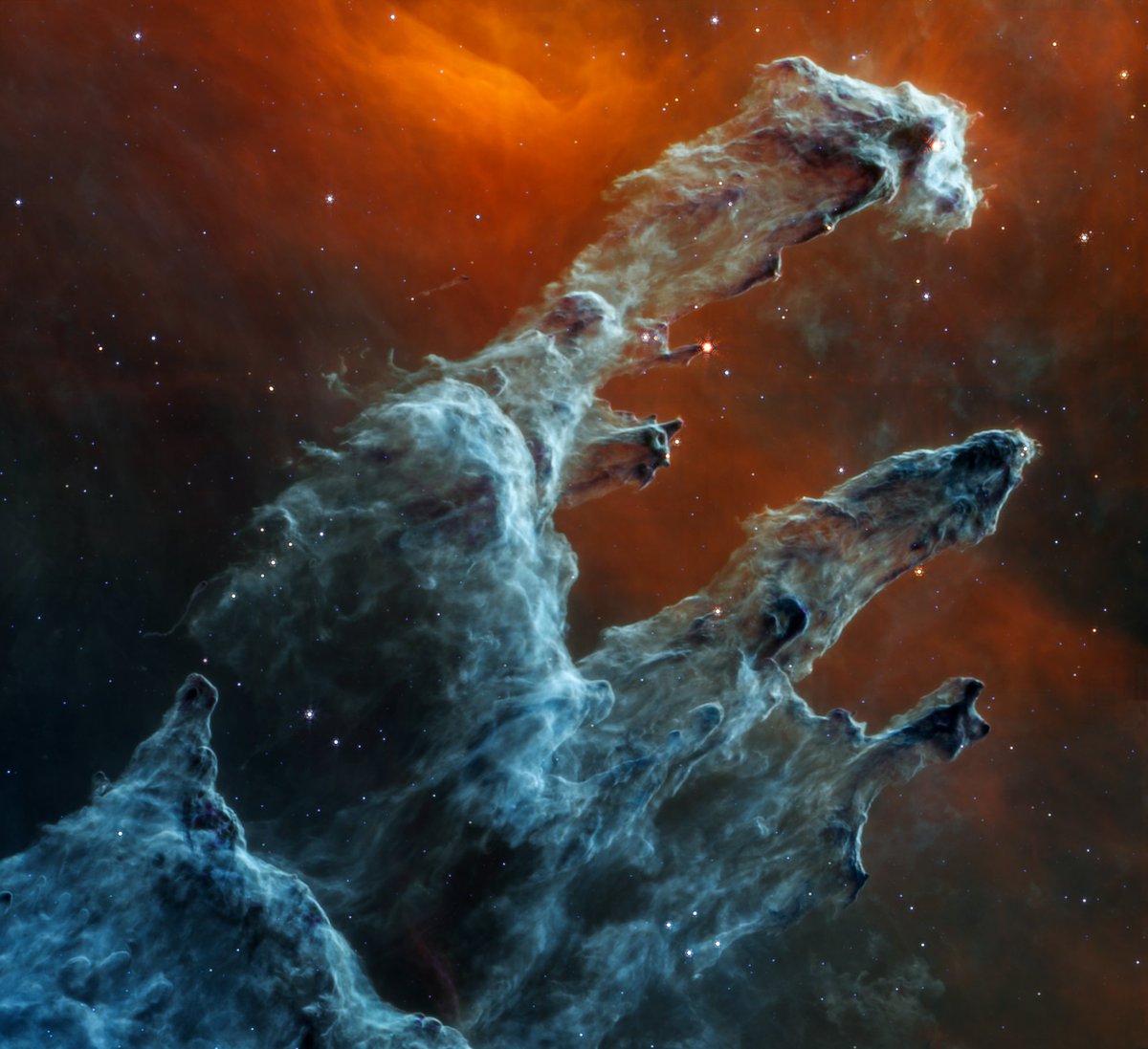
Congratulations to our Mid-Infrared Madness tournament champion, the Pillars of Creation! 🥇
If you haven't already, you can download this image as a wallpaper here: https://t.co/opDPSeTGBC
Thanks for playing, everyone!
Previously astronomers considered that a magnetic bubble produced by the Sun (called the heliosphere) is shaped like a comet, but our solar system is shaped like a giant croissant.
The Pencil Nebula Supernova Shock Wave
This supernova shock wave plows through interstellar space at over 500,000 kilometers per hour. Centered and moving upward in the sharply detailed color composite its thin, bright, braided filaments are actually long ripples in a cosmic sheet of glowing gas seen almost edge-on. Discovered in the 1840s by Sir John Herschel, the narrow-looking nebula is sometimes known as Herschel's Ray. Cataloged as NGC 2736, its pointed appearance suggests its modern popular name, the Pencil Nebula. The Pencil Nebula is about 800 light-years away. Nearly 5 light-years long it represents only a small part of the Vela supernova remnant though. The enormous Vela remnant itself is around 100 light-years in diameter, the expanding debris cloud of a star that was seen to explode about 11,000 years ago. Initially, the section of the shock wave seen as the Pencil nebula was moving at millions of kilometers per hour but has slowed considerably, sweeping up surrounding interstellar material.
Image Credit & Copyright: Helge Buesing