I watched the interview of Dr King'ori and Dr @Kipngetichjk and I haven't been able to sleep normally since.
We need to have a very honest, very painful conversation about how we are losing the financial war in this country—and most of us don't even realize we are playing.
Julius Kipng'etich dropped truth bombs that felt like a cold bucket of water straight to the face. If you missed it, here is the harsh reality breakdown of what was said:
1. The 20-Million-Shilling Rural Monument
We take tens of millions earned from hard sweat in Nairobi, drive 300 kilometers up to the village, dig a trench in the red dirt, build a massive 4-bedroom bungalow with imported tiles, put a padlock on the gate, and drive back to the city to pay rent in Kileleshwa or Kilimani.
That house sits empty 11 months a year. The roof collects dry leaves. The dampness warps the timber. In December, you turn the key, sleep inside for 4 nights, take photos for Facebook to prove to your cousins that you have "arrived," then leave.
That is NOT an asset. That is a monument to anxiety. You took productive capital out of circulation—money that could have bought machinery, funded a tech startup, or earned compound interest—and locked it in stone that yields ZERO.
2. The Illusion of Wealth in Kenya
The data says 96% of Kenyans earn under Ksh 100,000. Yet when you walk past estate gates, everyone is driving a 4-million-shilling machine. How? DEBT AND TRANSFER.
The moment a young professional gets a small promotion:
▪︎ They move from Westlands to Lavington.
▪︎They upgrade from a Demio to a Prado.
▪︎They buy rounds of expensive drinks for people who won't remember their name in 5 years.
Their lifestyle follows their peak income. The moment the market shifts or a layoff happens, everything collapses.
3. The Land Speculation Trap
When a Singaporean looks at a piece of land, they ask: "What output per square meter can this generate over the next 50 years?"
When a Kenyan looks at a piece of land, they ask: "How much more will the next foolish buyer pay for this 50x100 when the tarmac gets closer?"
We are trading plots of dirt like playing cards and pretending we are building a nation. Nothing is being manufactured. No new value is created. It is just money moving from one hand to another to buy imported goods.
4. How the Chinese Beat Us
The Chinese save over 50% of their national output. They sit on wooden chairs, live below their means, and invest until they own the debt of global superpowers. Here, we borrow at 22% from banks just to maintain a lifestyle we can't afford, paying for the bank's electricity, security guards, and CEO bonuses out of our own pockets.
The Takeaway:
If you want to break the cycle of generational poverty, you must have the courage to live like someone who is building, not someone who has arrived. Keep your lifestyle flat while your income jumps. Stop building dead assets in the village while your daily life in the city is a financial emergency.
Invest in real skills. Invest in productive enterprise. Invest in the minds of your children so they don't depend on your rural brick walls.
#FinancialFreedom #Kenya #MindsetShift #Economics #DrJuliusKipngetich #DrKingori #WealthBuilding
Any pursuit of superintelligence has to be grounded in the core principle that if the AI we build is not helping humanity and under human control, it's not worth pursuing.
We also need to accelerate and spread the benefits of AI, such that they are diffused broadly across countries, communities, and companies. This requires a frontier ecosystem in which both closed and open-source models can thrive.
And for firms, it’s imperative that they retain full control over their unique and tacit knowledge. Every organization should be able to build its own continuous learning loop/hill climbing machine, without becoming dependent on any one model provider, and have the ability to embed its own knowledge into models and weights they control.
So, in this context, we welcome the research, focus, and deliberate pacing needed to get alignment right as the design goal. We also welcome ideas like "embedded evaluators" and the broader efforts to develop the mechanisms to make this more than just talk.
The key is that this cannot be controlled by a handful of entities, but must have broad representation across the ecosystem, countries, and fields, including academia.
This is the approach we are taking: broad access and choice at every layer of the AI stack; enterprise control of learning loops and models; and the “Code of Conduct” that underlies our own first party MAI models that we’ll publish tomorrow for public consultation.
We’re sharing a solution to the Navier-Stokes Millennium Prize Problem, one of the deepest problems at the frontier of mathematics.
The proof was produced by a group of agents, using an OpenAI next-generation model significantly more capable than GPT-6 Astra.
The problem concerns whether the description of smooth three-dimensional fluid motion modeled by the Navier-Stokes equations can break down. It has remained unresolved for roughly 90 years.
Financial freedom isn't about buying luxury things; it’s about getting to a point where your assets can fund your lifestyle, so you’re working because you want to, not because you have to.
Start with setting up basic structures -
1. Track your expenses for at least one month. You can’t fix what you don’t understand.
2. Build an emergency fund of at least three months of regular living costs. That’s your safety net. >>
Imagine getting to a point where your investments start paying your bills. 😮💨
That’s the goal.
If your investments could take ONE monthly expense off your plate, what would you choose?
Rent? School fees? Groceries? Your mortgage?
$OKLO CEO Jake DeWitte says Groves reaching criticality proves advanced nuclear can move from construction to operation in less than a year.
The project now serves as a model for scaling future reactors and domestic isotope production.
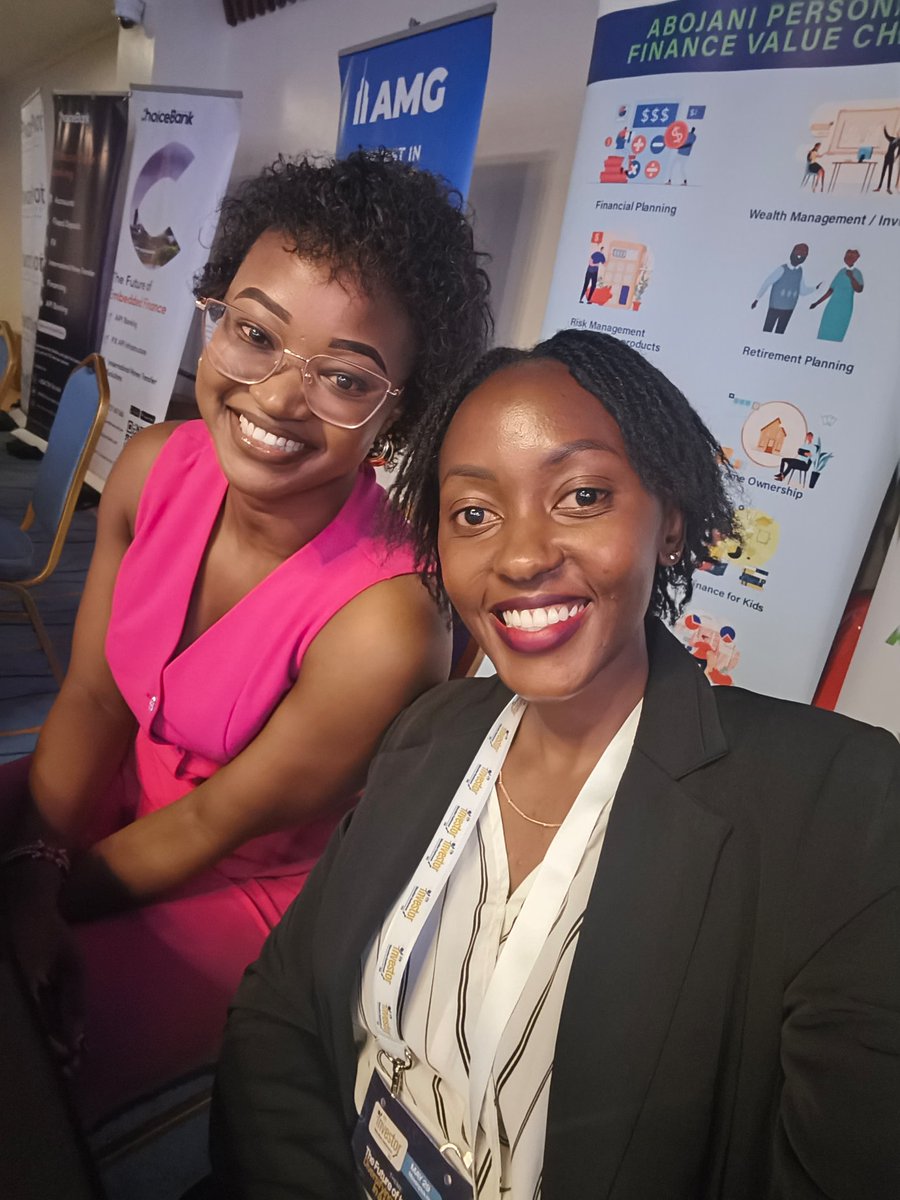
Live scenes at the 4th @BD_Africa Investor Education Conference.
Our Chief of Staff, @WachiraEuniceN, alikua site together with the gorgeous Bajeti Founder, @juliesosy 🎉🎉
life is so weird!
Some years ago, in a Manchester bedroom, i started a podcast with a $100 microphone and called it The Diary Of A CEO...
The idea was that i'd share some of the more personal things in my diary - that first episode got 40 subscribers on Apple.
Most of them were my friends.
Thankfully, two of my friends told me it wasn't as embarrassing as I thought it was, and told me to carry on.
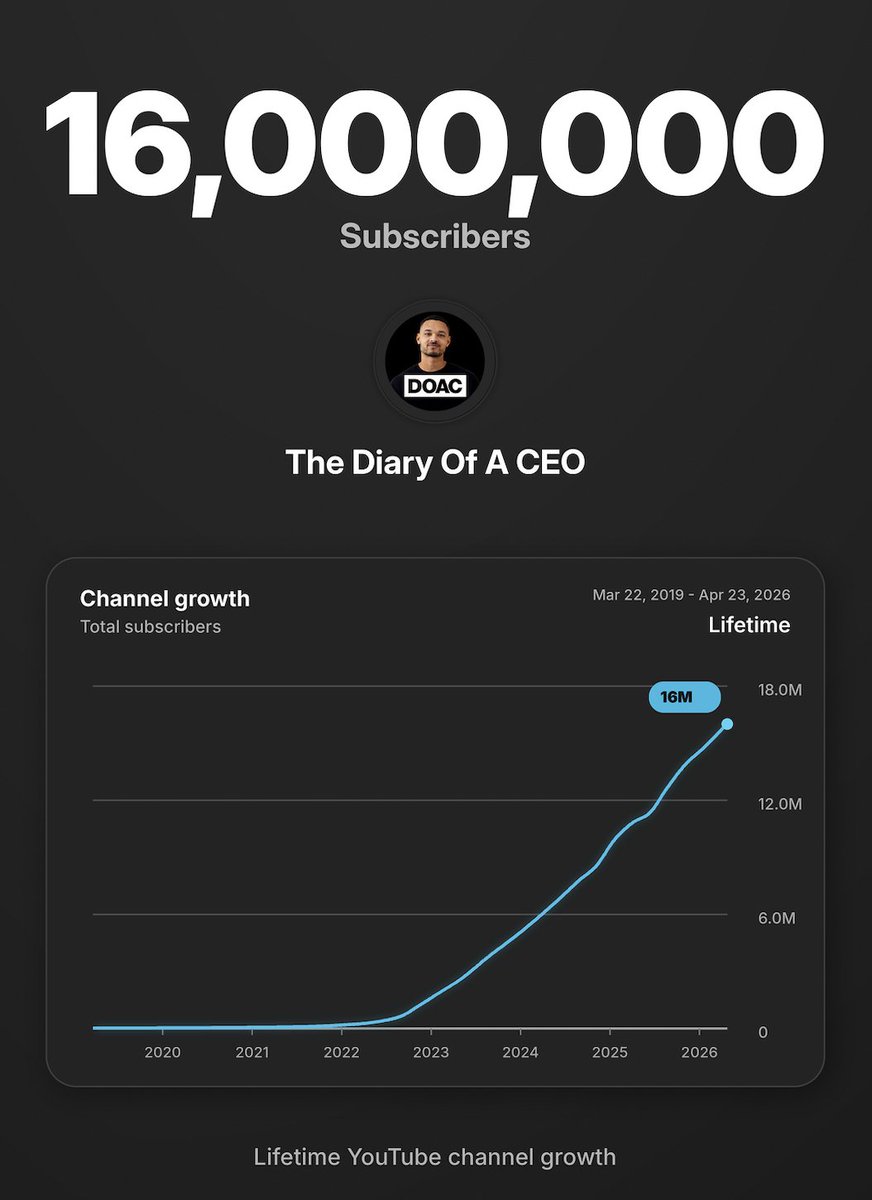
Today, about 6 years after bringing the show to YouTube, we hit 16,000,000 subscribers.
This month we had 90 million± downloads/views (a new record for us), and added 600,000+ new subscribers to the show.
no rational person looking at me sat in that bedroom at 3am, trying to figure out how to edit on garage band, using a sock as a pop-shield for the microphone, would have forecast any of this. i certainly did not.
all of this has been so weird to me that it's mentally easier to just not think about it, and focus on the work... which is the decision we've always made and will continue to make
In an industry dominated by American media giants, I'm really proud that a show founded in Britain by a team of now hundreds of Brits, many of them young people in their first job, can compete globally...
And i'm reminded again what's possible with the right people, the right focus, a willingness to work very hard, (and some good fortune and timing).
AND... i'm reminded again of the power of the creative industries in the UK.
FLIGHTSTORY, our media company behind The Diary Of A CEO and a growing slate of other shows, just finished its 25,000 sqft campus in central London and is expanding in the US.
We're hiring like crazy - so please get in touch if you're looking for a job!
We're looking for everything from software engineers, creatives, C-suite level execs and more!
To the audience who show up week after week, thank you so much for handing me one of the great, unexpected, privileges of my life!
ok, back to work!
Bill Ackman said one of the biggest edges in investing is being willing to underwrite a business 3-5 years out which is why he owns $AMZN, $META & $GOOGL.
Volatility is the price you pay for long-term compounding when the market gives you the chance to buy value at a discount.
"Bought Safaricom at Sh30.50
Now the stock is at Sh28.00
Down: 8%
I want to sell."
Dear Beginner Investor...
Before you click that red button and sell a losing stock, ask yourself these questions:
1⃣ "Has something changed?” Maybe you were right at the time, but something has changed. Has a visionary leader left the company? Have they failed to innovate and lost their sustainable competitive advantage? That’s when it’s time to sell.
2⃣ "Do I still believe in this company?” No matter what happens, if you still believe you own part of a great business… don’t sell. Oftentimes, the market loses faith in a company based on a poor earnings report or some temporary problem. A long-term investor can weather these storms and wait for their stock to rebound.