🚀 Draft chapters my forthcoming MIT Press book:
𝗛𝗲𝘁𝗲𝗿𝗼𝗴𝗲𝗻𝗲𝗼𝘂𝘀 𝗔𝗴𝗲𝗻𝘁 𝗠𝗮𝗰𝗿𝗼𝗲𝗰𝗼𝗻𝗼𝗺𝗶𝗰𝘀: A Tractable New Keynesian Framework
A modern, analytical roadmap to TANK & HANK models for researchers, students and policy institutions
https://t.co/La1oqEmGEY
👇
A slightly simplified version of Mankiw-Reis makes it trivial to compute analytic solutions, and solves one of the main problems of monetary economics, how higher interest rates lower inflation going forward
https://t.co/SmAZBHBBhR
Very happy to share that my Job Market Paper is forthcoming in the Journal of Monetary Economics.
🔗 The paper is available at the following link, with 50 days’ free access: https://t.co/W8JSFnLuW2
An absolute banger of a paper.
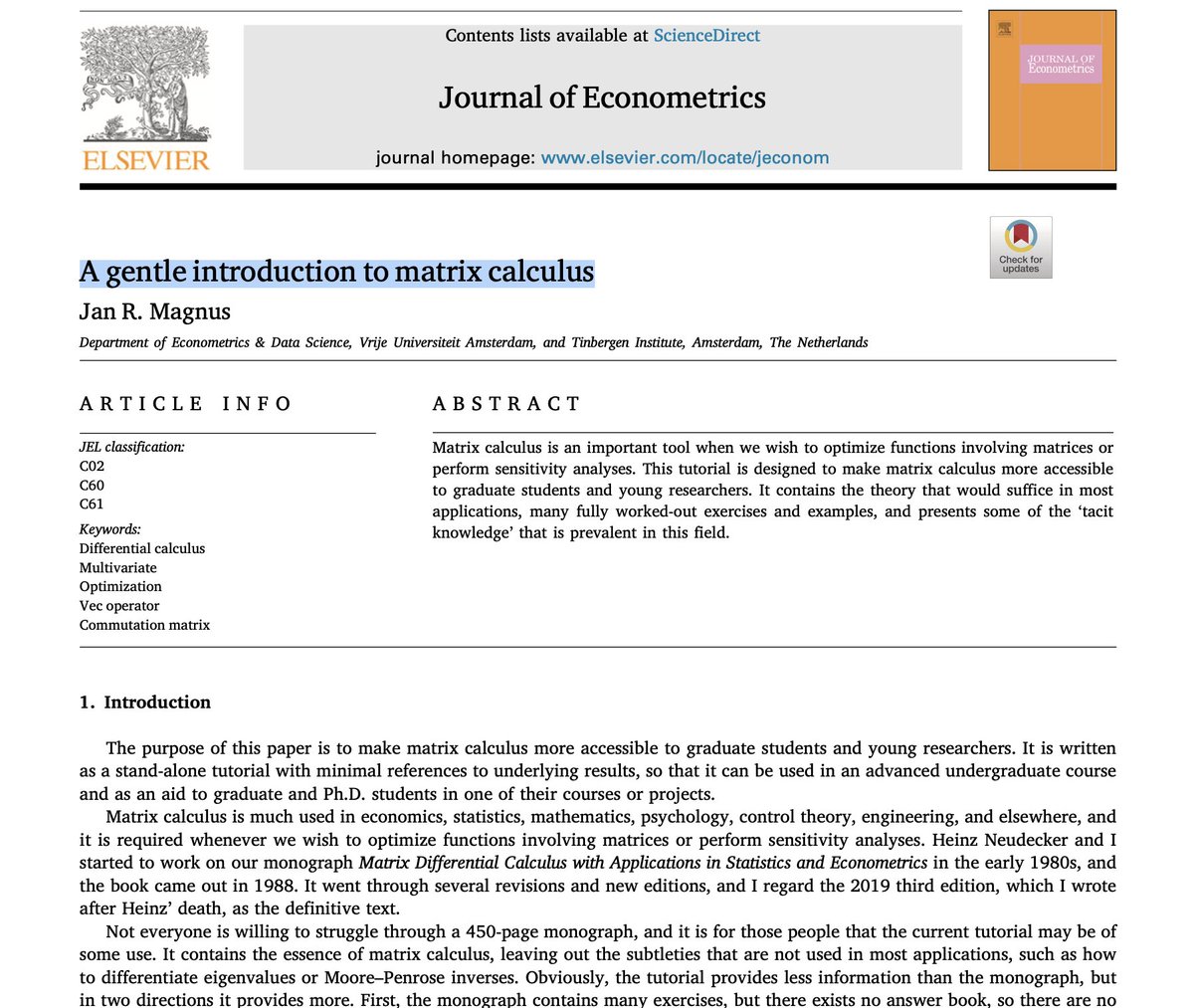
“A Gentle Introduction to Matrix Calculus” by econometrics legend Jan Magnus — one of the clearest explanations of matrix derivatives ever written.
If you work in econometrics, machine learning, statistics, or optimisation, this paper is pure gold.
Spurred by @GautiEggertsson, here is Chris Sims showing up in footnote #1 for 2 additional Nobel prize papers: Kydland and Prescott (1977) and Hansen (1982).
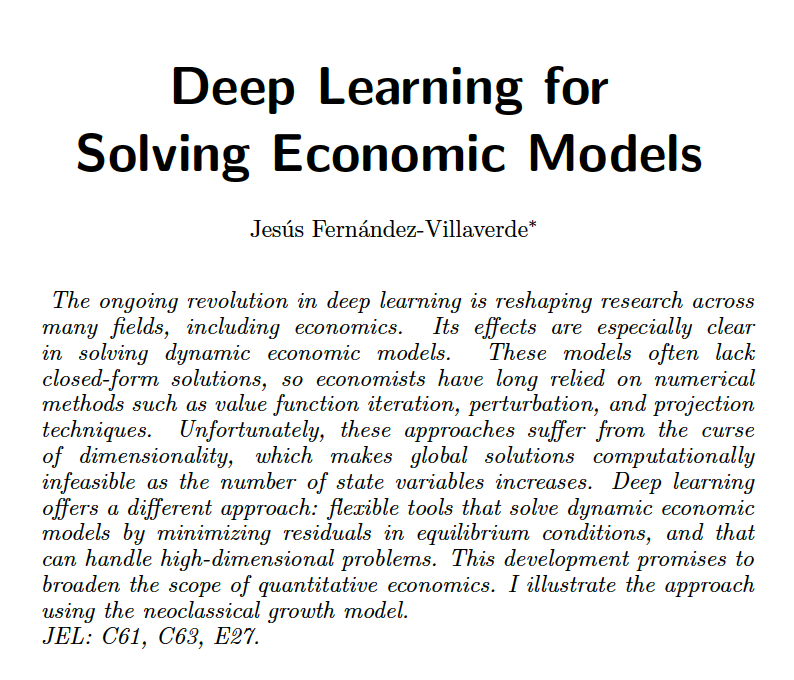
By now, I have published a fair number of papers, and one more acceptance would have close to zero marginal impact on anything that matters professionally. But getting my survey on “Deep Learning for Solving Models” accepted into the Journal of Economic Literature made me genuinely happy, for reasons that have nothing to do with my CV.
I had the misfortune of studying my undergraduate degree in economics at a quite awful institution. Two professors, David Taguas and Alfredo Arahuetes, were outstanding, and I owe them a great deal. The rest were well below any reasonable professional level, and some violated the basic standards of ethical conduct. They had no business teaching economics at any level, let alone at a university that charged tuition and claimed to prepare students for professional life.
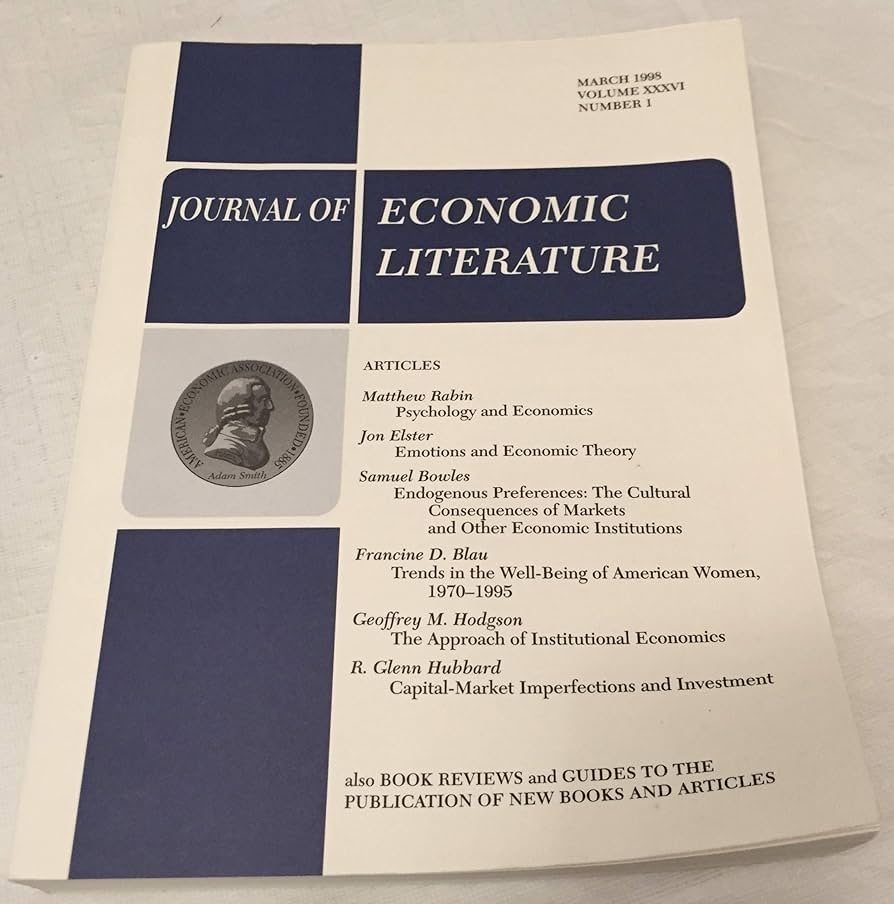
I had to work out most of my education on my own. The surveys published in the Journal of Economic Literature were how I did it. I spent hours in the library’s reading room going through one survey after another on topics I had never been properly taught. Some helped more than others, but collectively they gave me a solid enough foundation that, when I arrived at Minnesota for my PhD, I discovered, to my considerable surprise, that I was ahead of nearly all the other first-year students, including some who held master’s degrees, despite the fact that I had finished my undergraduate degree just six weeks before. I owe the Journal of Economic Literature a debt I will never be able to repay. Publishing a survey there is the closest I can come to trying.
So, the thought that some student somewhere, working on her own in a library or on a laptop, might find my survey useful gives me tremendous satisfaction.
But there is a broader point worth making. Even in the world of AI, the profession has an important mission in making educational material widely available. Textbooks, surveys, teaching slides, these are public goods in the economist’s sense: high social value, insufficient private incentive to produce. This is also why I post all my slides and teaching material online:
https://t.co/jcFH9WK9Qu
We do not reward these activities nearly enough, and their supply is well below what any reasonable social planner would choose. I do not have a good proposal for changing this, and I would welcome suggestions.
What I do find heartbreaking is that many of the great economists of the past couple of generations never wrote textbooks on their areas of expertise. I do not mean this as criticism. All of them maximize, and perhaps they all suffer from the same bias I suffer from: the belief that one can always do it next year. But I often think about the hours of pure intellectual pleasure I would have had reading “Time Series Econometrics: An Advanced Textbook” by Chris Sims or “Methods in Structural Estimation” by Pat Bajari. Those books do not exist. They should.
I am very happy that my survey paper, "Deep Learning for Solving Economic Models," is forthcoming in the Journal of Economic Literature (pending final replication checks, which should be quick).
The paper benefited greatly from the editor, David Romer, five referees, and many friends who read earlier versions. I believe the result is a solid introduction to the field, though in 48 pages, there is only so much one can do. So, I created a companion webpage:
https://t.co/zZpOLFXpDk
where you can find the paper, the code, and some slide decks with my teaching material. My plan is to expand the slides over time, adding new material and updating them as new results appear. I will probably do a thorough revision once the spring semester is over.
Those who follow my feed know that I think deep learning is the most fundamental change to computational economics in the last 40 years. I am by now convinced it is more important than the development of Markov chain Monte Carlo methods in the early 1990s or the introduction of projection and perturbation methods in the 1980s. To find a comparable shift, one would probably need to go back to Richard Bellman's invention of value function iteration in 1957.
More pointedly, we need to redesign the Ph.D. in economics. Not at the margin. From the ground up. Economists can either fully embrace the deep learning revolution or become irrelevant, as has already happened, I would dare say, to some fields in academia that refused to accept reality.
Finally, let me apologize to everyone working in this area whom I could not cite. Space was a binding constraint.
And yes, this post was written with the considerable help of AI. There is nothing I am prouder of than the fact that AI is now an integral part of every step I take in my professional life.
The BIS Time-series Regression Oracle (BISTRO) works like a ChatGPT for time series: it provides forecasts for key macroeconomic series and enables the exploration of scenarios.
Researchers can try it out: https://t.co/ZHDiak1dt4
Learn more: https://t.co/8DqPCVaqWG
¡Somos campeones de la #ONEFA! 🏆🏈
Felicidades a nuestros @UANL_Autenticos 🐯 por conquistar el título de la Liga Mayor 2025 en el #ClásicoRegioEstudiantil ante los #Borregos 🐑 del Tec de Monterrey. Su persistencia, disciplina y esfuerzo son un orgullo para toda la #UANL. 👏🏻
The 3-eq New Keynesian model might seem like a “mickey-mouse” model. Yet don’t be fooled. It takes, at least to me, one semester to derive it.
There is so much behind it, and so much to be learnt. And yet finally condensed in such an elegant, compact, insightful format. 👇
I want to share three cool results from our new paper: "Efficient Estimation of Nonlinear DSGE Models"
https://t.co/LqEL4qABhC w/ Sean McCrary
First question is of course:
🤔 Does it matter how you solve and filter? Yes!
▶️Using a global model solution as data-generating process shows 1st and 2nd-order perturbation solutions result in biased parameter estimates (see Figure: outside option nu and bargaining power eta in the DMP model). Our proposed method (labeled in the figure as TVKF) is many times faster than existing nonlinear solution and filtering methods (e.g., global + particle filter) but just as accurate!
I’m happy to share that our paper “Comparison of Inflation Expectations from Surveys and Markets Across Different Horizons,” written with Rocio Elizondo, has been accepted for publication in the Latin American Journal of Central Banking. Link here: https://t.co/D2nqW35MfU
Understanding these patterns is key, as inflation expectations are part of a broader set of indicators that help identify potential inflationary pressures. Monitoring these expectations allows central banks to act promptly and decisively to maintain price stability.
I’m happy to share that our paper “Comparison of Inflation Expectations from Surveys and Markets Across Different Horizons,” written with Rocio Elizondo, has been accepted for publication in the Latin American Journal of Central Banking. Link here: https://t.co/D2nqW35MfU
5/5 Convergence level: Combining both survey- and market-based expectations yields a more stable and lower estimate of the level at which inflation expectations converge in the absence of shocks.