“The end of friction” is the theme of @AtlanticoPart's 6th annual Latin America Digital Transformation Report.
My top 10 highlights on LatAm tech and VC this year include AI in LatAm, tariff impact, founder archetypes, and venture returns.
Link to report at the end of thread👇
🌎💻 Latin America now has more developers on GitHub than China.
The region went from 3.3M to 16M in just 5 years — and Brazil is now the world's 4th largest developer hub.
https://t.co/3m3QPQKSxW
Today, we're announcing A* III, a $450 million early-stage fund.
We started @A_StarVC with the simple idea to be a founder's first believer.
We are generalists by sector, but specialists in the stage and craft of seed investing. We partner with founders before there is consensus, before there is traction, and often before there is even a product. We are not organized around a market thesis. We back exceptional builders and follow them into the most important categories.
That matters because seed investing has changed. It is more crowded, more visible, and increasingly transactional. Too often, firms use seed to secure an option and then wait for proof before investing real time and attention. Seed has become a market of access. We believe it should be a market of conviction.
We built A* around a different model. We commit early. We show up before external validation, deploying both time and capital from day zero to help founders find their first customer, make an early hire, or work through the decisions that define the company.
We are selective at the start and concentrated over time. We partner with a small number of founders and deepen our commitment as their companies take shape. The best outcomes come from knowing where to go deep and having the discipline to do it.
This approach has led us to companies like Ramp, Decagon, Whop, Cape, Simile, Paraform, Watney Robotics, and Mercor.
We're grateful to the founders who have chosen to build with us and to the limited partners who have backed us. With this fund, A* manages over $1 billion in assets less than five years after launch. Our job remains what it was on day one: back exceptional founders early and be the partner they need when it matters most.
The lazy take on Latin America is that the region's role in the global tech stack is to localize models validated elsewhere.
Enter shows the region’s generational companies will innovate on a global scale.
Enter is the first AI unicorn from Latin America. It will not be the last.
Congratulations to the Enter team, excited for the adventure ahead!
https://t.co/wfO7WJxvBF
Latin America just produced its first AI unicorn.
US investors should pay attention to how it happened, because the story breaks almost every assumption baked into how the region is usually covered👇
A great founder recruits a team better than they are.
He recruited the co-founder/CTO and the CMO of Wildlife (Brazilian gaming unicorn) as co-founders.
Mike Mac-Vicar is now the first person ever to co-found two unicorns in Latin America.
🚨🇧🇷 TV Globo says more than 2 million people are at the Shakira concert on Copacabana Beach.
Aerial footage barely captures it.
Brazil is operating on a different scale... the beach has officially become its own metropolis for the night.
@seni0re Thiel’s Founders Fund is an investor already. Came to see the company, the country and participate in the event to support the company (it was an AI leadership forum for CEOs and Chiefs of Legal)
The second driver of Enter’s moat is its deep enterprise embedding via custom integrations and forward-deployed engineers.
Revenue per account will be slower in the first couple of months. But every dollar that hits the bank account is structurally stickier, because Enter is no longer commodity software the customer uses. It becomes the infrastructure the customer runs on.
The first component of Enter’s moat is a real data network effect.
Because Enter serves every major bank, it knows how every judge in the country rules, what settlement amounts look like across the entire industry, what damages get awarded, what arguments work where.
No single bank could build this dataset alone. Enter has it because it serves all of them (the story repeats itself in many sectors).
That data advantage compounds with every new client and is impossible for a competitor to replicate without first dislodging Enter from accounts that would suffer if they left Enter’s platform.
@drewcrawford_ This is a great synthesis. Congrats on the high-quality analysis. We recently hosted discussions with nearly 100 of Brazil’s top leaders and heard a lot of the same themes.
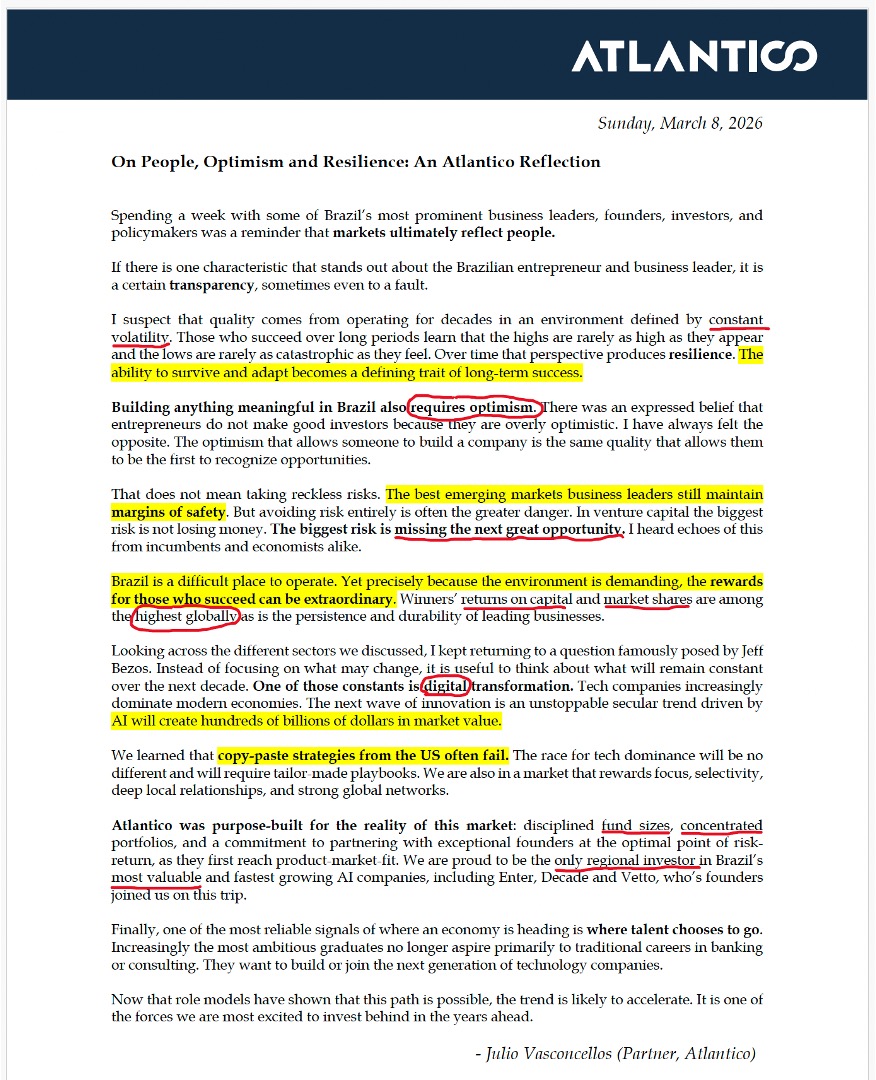
Most investors are underexposed to Brazil not because it lacks opportunity but because it looks hard.
Fortunes will be made by those that take the time to understand the fundamentals.
We decided to publish the conclusions from meetings with nearly 100 of the country's leaders during Atlantico’s Brazil Trek
Who will win the election?
Why is Brazil a safe haven amidst geopolitical turmoil?
Who is building the next $100Bn company?
read on...
@mmjukic I agree that realized returns versus the country’s potential, Brazil has come up short. It has the opportunity of being a global powerhouse, but politics have gotten in the way. The way to invest in Brazil is not top down, but bottom up.
Most investors are underexposed to Brazil not because it lacks opportunity but because it looks hard.
Fortunes will be made by those that take the time to understand the fundamentals.
We decided to publish the conclusions from meetings with nearly 100 of the country's leaders during Atlantico’s Brazil Trek
Who will win the election?
Why is Brazil a safe haven amidst geopolitical turmoil?
Who is building the next $100Bn company?
read on...
Brazil feeds a billion people.
It holds 12% of the world’s freshwater.
It produces 87% of its electricity from renewables at half the cost of American power.
It holds 94% of global niobium, the second-largest reserves of rare earths, and the second-largest reserves of graphite.
Its stock market trades at 9.25x forward earnings.
The S&P 500 trades at 21x.
An American investor pays more than twice as much per dollar of expected earnings for exposure to the US economy than for the country that holds the minerals, the water, the food, and the energy that the 21st century runs on.
Someone explain to me how that math works.
Read why I’m bullish on Brazil below 👇