Entropy is one of those formulas that many of us learn, swallow whole, and even use regularly without really understanding.
(E.g., where does that “log” come from? Are there other possible formulas?)
Yet there's an intuitive & almost inevitable way to arrive at this expression.
Projected gradient and Frank-Wolfe are the cornerstones of constrained optimization. PG typically evolves on the boundary while FW operates as an interior point method. https://t.co/PhznRjr2KU
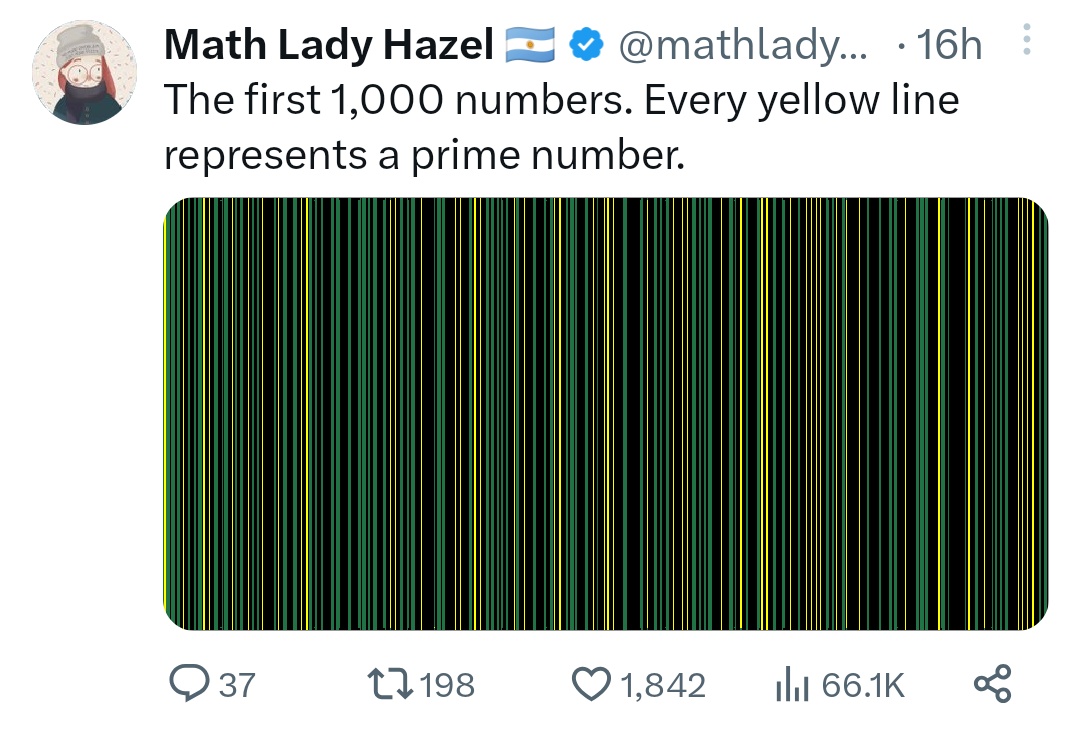
Really interesting result of Twitter's thumbnail compression here: when you see this tweet on your timeline, a lot of the lines appear green; when you expand the tweet, there are fewer; and when you expand the image itself, you discover that there are no green lines at all
When you study statistics, people just start talking at you like you're supposed to understand the difference between "probability" and "likelihood."
If you're confused, you're not alone: these words have an *identical* meaning in English—but an important distinction in math.
Oldies but goldies: W. Kermack, A. McKendrick, Contributions to the mathematical theory of epidemics, 1927. Proposed the SIR model, the most basic mathematical model of infectious disease transmission. https://t.co/4HrcTHnbXv
Oldies but goldies: George Dantzig, Origins of the simplex method, 1987. Dantzig invented the simplex in 1947, and it remains one of the workhorses of linear programming, used in countless applications. https://t.co/tQeuuYl5Bp https://t.co/tNCYtZswNs
Hilbert space-filling curve defines a continuous map from a segment to a square through an iterative refinement process. Often used to store and traverse 2D arrays. https://t.co/9QDUv6pCu1 https://t.co/nF2RQZmZWA
Oldies but goldies: H. Kuhn, The Hungarian Method for the assignment problem, 1955. The most celebrated algorithm to solve efficiently (almost cubic time) the assignment problem. https://t.co/qdTPVIJAa4
@DoctorJosh the concept of "pulling on a maze to solve it" is a consequence of duality theory applied to the shortest path problem: https://t.co/K6kVxNm7gp
Minimizing sum of p-powers of the distance generalizes the mean (p=2). For p=1, one obtains the median which is robust to outliers. https://t.co/nuKyBL7D7R
Hot off the press! 📢 We're proud to announce new funding, led by our investment partner @mkcapital. Together we will accelerate development of our cloud-native SaaS #supplychaindesign solution. Get the scoop: https://t.co/JvalmnNoiV #supplychain#funding
Network flow problem is a specific class of linear programs that finds numerous applications (eg network, communication, optimal transport). On contrary to general LP, there are efficient cubic time simplex solvers. https://t.co/AShT7ZnGIt
Our paper helping decision makers improve the #resilience of interconnected #power and #water infrastructure is now available online at: https://t.co/N1OBxu1yrh
Thanks to @INFEWS_UT for supporting this work!
#hurricanes#PuertoRico
Big News at the #SCIPOPT Workshop. As of today, dual licensing is history, and SCIP is fully free software, distributed under the Apache 2.0 license @AchterbergT@ambrosgleixner#orms
Weiszfeld's algorithm is an iterative least square method to compute medians (p=1) and in general sums of distance to some power p. Using p<2 makes the solution robust to outliers. https://t.co/NB1WoF5mtc