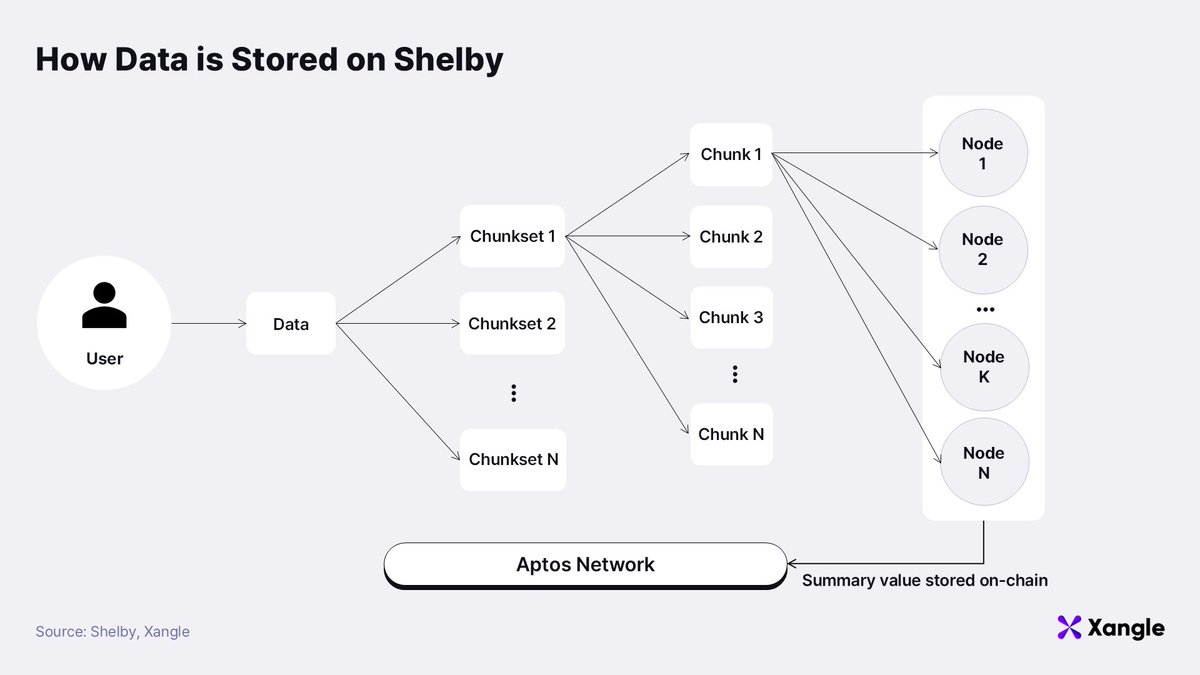
Recently, Aptos introduced Shelby, a decentralized, read-centric storage project that has been gaining significant attention. The launch of the @shelbyserves project is naturally sparking speculation around the potential $SHELBY token.
Decentralized storage is a sector with growing technical demand and real-world utility. Peer projects in this space tend to have relatively high fully diluted valuations. As of June 30, 2025, Filecoin’s FDV is approximately $4.4 billion, and Walrus is around $2 billion. In this context, Shelby’s debut could become more than just a new storage protocol. It has the potential to act as a major catalyst for the entire Aptos ecosystem.
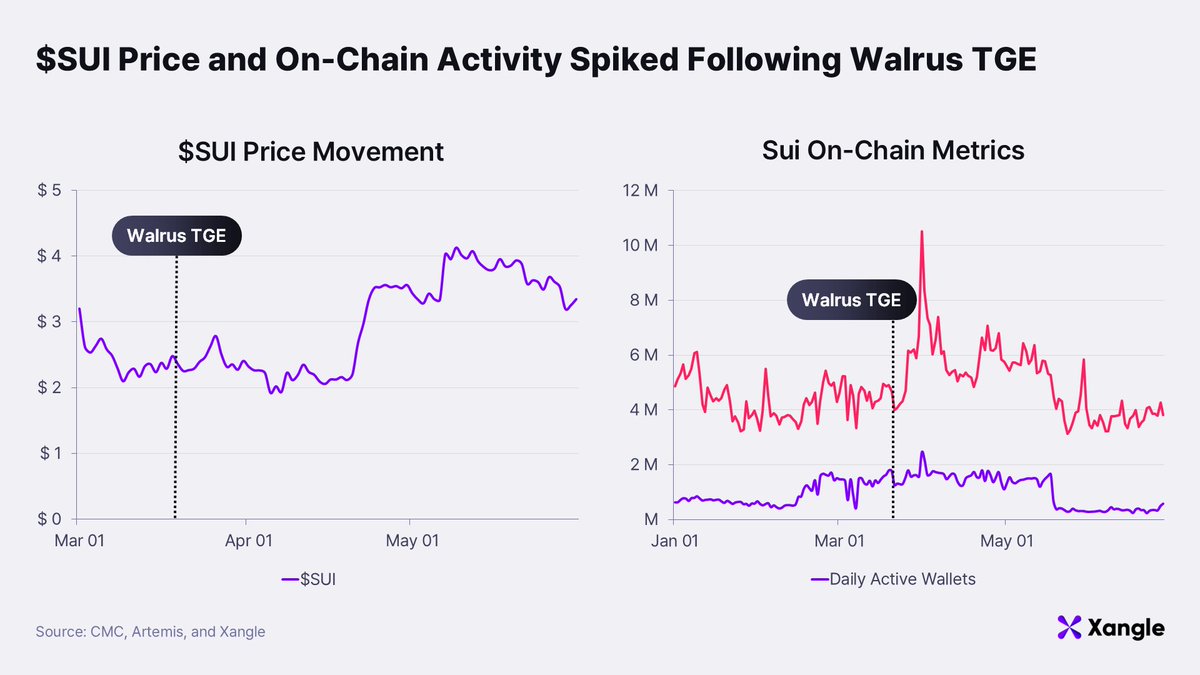
A relevant case study can be found in Walrus, a decentralized storage protocol built on Sui, another Move-based blockchain like Aptos. WAL conducted a large-scale airdrop targeting testnet participants and Sui ecosystem contributors. Four percent of the total token supply was distributed through the initial airdrop, which amounted to roughly $80 million based on a $2 billion FDV. The top airdrop recipient received 100,000 WAL, equivalent to about $40,000 as of June 30.
Following the event, the Sui ecosystem experienced a significant rise in both transaction volume and active users. Around the time of WAL’s token generation event, the price of SUI rose by approximately 20 percent in just five days. Notably, the highest daily active address count and transaction volume in 2025 also coincided with the WAL event. This example demonstrates that decentralized storage can impact not just protocol-level success but also the broader ecosystem’s activity and asset valuations.
On the technical side, Shelby is generating strong expectations. It leverages Clay Code based erasure coding to achieve efficiency comparable to Web2 cloud services and solves data bottlenecks through micropayment channels and a dedicated high speed network. It also enhances data quality through a read based incentive model that rewards users when data is accessed.
This has raised expectations that Shelby could support decentralized applications that require high performance data infrastructure, such as AI inference systems, high throughput DeFi protocols, and media streaming platforms.
If you’d like to learn more about the technical strengths of Shelby and how it could transform the Aptos ecosystem, please refer to the research linked below.
https://t.co/TridmWNHgd
Dunamu (Upbit) is honestly one of the most interesting unlisted stocks in Korea right now.
Someone should just tokenize Dunamu on @GIWA_by_Upbit already. That would go crazy.
베리에이셔널, 스왑 트레이딩 컴페티션 개최
$20,000 상금이 걸린 첫 번째 스왑 트레이딩 대회를 개최합니다!
🥇: 5,000 USDC
🥈: 4,000 USDC
🥉: 3,000 USDC
시작: 2026년 9월 10일 오전 9:00 (KST)
종료: 2026년 9월 24일 오전 9:00 (KST)
We’re hosting the first Variational swaps trading competition with $20,000 in prizes!
The competition will rank users based on a “Competition Score” (PnL on Swap Markets × √Volume on Swap Markets)
👇
Honestly, I think swaps are a bit different.
The trading experience is really good. The spreads and funding rates are insanely low.
Once more assets are launched, I think it could really change the market landscape
Execution costs on swaps are lower than the most liquid TradFi perp venues at every order size.
At large order sizes, swaps are up to 8 times cheaper to trade.
🎙 Derive Podcast: “Leading the Onchain Options Market, Derive Pushes Innovation Again with V3”
Blockmedia sat down with @nickforster , Co-founder and CEO of @DeriveXYZ , to discuss the future of onchain options.
Rather than simply introducing Derive’s product, the podcast explores the new strategies options can offer investors, the potential of the onchain options market, the factors behind Derive’s growth, and where the protocol is headed next.
Here are some of the key questions and takeaways 👇
Q1. How are options different from spot and perpetual futures?
Options are more than just a way to bet on whether prices will go up or down. They can be used to hedge risk, generate yield, and express more nuanced market views.
Investors can protect their holdings against downside risk or sell calls and puts to earn additional premium income. By combining multiple options, traders can also build a much wider range of strategies tailored to different market conditions and objectives.
Q2. What drove Derive’s rapid growth in the onchain options market?
Nick attributed Derive’s growth to a combination of market timing and five years of product development.
Building an options market requires far more than simply launching a trading venue. Liquidity must be available across a huge number of strike prices and expiries.
Over the years, Derive has built deep liquidity across options and perpetuals, alongside strong relationships with market makers and traders. As demand for new yield-generating strategies has grown, that infrastructure has begun to translate into meaningful growth.
Q3. What are the advantages of trading options onchain?
The most fundamental benefits are self-custody and transparency.
Users can retain custody of their assets while trading and directly verify the protocol’s collateral, solvency, and risk-management framework onchain.
But the larger opportunity lies in composability. Other protocols and services can use Derive’s options liquidity to build yield products, structured products, and entirely new financial services on top of the protocol.
Q4. What changes with Derive V3?
The core idea behind V3 is to evolve Derive from a standalone options exchange into an integrated risk engine capable of supporting a wide range of financial strategies.
Within a single system, users will be able to manage △calls and puts △perpetual futures △lending and borrowing △spot-related positions, while the range of supported assets expands from crypto into RWAs.
A new Vault infrastructure is also designed to dramatically shorten the time required to integrate new strategies and products. The goal is to make it easier for external teams to build and launch structured products and investment strategies on top of Derive.
💡 The core takeaway from the podcast
The value of options goes far beyond leveraged speculation.
At their core, options allow investors to hedge existing positions, generate additional yield, and turn different market views into customized strategies.
Derive is taking that utility one step further. With V3, the protocol aims to connect options, perpetuals, lending, and RWAs, evolving into an onchain derivatives infrastructure where a much broader range of structured products can be built.
🎥 Watch the full podcast to hear more about Derive’s view on the future of onchain options and its strategy for V3.
https://t.co/zrc2rtvk60