Crypto made asset issuance permissionless
It never made derivatives creation permissionless
A futures market is not just a ticker and a pool. It is an agreement between contract design, reference pricing, liquidity, matching, margin, clearing, collateral, liquidation and distribution
In the traditional derivatives stack, those functions are split across institutions:
The exchange defines the contract and operates the matching engine
The clearing house becomes the central counterparty, sets margining rules, nets obligations, manages settlement and maintains the default waterfall.
FCMs, brokers and prime brokers provide market access, financing, collateral management and house margin
It is expensive and slow to coordinate, but robust!
CEXs compressed that stack, but kept the most valuable gate for themselves. Everyone has heard what a listing actually costs 😄
Ten years of CEX innovation also failed to bring TradFi-level capital efficiency to defi. Most perp venues still margin positions individually or use static margin tables that barely respond to changing market conditions
Portfolio margin is the most powerful tool in derivatives and the most gatekept. It is why a fund runs a hedged book for a fraction of the capital a retail account posts on the same two legs. In TradFi you need an ISDA, a prime broker and a six figure account to access it.
We built it into the base layer of the exchange and opened it to everyone..
Margin should scale with the net risk of the whole book, not the gross size of each position alone. Required margin scales with portfolio variance -when one position offsets another, the required collateral should reduce. A real hedge should release capital instead of being margined twice
CME is the Industry standard benchmark - SPAN evaluates a discrete risk array and grants cross-position relief through exchange-defined spread credits!
Every crypto offset CME offers, is a contract against itself in another wrapper. Bitcoin against Micro Bitcoin. Ether against Micro Ether. Futures against options on the same underlying. Long Bitcoin, short Ether is two different assets, and you need to use a third product, the Ether/Bitcoin Ratio future to access the benefit.
Here's how BULK risk engine (inspired by SPAN) performs better:
Netting: every position is evaluated against every other position through a live correlation matrix. The measured relationship is the credit, there is no eligible-spread list
Regime: maintenance margin changes with the live volatility and trend state across nine market regimes. A position should not require the same margin in a calm trend and a correlated crash
Resolution. SPAN is 16 scenarios. BULK runs a 500,000 path Monte Carlo at every point of a 3,024 point grid of threshold by leverage by regime by side. Roughly 1.5 billion simulated paths per asset (and more), each path 25k+ steps, with regime transition dynamics. It prices the real tail and the path into it..
the resulting risk surfaces and correlations are protocol state. Every validator applies the same margin, liquidation and settlement logic. There is no private risk desk granting one account a better margin agreement
Same principle CME pioneered, margin the net risk of the book. A generation newer in execution, and transparently decentralised!
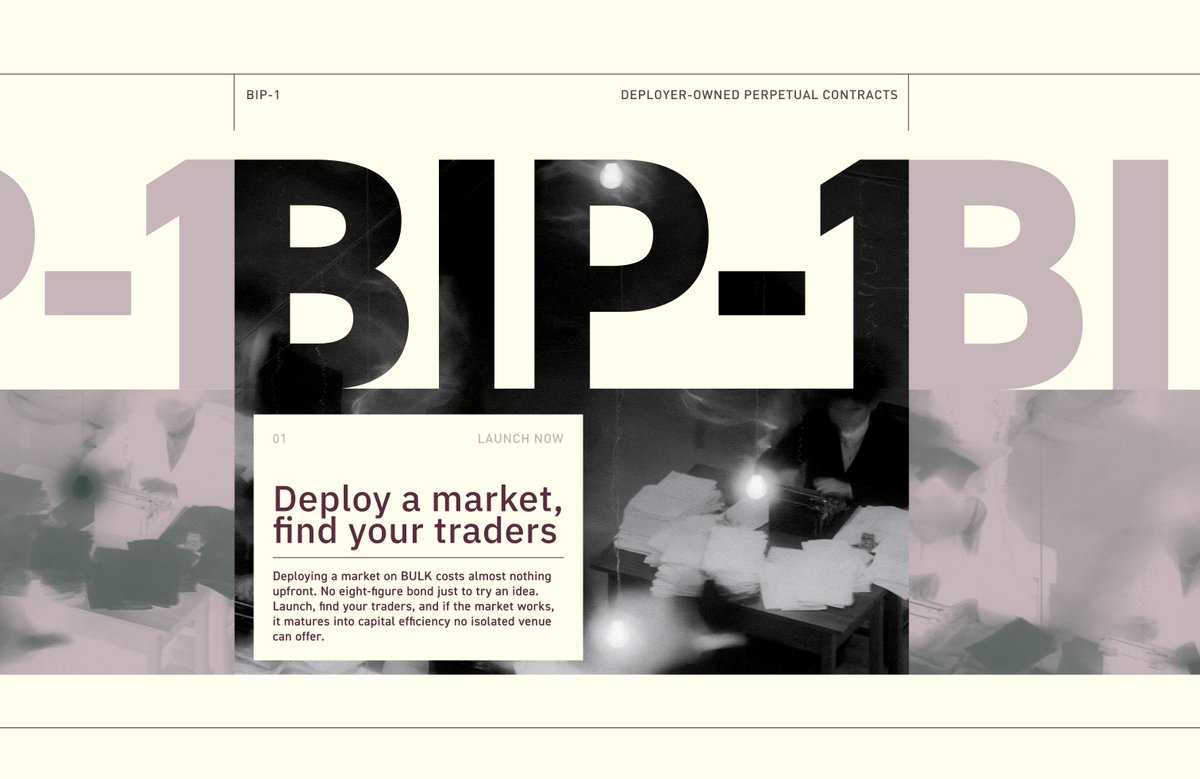
BIP-1 brings that engine to market creation
BULK compresses functions divided between the exchange, clearing house, broker and prime broker into one deterministic base layer.
For deployers, the opportunity is larger than launching another long-tail crypto perp. A deployer can build markets around commodities, rates, indices, sector baskets, regional assets or any other product with a defensible reference price and real liquidity.
You can prove demand for your idea without persuading any committee!
And once that market matures, its traders enjoy the fruits of portfolio margining. The market can become part of a wider capital network, where positions hedge against existing markets and collateral is allocated to the net risk of the whole portfolio
Innovate.
Deploy.
Prove demand.
Calibrate the risk.
Unlock Portfolio margining.
That is BIP-1
@Divergent_XBT@bulktrade You can keep track of newest changes here @bulktradenews
We try to schedule a upgrade every 2-3 weeks, to enhance ux, new features etc - every exchange does this too
Few trading pairs - what pairs do you want to trade? we will add them
I’ve always believed that you either do something better than everyone else, or you don’t touch it at all. So when we sat down to rethink referrals at @bulktrade, we started from scratch.
Weekly codes are gone. You now have one link you can share anywhere, without copying codes one by one.
On top of AURA, you earn up to 15% of your referrals’ trading fees and up to 2% from the traders they bring in. There are no requirements to start earning and no cap this season, so if you make $10M, it’s all yours.
Personally, what always bothered me about referral programs is that the value goes to one side, usually the referrer. We wanted the trader you invite to benefit too, so they get up to a 10% boost on their Trading AURA. Using a referral link finally makes sense for both parties.
And this is only V1. We’ll keep adding new perks for the traders you invite, and much more is coming!
REFER FRIENDS TO BULK. GET PAID. 💰
It’s not just AURA anymore… referrers now earn:
→ 10% of your referrals’ fees
→ 1% of THEIR referrals’ fees
→ No earnings cap for Season 1
You're gonna get tired of winning 👀
Grab your ref link: https://t.co/n09fCINWE3
BULK Scheduled Mainnet Maintenance - 19 October
We’ll be deploying hotfixes today at 22:00 UTC, with approximately 15 minutes of downtime. Service is expected to resume at 22:15 UTC.
This update restores manual ISO margin top-ups through internal transfers, and brings in fixes needed for BIP1 markets
All resting ALO (post-only) orders will be cancelled post upgrade.
No api break is expected. Happy trading!
BULK brings the SIMM-style model banks use for uncleared derivatives onchain: every position's requirement is combined through a correlation table, so offsets across coins count, something summed and scenario engines don't give. A market maker's book long some coins and short others can need about 20% of what its positions need one by one: roughly 5x the inventory on the same capital, and 5x the leverage
The discount rests on correlations holding, and on 10/10 ETH's correlation with BTC fell from about 0.86 to about 0.46. BULK phases higher rates in gradually and doesn't liquidate an account in profit just because its requirement rose
The plan is one account for a trader's whole Solana book. Kamino and Loopscale positions would count as collateral where they sit, BulkSOL and other assets would be haircut by their volatility and their correlation to the positions they back, and spot, options and borrowing would join perps in the same account
THE CHALLENGER SERIES HAS LEVELED UP 🏆
League Cash rewards and Gauntlets are LIVE
50,000 AURA is set aside for Taker Volume in this week’s gauntlet, go get it!
Check your rank: https://t.co/MtXQZUdOHO
Introducing: The Challenger Series - S1
To start, we are allocating 12.5% of net fees to weekly reward pools for leagues Gold -> Challenger!
What's new 👇
Elliptical cryptography is built on math assumptions and tricks, if indeed open ai or anthropic has found a (log p)^k solution to discrete log then it’s also plausible to assume that other open source labs or frontier research groups will find it too
High performance cryptography needs a better way to do hash based crypto, they are computationally demands and mssg size will balloon
Today I call upon the blockchain industry to calmly begin planning for "bunker mode". My personal recommendation is to set in motion a controlled mass migration of assets to fresh addresses, i.e. addresses whose pubkeys remain hidden behind a hash.
Holders, starting with large and sophisticated ones, should consider moving the bulk of their funds to addresses that have never signed a transaction. And when they do sign one, they should also move remaining funds to a new address (possibly generated from the same seed phrase).
Don't rush. While I believe there is cause for action a rushed migration would do more harm than good. Don't panic either. Moving assets to protected addresses is a simple, preventative step which does not require new cryptography or new wallets.
IMO it is now reasonable to brace for the possibility that ECDSA breaks before qday, in the worst case in months not years. By "break" I mean fast private key recovery (e.g. in one week) on available hardware (e.g. a large GPU cluster).
Recent days have been humbling for human mathematical intuition. Long-held, unquestioned hypotheses have fallen. This includes the n log(n) bound for integer multiplication and the 3SUM conjecture. In hindsight, May's unexpected disproof of the Erdős unit distance conjecture was our warning shot.
Yesterday's OpenAI drop made it clear that mathematical superintelligence is upon us. They say there are weeks where decades happen. We are about to live through weeks where centuries of mathematical progress happen. Could our magic 64-byte ECDSA signatures be too good to be true? Was it just security through obscurity all this time?
Elliptic curves feel especially vulnerable to superintelligence. Curves carry rich structure, with room for fancy tricks like Schoof, Frobenius, pairings. (By contrast, hashes are designed to minimise algebraic structure.)
Separately, as Ewin Tang can attest, an efficient quantum algorithm sometimes foreshadows an efficient classical one. We should be open to the possibility of a classical counterpart to Shor that breaks elliptic curves and RSA at once.
Also noteworthy is the striking under-representation of cryptographic breakthroughs among the 722 mathematical results OpenAI published. I've witnessed first-hand the US government censoring academic quantum cryptanalysis results. Backroom interventionism is my base case.
I urge large, sophisticated actors to lead by example. Project11's "risq list" (bitcoin-risq-list.projecteleven[.]com) is a great tracker of exposed BTC pubkeys. Binance, Bitbank, Robinhood, Bitfinex, and Tether have an opportunity to harden their cold storage. Next month I'll address institutions in London in a live Q&A (forum.ethereuminstitutional[.]org/london-2026).
Again, please do not rush. Wallets holding under 50 BTC enjoy partial cover from "Satoshi's shield", i.e. his 20K exposed addresses that hold 50 BTC each. Load-bearing signers like oracles and L2 security councils should consider rotating ECDSA pubkeys with every signed message and/or multi-signing with a hash-based schemes like SPHINCS.
Exiting bunker mode safely will require post-AI cryptography. My inclination is to go all-in on hash-based cryptography and avoid structured mathematical assumptions entirely, whether from curves, lattices, or isogenies. A single battle-tested hash (e.g. from the SHA or BLAKE families) yields plausible post-AI security.
The Ethereum roadmap on strawmap[.]org fully embraces hash-based cryptography with end-to-end formal verification as a response to the quantum threat. Those timelines must now be revisited and accelerated in light of mathematical superintelligence. I'll be pushing for maximum defensive acceleration.
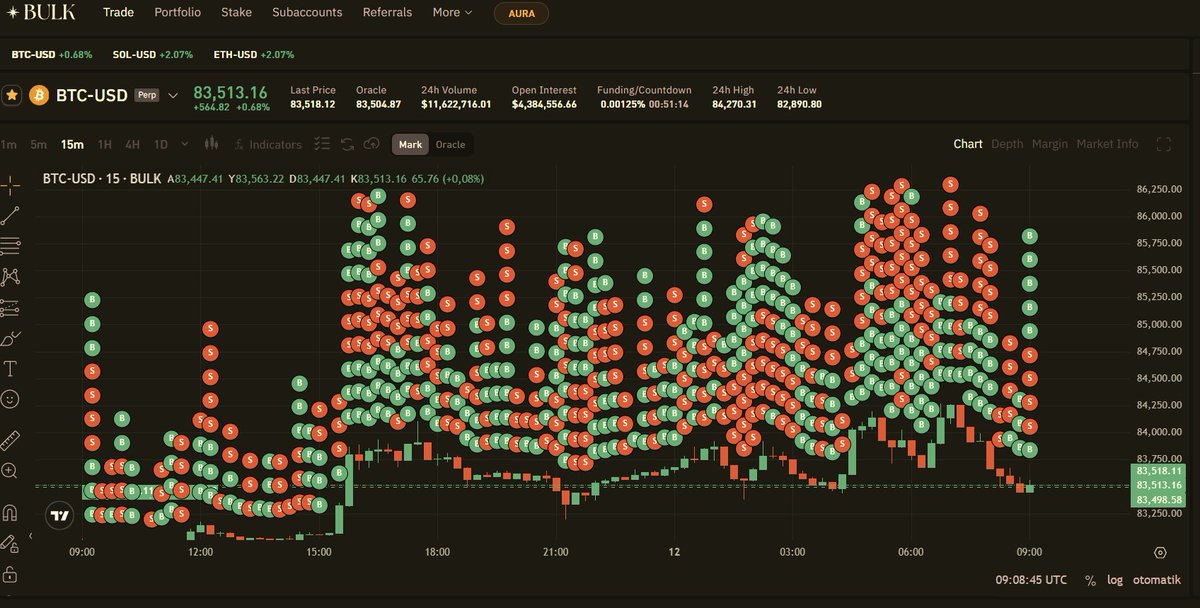
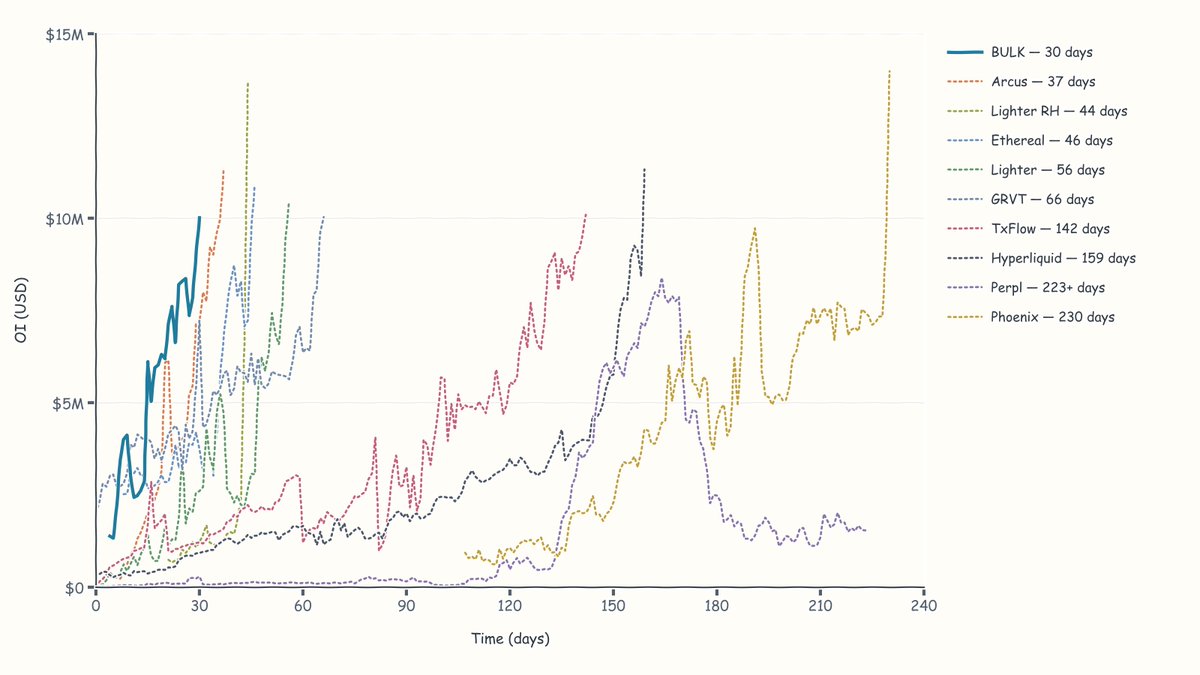
BULK is one of the fastest growing derivatives exchanges
A 8% compounded daily growth, on avg $350k in net OI added per day since launch
Global derivatives represent roughly $1 quadrillion in outstanding notional. At $100B+ in open interest, perps represent only around 0.01% of that scale
In the last few months Perps have already demonstrated substantial demand and price discovery during non trading hours. As more of traditional finance catches on to perpetuals, I believe capturing more than 10% of the broader derivatives market over the next few years is possible
But to get there, we (onchain) need the risk infrastructure that tradfi has spent decades developing: that allows institutions to manage complex portfolios.
SPAN is part of that history. Used since 1988 across exchanges and clearing orgs worldwide, it puts portfolio risk and eligible hedge offsets at the centre of margining
Cme's portfolio-margining programme alone averaged $8.4B in daily margin savings during 2025, with savings exceeding $10B per day at the beginning of 2026
That is billions of dollars in lower collateral requirements through better portfolio risk management
In the next few years, there wont be a distinction between trad and defi. But if we want to make that happen, we have to do better
We, as a industry should offer the beautiful features of blockchain to risk infrastructure built through decades
That is the direction we believe onchain derivatives should take to grow: recognise useful hedges, charge for the risk that remains, and account for what it would cost to close positions under stress.
Ultimately, that means helping traders use their capital more efficiently
BULK brings that portfolio-risk philosophy onchain through its own margin model. A long BTC / short SOL portfolio can receive margin credit because the positions partially offset. The credit depends on sizing, correlations and risk conditions, while leverage constraints and closeout reserves remain in place
We are so early, To bring the world of derivatives onchain, we need to learn, adapt and build a better system
For us at BULK, the job is clear: build and share the best risk systems onchain, and shove it down tradfi's throat
Over time, we want to bring that same margining philosophy to a broader set of instruments: swaps, forwards, options and other OTC derivatives, alongside interest-rate and FX futures and options
Accelerating, tick by tick.
Trad markets have prime brokers that share the pool and provide credit line. Onchain venues are very expensive in terms of margin requirements. A hedge under SPAN cuts the margin cost for a broker upto 40-80%. We need hedge discounts and correlations offered by these trad venues to make it compelling for brokers
Check out what we are doing with bulk - native span offering onchain