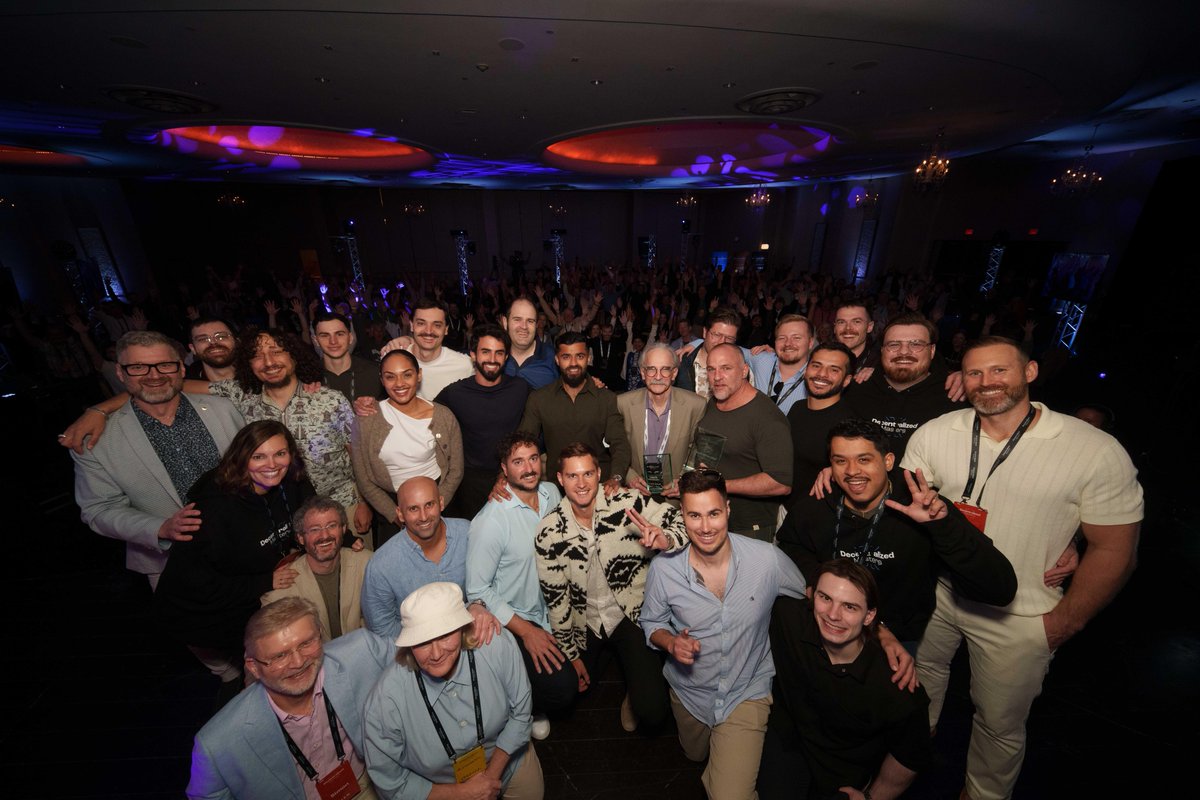
Two weeks ago we held Market Intelligence Live in Miami. Three days at the Fontainebleau with hundreds of our members.
3 days packed with real strategy sessions on positioning capital for 2026 to 2030.
The conversations that happened in that room, at dinner, in smaller breakout sessions, were the most valuable of my career.
Building a community online is one thing.
Meeting them in person changes everything.
The $25K minimum was never what stood between you and day trading profits.
Investing has three parts: planning, execution, and behaviour. This change hands you execution. Planning and behaviour were always yours to build.
For 25 years a rule supplied the discipline. The investors who learn to supply their own just gained the most.
Owning more assets doesn't make you a better investor, but knowing which assets fit your investment strategy will.
A poor investor focuses on too many opportunities. It doesn't matter if the asset aligns with their risk tolerance, time horizon, or portfolio strategy. None of their positions will build wealth systematically.
A great investor is the opposite. Their investments fit a deliberate investment plan. If they define risk tolerance before position sizing, their portfolio survives downturns.
Being a poor investor with no plan is worse than not investing at all. Your portfolio will be whatever trainwreck you conjure up while scanning opportunities with no filter.
Let's say you go to the grocery store without a shopping list. You waste time scanning aisles and end up with more items in your cart than you should have. This same logic applies to picking the basket of assets that form your portfolio. The only difference is that your wealth will be affected by several orders of magnitude because of poor investment discipline.
At the end of the cycle, a poor investor will end up with dozens of trades, trading fees stacking up, and significant underperformance.
If you want to grow your wealth, your primary battle is planning first. You versus the temptation to skip straight to execution. Fighting every day to define your strategy before you deploy capital.
The order isn't optional if you want to be a great investor: planning, execution, and then behavioural discipline.
Your wealth depends on it.
Retail investors often don't have a portfolio. They just have a collection of individual bets with nothing connecting them to an actual investment strategy.
They evaluate opportunities one by one. If something looks good, they buy it. And if something else looks good, they buy that too. But without a clear strategy, retail investors have no filter for how their collection of assets should fit together.
This approach misses the forest for the trees.
Every investment needs to be assessed based on whether it belongs in your portfolio, instead of each asset looking promising in isolation.
The investors who build real wealth start with the forest by mapping out their overall strategy first. Then they create filters to define what assets do and don’t belong. Then every opportunity gets assessed against those filters.
There's no reason to rely on luck when a strategy exists. You need an investment strategy built around your goals. Start analysing your portfolio by mapping out what you own, why you own it, and whether it belongs.
I've never told anyone this.
I didn't score as well on my CFA Level 3 exam as I did on Level 1 and Level 2.
I blamed it on working 24/7 as an investment banker and studying after midnight.
Level 3 is more than testing your knowledge of complex math formulas. It's about behavioural finance and the art of managing your emotions and understanding that markets are just the sum of every player's psychology, biases, and blind spots.
I understood the behavioural finance concepts. I just didn't believe they mattered at the time.
2017 proved me wrong. I made my first real money in crypto and then lost all of it.
I didn't take profit when I should have. At the time I thought I was a genius, but in hindsight, it was just luck.
The CFA Level 3 exam was trying to teach me the exact thing that later cost me everything I'd made that cycle. I just wasn't ready to hear it.
In 2021, I caught the cycle again. This time I kept what I made.
The only difference between losing it all and keeping it was my understanding of human psychology.
(This is commentary from my own experience, not investment advice. Always consult a qualified advisor for your situation.)
In this market, your wealth is no more stable than a melting ice cube.
With dollar devaluation currently running at 5% per year with no supply cap, fiat currencies are designed to devalue. By many estimates, real inflation runs higher than the official number, adding another few percent per year on top.
You need your investments to earn close to 10% per year just to maintain your wealth.
Sticking your money in your savings account won't help you. Neither do bonds or high-yield accounts that pay 4-5%.
Retail investors often skip this calculation entirely and put money somewhere that feels safe and call it a strategy.
However, some investors have started looking at stablecoin liquidity pools as one way to target higher yields. Unlike savings accounts and bonds, many of these pools have at times paid out more.
They don't carry the same directional market risk as equities, but they carry their own risks instead: smart contract risk, depeg risk, and liquidity risk.
That doesn't make stablecoin liquidity pools safe. But it's worth understanding they exist before assuming your only options are the ones your bank is offering you.
(This is commentary, not investment advice. Stablecoin liquidity pools carry significant risks including smart contract and depeg risk. Do your own research and consult a qualified advisor.)
ANCHORING BIAS COSTS RETAIL INVESTORS MORE MONEY THAN ANY OTHER BEHAVIOURAL FAILURE.
It makes you hold winners to zero, refuse to buy back in, and confuse memory with reality.
5 ways retail investors fall into this trap without realising it:
1. "The all-time high is X, I'd be making so little profit if I sold now."
5. “This industry/narrative is going to be the next big thing.”
As the old saying goes, "The market can stay irrational longer than you can stay liquid."
You may be right. You may even be ahead of your time. But that's just as harmful as being wrong. When you invest, you have to be right at the right time.
Anchoring can affect anyone. When it comes to investing, we typically look backwards to make investment decisions, but looking forward is the only direction that matters when you invest.
For most of my career in finance, the best information had one entry requirement:
You already had to be wealthy enough to matter.
That gap is why I co-founded Decentralized Masters.
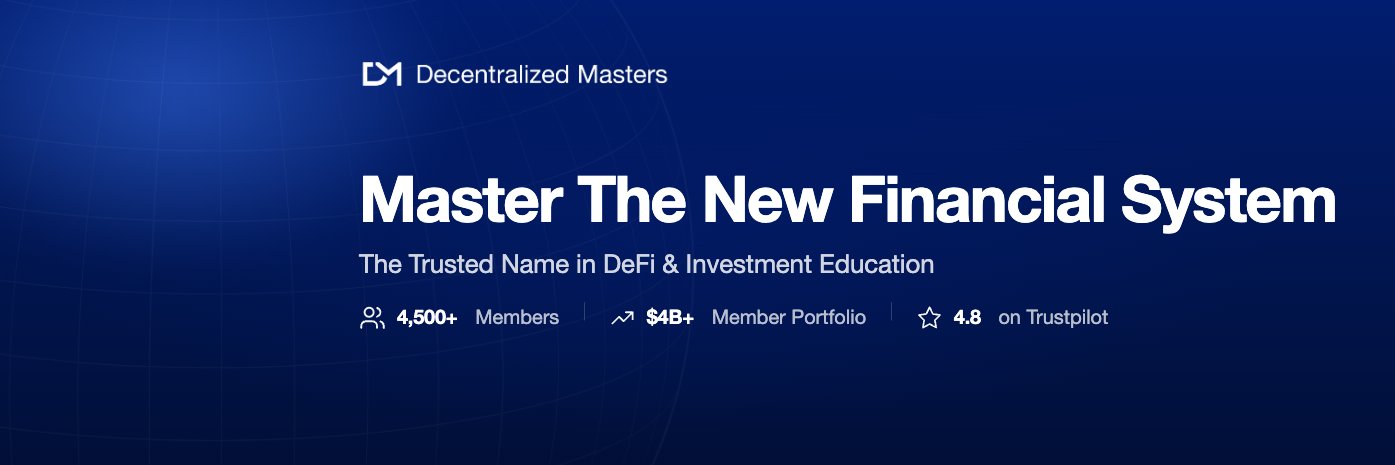
Three years later, we’re 4,000+ members, $4B+ in collective net worth, and a team of 150+.
And this week, a new look to match what we've grown into.
Thousands of people who were never supposed to have this kind of access, building real financial sovereignty anyway.
That's the part I'm proud of.
Had a wealthy friend tell me that the ability to invest in yourself with uncertain outcomes is what separates those who hit their potential from those who don't.
A few ways I've applied this:
- Investing your capital when every institution is shutting you down will teach you more about conviction than any business school ever could.
- Investing your time to learn a skill with no guaranteed payoff will separate you from everyone waiting for certainty before they commit
- Investing your reputation into a business that banks and ad platforms won't support will separate you from those who wait for permission
Making a major leap in life requires an investment
Could be a $$ investment, time investment (learning), or something else. But there's no free lunch. No investment, no leap
It's that simple. If you're not willing to invest with an uncertain outcome, zero progress will be made
My #1 regret as an investor:
Listening to traditional finance advice that lost me nearly everything I'd made trading the 2017 crypto cycle.
I was working at a hedge fund analysing investments. Every instinct I had came from my finance experience.
> Buy and hold
> Fundamental analysis
> Long-term thinking
This model works for equities.
But in 2017, when crypto ran up, I caught the run early and turned a small starting position into what could be life-changing money in months.
Every instinct said, "Hold."
In equities, that instinct is right. You don't sell Amazon because it's up 300%. You continue to hold generational companies.
But crypto in 2017 wasn't Amazon. It was a liquidity-driven narrative cycle with no earnings, moat, or a price floor.
The bear market erased all of my gains… despite applying the smartest version of the traditional finance models.
I spent the next few years building a different system. Instead of the "buy and hold" model, I created a framework built for assets that move in cycles, not decades.
In 2021, I noticed the same crypto cycle was starting to repeat.
But this time I had a system built for crypto, not equities. This time, I caught the cycle again. And this time, I kept what I made.
Applying traditional finance frameworks to crypto was an expensive mistake.
The frameworks that built your wealth in one asset class will destroy it in another.
(By the way - this is commentary from my own experience, not investment advice. Always consult a qualified advisor for your situation).
Obstacles we overcame in the first 6 months of launching a financial education company that’s grown to 5000+ members:
1. Payment processor shut down
Stripe killed our account without any warning. Froze our account with our funds stuck inside.
We were only running educational content around DeFi frameworks, risk management, and position sizing. The email from Stripe just said "account closed". There was no appeal process available to us.
2. Bank accounts closed
Our banking partners sent account-closure letters. No reason given. We had to manually wire transfer reserves before access was revoked.
Every traditional financial institution was shutting us down before we even had customers.
3. Ad platforms refused us
Meta and YouTube killed our ad accounts a few weeks after launch. We appealed and got denied. No policy violation was cited, even though real humans had reviewed the creative before we posted.
4. $200K invested before a single ad ran
We put up $200K of our own capital in the first 6 months.
Had to rebuild our payment systems, find new banking partners, and build organic distribution when every paid channel closed.
We kept going. It built our conviction. We took it as a signal from the big institutions that more people needed our educational finance content.
All these obstacles meant we were either deeply wrong or very early.
We bet on early.
3.5 years later: 150 employees. 5,000+ members. 800+ reviews. Hundreds of video case studies.
These institutions that cancelled us didn’t realise that they were validating our mission.
When the legacy infrastructure doesn't want you to teach something, that's usually the thing people need to learn most.
In my experience, behavioural mastery is one of the biggest determinants of whether you build crypto wealth or destroy it.
(This is general commentary on behavioural patterns. Not personalized investment advice. Every position requires consideration of your situation, risk tolerance, and goals.)
If you’re ignoring behavioural finance, you’re basically guaranteed to lose money in every crypto cycle.
If you've lost money in crypto despite doing the research, it likely wasn't your analysis. It was one of these 5 behavioural traps:
1. Holding a winner too long.
I've watched people hold through clear fundamental deterioration signals: team departures, declining TVL, and broken tokenomics because their sources said, "This is FUD. Stay strong."
If you can't name three specific things that would make you sell this position, you are investing based on your attachment to the position, rather than your conviction.
The group chats, the Twitter threads, and the Discord servers all act as bias amplifiers.
In crypto, every bias operates at 10x because the feedback loops are instant, public, and emotionally charged.