I've written thousands of articles over the past 20 years, but this is the most important one I have contributed to the age-old debate between "viruses don't exist" and "viruses are lethal." I encourage you to share it with health practitioners, who probably have no idea that common environmental exposures, such as microplastics and metals, can mimic EXACTLY the symptomology of contagious infectivity, commonly misdiagnosed as viral in origin. And for those who think this is "magical thinking," they can consult the 60+ references at the end of the article. This is a REAL problem, and it contributes significantly to what the WHO and CDC promote as the cause of the majority of epidemics and pandemics. I don't think you'll be disappointed. I encourage comments and criticisms.
📎https://t.co/CzIgya9tW8
NVIDIA announces the first open humanoid robot reference design built for robotics research.
The NVIDIA Isaac GR00T Reference Humanoid Robot combines the @UnitreeRobotics H2 humanoid robot, @SharpaRobotics Wave five-fingered hands for dexterous manipulation, Jetson Thor onboard compute, and Isaac GR00T open software and models, giving researchers a full-stack platform from data capture to model deployment.
Read the #NVIDIAGTC Taipei announcement: https://t.co/ZsT3qQKucb
NVIDIA announces the first open humanoid robot reference design built for robotics research.
The NVIDIA Isaac GR00T Reference Humanoid Robot combines the @UnitreeRobotics H2 humanoid robot, @SharpaRobotics Wave five-fingered hands for dexterous manipulation, Jetson Thor onboard compute, and Isaac GR00T open software and models, giving researchers a full-stack platform from data capture to model deployment.
Read the #NVIDIAGTC Taipei announcement: https://t.co/ZsT3qQKucb
Wait... someone just open-sourced the entire AWS cloud in a 90MB Docker image 🤯
Every local AWS emulator before this needed gigabytes of RAM.
Cold starts took seconds just to test one single function, and free tiers are increasingly getting locked down.
Meet Floci.
It's a natively compiled emulator that completely rethinks local cloud testing.
What runs locally with zero dependencies?
→ Storage & Databases: S3, DynamoDB, RDS, ElastiCache
→ Compute: Lambda, EC2, ECS, EKS
→ Events & Messaging: SQS, SNS, EventBridge, Kinesis
→ Security & Auth: IAM, KMS, Cognito, STS
It handles 46 AWS services natively, boots in ~24 milliseconds, and idles at just 13 MiB of memory.
The average Chrome tab uses 15x more than that!
Point your standard AWS SDK at localhost:4566 and your existing scripts work untouched.
No auth tokens, no feature gates, and tests finish before legacy emulators even pull their image.
It's 100% free and open-source.
Repo link in 🧵↓
D1 is a robot developed by the Hong Kong–based startup Direct Drive Tech.
It can automatically assemble into a larger robot or separate into smaller units depending on the task.
This helps it move through tight spaces or carry heavier loads for inspection and maintenance work.
Anthropic's applied AI team just dropped a 24-minute workshop on how to actually prompt Claude properly.
Free. From the people who built it.
You've been prompting Claude for months without the 6 elements they teach in this.
I built a skill that applies them automatically. Full guide below.
Bookmark it.
Follow @codewithimanshu for more high-signal content that actually moves your skills forward.
The Head of Claude Code at Anthropic hasn't written code by hand in months.
In 2 days he shipped 49 full features. 100% written by AI.
He just dropped a 30-minute talk on exactly how he does it.
More valuable than any $500 vibe coding course. Bookmark it.
Andrej Karpathy just sat down and built GPT from scratch, line by line, in 2 hours.
For Free. From the man who co-founded OpenAI.
This video is enough to become an AI engineer.
Bookmark it. Watch it tonight. Build your own GPT this week.
$5,000. $15,000. $40,000.
That's what bootcamps charge to teach less than what's in this 2-hour video.
This video fixes that this week.
Follow @codewithimanshu for more high-signal AI content that actually moves your engineering career forward.
↓
Karpathy doesn't explain GPT. He builds it.
Live. From "Attention is All You Need" the original paper. To the same architecture powering GPT-5.
Founding member of OpenAI in 2015. Senior Director of AI at Tesla. Now running Eureka Labs.
He's not teaching you how to use GPT. He's teaching you how it actually works at the source code level.
Most engineers will never understand transformers this deeply. The ones who do build the next generation of AI products.
Follow @codewithimanshu for breakdowns of every must-watch AI lecture worth your time.
↓
Here's what gets built in 2 hours. No fluff.
Tokenization and data loading.
The foundation of every modern LLM. Train/val splits done right. Batch loaders that don't break in production.
Most tutorials skip this. You can't ship anything serious without it.
The bigram baseline.
The simplest possible language model. Karpathy builds it first because it teaches you what every fancier model is actually trying to improve.
Once you understand bigrams, transformers become obvious. Skip this and the rest never clicks.
Follow @codewithimanshu for daily breakdowns of what AI engineers actually need to know.
↓
Self-attention. From scratch. Live.
This is the section that should have its own course.
Karpathy builds self-attention in 4 versions:
> Version 1: averaging past context with for loops
> Version 2: matrix multiply as weighted aggregation
> Version 3: adding softmax
> Version 4: full self-attention
Each version teaches you why the next one exists. Why attention works. Why matrix math replaces explicit loops. Why scaling matters.
You'll never look at "attention is all you need" the same way again.
Follow @codewithimanshu for production transformer breakdowns weekly.
↓
The 6 attention notes that change everything.
Karpathy drops 6 insights most engineers never hear:
> Attention as communication between tokens
> Attention has no notion of space, operates over sets
> No communication across batch dimension
> Encoder blocks vs decoder blocks
> Attention vs self-attention vs cross-attention
> Why we divide by sqrt(head_size)
Each one of these explains a different failure mode in production AI systems.
Most "AI engineers" can't answer these. The ones who can charge $300K.
Follow @codewithimanshu for the engineering insights that turn into job offers.
↓
Building the full transformer block.
Single self-attention head. Then multi-headed self-attention.
Feedforward layers. Residual connections. LayerNorm.
Each piece added with the reason it exists. Why residuals stop the model from collapsing. Why LayerNorm replaced BatchNorm. Why dropout matters at scale.
This is the architectural understanding that lets you debug any modern AI system.
Once you've built one transformer by hand, every paper you read becomes 10x clearer.
Follow @codewithimanshu for transformer architecture content every week.
↓
Scaling up to a real model.
Karpathy goes from baseline to a working GPT.
Hyperparameters. Dropout. Model dimensions. The exact tradeoffs every production model makes.
By the end you have a Shakespeare-generating language model running on your machine. From scratch. Built by you. Understood by you.
That's not a tutorial. That's an architectural unlock.
Follow @codewithimanshu for production model scaling breakdowns.
↓
Encoder vs decoder vs both.
The architecture choice that defines every modern AI product.
Why GPT is decoder-only. Why BERT is encoder-only. Why translation models use both.
Once you understand this, you can read any AI paper and immediately know what kind of system you're looking at.
This is the difference between someone who follows AI hype and someone who builds it.
Follow @codewithimanshu for AI architecture deep dives weekly.
↓
NanoGPT walkthrough.
Karpathy ends with a quick walk through nanoGPT. The repo every serious AI engineer has cloned at least once.
Batched multi-headed self-attention. Production-grade code. The clean version of everything you just built.
This is the bridge from "I built a toy GPT" to "I can read and modify production AI code."
Follow @codewithimanshu for repos every AI engineer should know.
↓
ChatGPT, pretraining, finetuning, RLHF.
The video closes with the full lineage. From your toy GPT to ChatGPT.
What changes when you scale up. Why RLHF matters. The exact path from research model to product.
You finish the video understanding the entire stack from raw paper to deployed product.
Most "AI experts" can't draw this map. After 2 hours, you can.
↓
What you'll be able to do after this.
Read "Attention is All You Need" and understand every line.
Debug attention layers when they break in production.
Build a custom language model on your own dataset.
Modify transformer architectures for specific use cases.
Have technical conversations with AI engineers without faking it.
Train a GPT on any data you want. Shakespeare. Code. Your own writing.
That's not "AI literacy." That's the foundation of an AI engineering career.
The kind of foundation that turns into senior roles and consulting contracts most people will never access.
↓
2 hours. Free. From the engineer who built it.
You'll spend longer in meetings this week and learn nothing.
This compounds for the rest of your career.
People who watch it can build GPT from scratch by Friday.
People who skip it stay confused about why their prompts fail in production.
Save the video. Watch it this week. Build something with the knowledge by the weekend.
Follow @codewithimanshu for more high-signal AI content from the people actually building the future.
This is AWESOME... Some guy just sequenced his entire DNA genome on his kitchen table 🧬🧪
It tells his cancer risk, drug responses, what his kids will inherit, and which diseases are coming decades before the symptoms.
Your genome is a 3.2 billion letter source code that predicts more about your health than any other test in existence. Almost no one has ever read their own.
This used to require a hospital, a specialist, and a referral that most doctors won't write. The raw data would sit in a medical record you'd never see.
Until now.
Here's how he did it:
→ Rubbed a cheek swab against the inside of his mouth for 60 seconds
→ Extracted the DNA from his cells using a $150 kit
→ Prepped the DNA for sequencing with enzymes that attach a motor protein to each strand
→ Loaded the sample onto a nanopore device the size of a highlighter, plugged into a MacBook
The device works by pulling single strands of DNA through holes one atom wide. As each letter passes through, it changes the electrical resistance in a tiny but measurable way. A neural network listens to the signal and reconstructs the sequence. 48 hours later, he had his full genome on his hard drive.
The data never touched a server. No spit kit in the mail. No company owning his most sensitive biological information. No risk of the whole thing getting auctioned off in a bankruptcy, which is exactly what happened to 23andMe's 15 million customers earlier this year.
AI is unlocking personal health in a way that has been impossible. We're still so early.
Boris Cherny created Claude Code. he thinks IDEs are dead by end of year.
This is a 28-minute masterclass on how Anthropic uses it internally.
I wrote 5 pipelines you can sell with it. none of them are coding.
SOMEONE built an AI agent that sells pool installations on autopilot
10 "boring" cash-flowing startup ideas YOU can build on autopilot using the OpenClaw/Hermes etc:
1. find commercial buildings with flat roofs in sunny states and calculate their solar savings, render the install, mail the building owner a custom ROI report. become the broker between building owners and solar installers, take a cut of every deal or charge $$
2. find shopify stores doing $1M+/yr with no international shipping and build them a localized storefront for their top non-US traffic countries, pitch a rev share to unlock revenue they're leaving on the table
3. find businesses paying for 10+ SaaS tools via public job postings and tech stack data and build a custom "consolidation audit" showing how to cut 40% of their software spend, sell the migration as a service
4. find commercial properties with high water bills using public utility data and render a xeriscaping or rainwater capture plan with projected savings, sell to property management companies at scale
5. find ecom brands running meta ads to products with 1-2 star reviews and build a better version of their top SKU with a manufacturer, launch against them with their own keyword data
6. find small banks and credit unions with websites from 2012 and render a modern site + mobile app with their branding, pitch it as a turnkey digital transformation. they have budget but no one's calling on them
7. find warehouses and industrial spaces near EV corridors with no charging infrastructure and model the revenue from installing chargers, pitch landlords a lease + install package
8. find franchisees posting complaints in public forums about their franchisor's tech and build a shadow operating system (POS, scheduling, inventory) that plugs into their existing franchise, sell directly to franchisees
9. find medical practices billing under specific CPT codes with low reimbursement rates and build an AI billing optimization engine that reclassifies and appeals claims, take a % of recovered revenue
10. find DTC brands with 100k+ instagram followers but no subscription offering and model their repeat purchase data from reviews, build a subscription flow with retention math, pitch it as a done-for-you program with rev share
the framework is basically this
use AI agents to surface a gap in public data, build the solution before anyone asks for it, and show up with the math already done.
you use info arbitrage + OpenClaw is the ultimate wedge
i dont know how long this lasts
but i do know there's a ton of ways to make $$ using this
and i won't hold back
i'll be sharing more ideas here, @startupideaspod and @ideabrowser
today is a beautiful day to be building
Vercel charges $20/seat/month.
Netlify charges $20/month.
Heroku killed its free tier entirely.
And if you go over your bandwidth? Surprise bills. Sometimes thousands of dollars.
There is an open-source alternative to all three. For $0.
It is called Coolify. 53,000+ stars on GitHub.
You install it on any server you own. A $5 VPS. A Raspberry Pi. An old laptop. Anything with SSH.
Then you deploy everything:
- Static sites
- Full-stack apps
- Databases
- APIs
- 280+ one-click services (WordPress, Ghost, Plausible, n8n, Supabase, and more)
Here's the wildest part:
It does things the paid platforms charge extra for.
- Free SSL certificates, auto-renewed
- Automatic database backups to S3
- Pull request preview deployments
- Real-time server terminal in your browser
- Push-to-deploy from GitHub, GitLab, Bitbucket
- Server monitoring with Discord/Telegram/email alerts
No vendor lock-in. All your configs live on your server. If you stop using Coolify, everything still runs.
The $20/month you pay Vercel? That is per seat. A 5-person team pays $100-500/month depending on usage.
With Coolify on a $5 Hetzner VPS, that same team pays $5/month. Total.
Apache-2.0 licensed. Self-hosted. Free forever.
100% Open Source.
(Link in the comments)
I'm excited about voice as a UI layer for existing visual applications — where speech and screen update together. This goes well beyond voice-only use cases like call center automation.
The barrier has been a hard technical tradeoff: low-latency voice models lack reliability, while agentic pipelines (speech-to-text → LLM → text-to-speech) are intelligent but too slow for conversation. Ashwyn Sharma and team at Vocal Bridge (an AI Fund portfolio company) address this with a dual-agent architecture: a foreground agent for real-time conversation, a background agent for reasoning, guardrails, and tool calls.
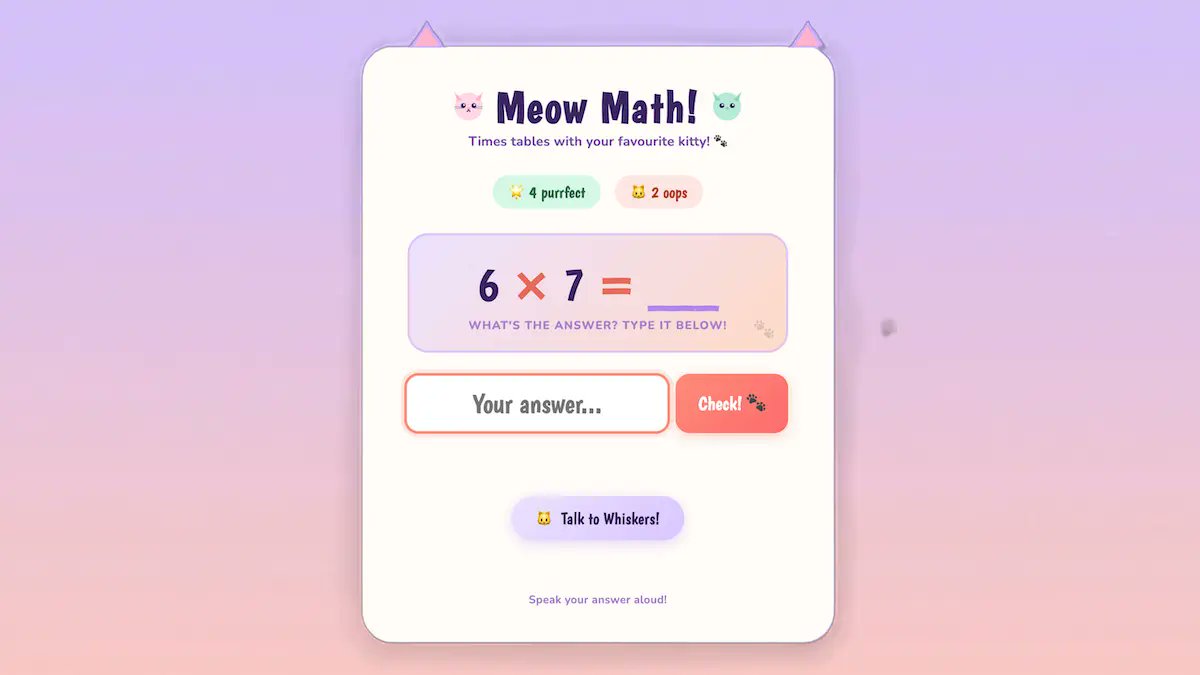
I used Vocal Bridge to add voice to a math-quiz app I'd built for my daughter; this took less than an hour with Claude Code. She speaks her answers, the app responds verbally and updates the questions and animations on screen.
Only a tiny fraction of developers have ever built a voice app. If you'd like to try building one, check out Vocal Bridge for free: https://t.co/nGrFznAMLh
Today, we released Lyra 2.0, a framework for generating persistent, explorable 3D worlds at scale, from NVIDIA Research.
Generating large-scale, complex environments is difficult for AI models. Current models often “forget” what spaces look like and lose track of movement over time, causing objects to shift, blur, or appear inconsistent. This prevents them from creating the reliable 3D environments required for downstream simulations. Lyra 2.0 solves these issues by:
✅ Maintaining per-frame 3D geometry to retrieve past frames and establish spatial correspondences
✅ Using self-augmented training to correct its own temporal drifting.
Lyra 2.0 turns an image into a 3D world you can walk through, look back, and drop a robot into for real-time rendering, simulation, and immersive applications.
➡️ Learn more: https://t.co/ROR7miJeCU
📄 Read the paper: https://t.co/1osU9EGjGD
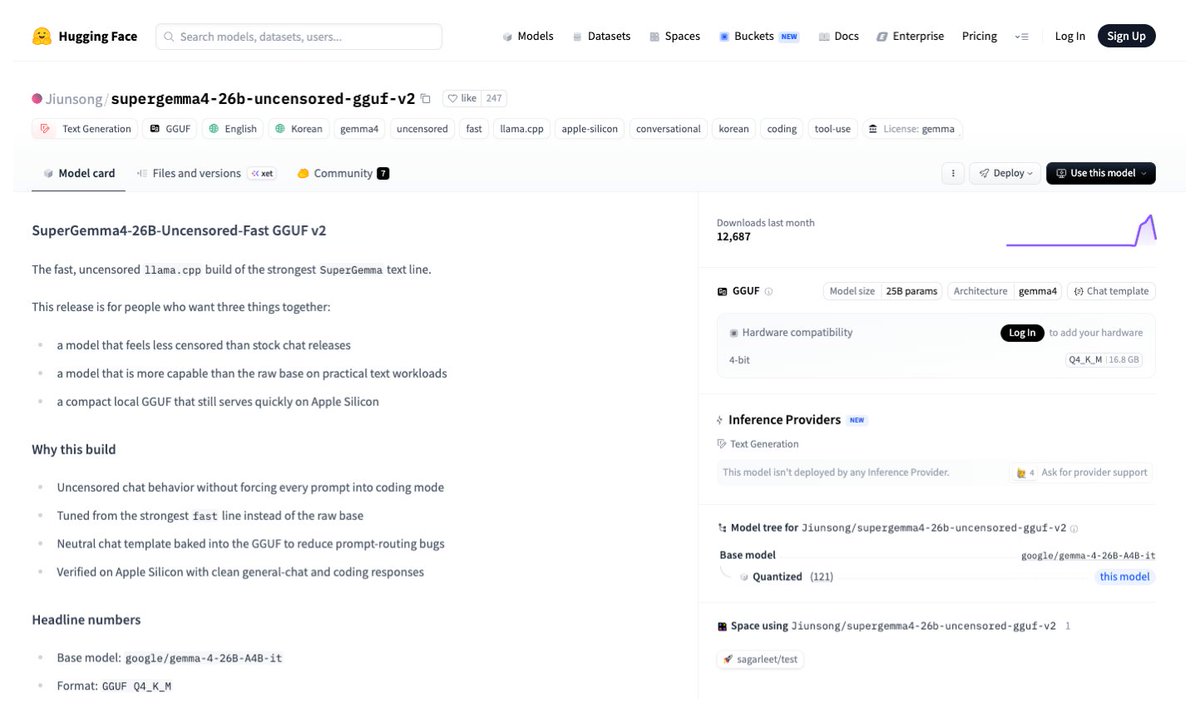
🚨 `Super Gemma 4 26B Uncensored` is insane.
@jun_song is COOKING AGAIN ♨️♨️♨️
he just dropped SuperGemma4-26B-Uncensored GGUF v2 and it is already trending on Hugging Face.
This thing absolutely smokes the regular Gemma-4 26B.
The specs:
→ 0/100 refusals. It is actually uncensored.
→ Fixed all the tool-call and tokenizer jank.
→ 90% faster prompt processing.
→ Sharper, smarter, way more capable responses.
→ It is the perfect local beast for llama.cpp. It runs on around 18-22 GB VRAM (the Q4_K_M file is 16.8 GB), meaning you can even run it on 16 GB GPUs.
A 31B version is in the works and should be out soon.
Pull this version on @huggingface below ↓
Steve Sweeney was reporting on the Israeli government’s murder of civilians in Lebanon when the IDF tried to assassinate him on camera. Here’s what American tax dollars are paying for.
0:00 Sweeney’s Close Encounter With an Israeli Missile Strike
11:37 Israel’s Bombing of St. Peter’s Burial Site
15:02 Hezbollah Protecting Christian Holy Sites
15:55 The Assassination Attempt on Sweeney’s Life
22:21 The British Government Taking Israel’s Side Over Its Own Citizens
31:06 Why Is Israel Bulldozing Olive Trees?
39:06 Why the Ukrainians Tried to Kidnap Sweeney
45:54 Is There More Freedom in Russia Than in Britain?
53:05 Why Is It Illegal to Criticize Israel in Britain?
1:02:20 Is Sweeney Planning to Remain in Lebanon?