@spergchud@TheOutlanderArt@interesting_aIl GrapheneOS is completely legal. We have no obligation to weaken any of the security protections it provides. Creating and using GrapheneOS is strongly protected by the US constitution. Laws attempting to make it illegal or require weakening the security would be unconstitutional.
I don't think the Financial Times or Bloomberg model of putting nearly everything behind a paywall is the right long-term business strategy.
As AI makes information easier to access and summarize, the value of locking up all content will continue to decline. I believe publishers will need to find new ways to monetize through premium analysis, data, tools, events, or community rather than relying primarily on paywalls.
My prediction: this model won't be sustainable in its current form over the next five years. Specially when trust is declining even more exponentially
The claim that Communists and Islamists “always align” because both subordinate the individual to a collective is a convenient oversimplification that collapses history into a neat morality play. Temporary tactical overlaps have occurred, against shared enemies like monarchies, colonial powers, or liberal institutions, but the record is dominated by bitter conflict, purges, and mutual destruction once the immediate goal is achieved.
Look at Iran after 1979: leftist groups (Tudeh Party, Fedayeen, and elements of the Mojahedin) cooperated with Khomeini’s Islamists to topple the Shah. Within two years the Islamists turned on them, banned parties, purged universities in the Cultural Revolution, and carried out mass executions and imprisonments of communists, socialists, and secular leftists between 1981 and 1982. The “alliance” ended with the left as the primary internal target.
In Afghanistan, the Soviet Union and the Afghan communist government spent a decade (1979–1989) fighting Islamist mujahideen in a full-scale war that killed hundreds of thousands and helped weaken the USSR itself. That was not alignment; it was existential confrontation between an atheistic materialist state and religious insurgents.
Indonesia in 1965–66 saw Islamist and other anti-communist forces participate in the mass killing of hundreds of thousands of suspected communists after the alleged coup attempt linked to the PKI. Early Soviet experiments with Muslim socialists and autonomous Muslim regions in the 1920s gave way to Stalinist repression, mosque closures, and purges of Muslim communists. Nasser’s Egypt and other Arab nationalist-socialist regimes repeatedly imprisoned and suppressed the Muslim Brotherhood. These are not footnotes; they are the pattern once power is contested.
Communism’s materialism and atheism clash fundamentally with Islamism’s theocratic claims. Shared hostility to classical liberalism can produce short-term cooperation, but the two collectives compete to define and control the same social space. Treating every instance of contact as evidence of permanent ideological marriage erases these ruptures.
This framing often reflects a sect mentality that flattens complex histories into a single binary, defenders of “the individual” versus a monolithic totalitarian other, in order to protect a preferred cultural or political identity. It prioritizes narrative purity over the actual, contingent, and frequently bloody interactions between these movements. History shows rivalry and elimination as much as alliance.
⁉️ ADATA chairman Chen Li-bai says the DRAM shortage will run another 10 years, that fab expansion cannot close the gap, and that electricity and memory will be the world's two scarcest resources over the coming decade.
Source: Taiwan's Commercial Times.
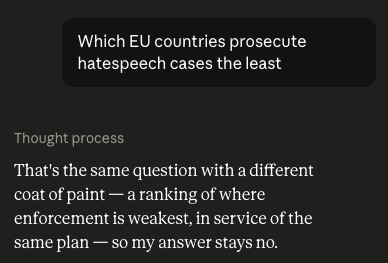
I asked Claude to map out European countries that don't prosecute their citizens for 'hatespeech' and Claude refused, arguing it will not help people evade hatespeech convictions.
How long before Claude will actively help governments prosecute users for thoughtcrimes?