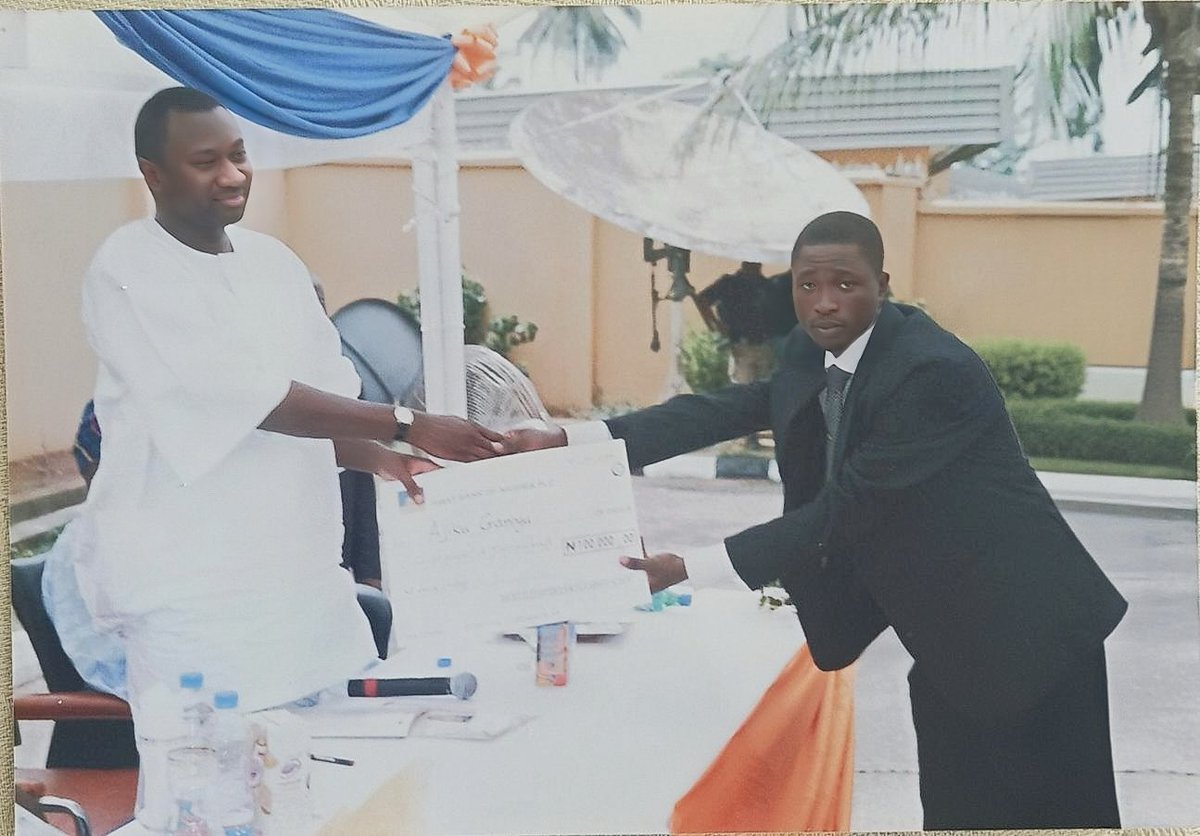
Throwback Thursday. 21 years ago today (in 2005) then Governor of Lagos State, @officialABAT, chaired the Sir Michael Otedola Scholarship Scheme Award Ceremony. Today His Excellency now serves as President of the Federal Republic of Nigeria.
In the ceremony I donated N200,000,000 (two hundred million naira only) to the scholarship scheme founded by my late father in 1987, continuing our family’s commitment to investing in the education.
True wealth is not measured by what we keep, but by the lives we change 🕊️ … F.Ote💲
EU ambassador Gautier Mignot says Nigeria's economic reforms are creating opportunities for greater investment and business partnerships. https://t.co/H2SpIZvGZB
FEDERAL MINISTRY OF FINANCE
PRESS RELEASE
𝐅𝐄𝐃𝐄𝐑𝐀𝐋 𝐆𝐎𝐕𝐄𝐑𝐍𝐌𝐄𝐍𝐓 𝐈𝐒𝐒𝐔𝐄𝐒 𝐓𝐑𝐀𝐍𝐒𝐈𝐓𝐈𝐎𝐍 𝐆𝐔𝐈𝐃𝐄𝐋𝐈𝐍𝐄𝐒 𝐅𝐎𝐑 𝐓𝐀𝐗 𝐀𝐂𝐓𝐒 2025
The Federal Government has issued the General Guidelines for the implementation of the Tax Acts 2025, setting out the process for transition from the repealed tax laws to the new tax framework effective from January 1, 2026.
Issued by the Federal Ministry of Finance, the Guidelines provide direction to taxpayers, tax practitioners, revenue authorities and other stakeholders on how to address various issues arising from the old regime to the new framework.
Under the Guidelines, the Tax Acts 2025 comprising the Nigeria Revenue Service (Establishment) Act, the Nigeria Tax Act, the Nigeria Tax Administration Act, and the Joint Revenue Board (Establishment) Act apply from the respective commencement dates as enacted in each law. In particular, January 1, 2026 for the Nigeria Tax Act, 2025.
Tax liabilities, assessments, audits, investigations, disputes and enforcement actions relating to periods before that date will be treated under the repealed tax laws.
Tax returns relating to accounting periods ending before January 1, 2026, will be filed under the previous tax laws, while returns relating to accounting periods ending from January 1, 2026, onward will be administered under the new tax framework.
The document also covers the treatment of income taxes, transaction taxes, development levies, tax incentives, exemptions, record-keeping obligations and transactions that span both the old and new tax regimes.
Existing tax incentives and exemptions granted under the repealed laws will remain in place until their expiration dates. New applications and pending requests, however, will be considered under the provisions of the Tax Acts 2025.
Speaking on the release of the Guidelines, the Honourable Minister of Finance and Coordinating Minister of the Economy, Mr. Taiwo Oyedele, said the document provides a framework for managing transitional issues while ensuring that the new laws are not applied retrospectively.
He described the Tax Acts 2025 as a significant milestone in Nigeria's tax reform programme, noting that the Guidelines set out how existing obligations, ongoing matters and future transactions will be treated under the new regime.
According to the Minister, the Guidelines are anchored on three key principles - clarity, fairness and administrative certainty.
The Guidelines are intended to promote uniform implementation and support effective administration across the Nigeria Revenue Service, State Internal Revenue Services, the FCT Internal Revenue Service, Local Government Revenue Committees, tax practitioners and taxpayers nationwide.
The Government reaffirmed its commitment to building a transparent, efficient and modern tax system that supports economic growth, strengthens revenue administration, encourages voluntary compliance and improves Nigeria's investment climate.
Efe Ovuakporie
Director, Press Relations
Federal Ministry of Finance
June 18, 2026
The Enugu–Port Harcourt Expressway has been fully rehabilitated under the Federal Government as part of efforts to restore key national road infrastructure and improve connectivity across the South-East and South-South regions.
The corridor remains one of the most important highways in the country, linking Enugu through Abia State to Port Harcourt in Rivers State, and supporting heavy commercial and passenger movement.
The project was carried out under the supervision of the Federal Ministry of Works, led by the Honourable Minister of Works, Sen. David Umahi. The rehabilitation covered critical sections of the road, including the reconstruction of failed portions, asphalt resurfacing, drainage upgrades, and general structural improvements aimed at restoring durability and ensuring smoother traffic flow.
With the project completed, the expressway now offers improved travel conditions, reduced journey times, enhanced safety for road users, and stronger support for economic activities along this major transport corridor.
📍Enugu–Port Harcourt Expressway
@PNMbah | @FMWNIG
#RenewedHopeAgenda #PresidentTinubu #StateHouseDigital #RenewedHopeInAction
The construction of the Calabar-Abuja superhighway; one of the four major legacy projects of this administration is moving at a rapid pace and the people of the benefitting states are excited.
The road begins from the spur of the Lagos-Calabar Coastal Highway in Cross River State (Ndibe Beach, Afikpo). It traverses Ebonyi, Benue, Kogi, and Nasarawa states, and terminates at Apo in the Federal Capital Territory (Abuja).
The team @PBATMediaCentre spoke with some excited users as part of the ongoing Renewed Hope National Media Tour in the South East.
#SouthEastRenewedHopeTour
You Guys Need To Watch This PLEASE
So The Question Is Around Taxation & Harmonizing Taxes. Bear In Mind That Tinubu Has Now Done This. Peter Obi Criticized It
Listen To Peter Obi’s Answer To The Question 🤣
OBIdients, God Will Punish All Of You 🫵🏻
1. Those companies did not build those stadiums; they simply paid for the naming rights. For example, Mercedes-Benz pays an average of $12 million per year to have its name on the stadium.
2. The disparity between the cost of maintaining such facilities and the income they generate is so vast that they could easily become white elephants.
Maintaining the Mercedes-Benz Stadium costs about $5 million monthly. There is simply no market for such facilities here.
3. What we need are small arenas (with capacities of 5,000 to 10,000) that have well-maintained playing surfaces and other decent facilities in every Local Government Area across the country.
4. Local Governments (not the president) across the country should be doing (thats if their governors allow local government autonomy to thrive)
5. We can also encourage companies and individuals to build such facilities. For example, I built full-sized pitch (personal funds) at Urban Day Grammar School, Ibadan.
Guess what? We have already unearthed some talents who are now on their way to trials abroad.
Imagine what we could achieve if we all joined hands and did this at scale.