@DrPaulCHIY Crucial progress. Raising the bar for AQLR accreditation signals a clear commitment to integrity and performance. Ensuring that practitioners meet the highest standards is the best way to protect the vulnerable and support the courts. Well said, Dr. Chiy!
@DrPaulCHIY Congratulations to @PaulChiy on the formal launch of his Chambers. A rare journey across CILEx, solicitors and the Bar brings valuable perspective to advocacy and advisory work. Wishing Chambers of Paul Chiy every success as it begins this new chapter.
The Chambers of Paul CHIY
I must apologise to my followers who have had to stumble across the Chambers of Paul Chiy and cross-examine me intensively before I had the chance to properly introduce it. The plan was always to make a formal announcement at the launch, but now that the cat is firmly out of the bag — thanks to some persistent poking and rigorous questioning — it feels only right to set out who we are and how we arrived here.
Many of you will know that the legal profession in England has long been described as bifurcated — solicitors on one side and barristers on the other. But the modern profession is more complex than that. The emergence and growth of Chartered Legal Executives (CILEx Lawyers) has created a third pathway, one that has steadily eroded the traditional boundaries and reshaped the way legal services are delivered.
My own career has taken me through all three branches: first as a Chartered Legal Executive, then as a solicitor-advocate, and now as a barrister. Out of more than 250,000 lawyers in England and Wales, fewer than ten hold all three qualifications — a path my professional journey has happened to take. And of that very small number, most are not authorised by their regulators to practise actively across all three. I am pleased to say that the Bar Standards Board (BSB) has granted me the specific exemption that enables this breadth of practice.
The Chambers of Paul Chiy is regulated by the Bar Standards Board of England and Wales, and this authorisation has now shifted my practice from solicitor-advocate to barrister, with full rights of audience before the courts.
For those curious about the difference between the three routes: solicitors tend to work closely with clients from the outset, managing cases, evidence and litigation; barristers traditionally specialise in courtroom advocacy and complex legal argument; and Chartered Legal Executives offer a specialist, practice-based route into the profession with expanding rights of audience and litigation authority. To have travelled through all three pathways — and to be authorised to draw on that combined experience — shapes the way I practise and the ethos of the Chambers.
You can read more about the Chambers and its foundations here:
🔗 https://t.co/gF3ABnWKTC
The Chambers of Paul Chiy is built on accessible, principled and effective legal representation across family, employment, civil and commercial disputes, and alternative dispute resolution. It reflects years of practice, development, and a commitment to doing law with clarity, purpose and integrity.
Thank you to everyone whose curiosity forced my hand sooner than expected. As always, your engagement keeps me on my toes.
#ChambersOfPaulChiy #Barrister #SolicitorAdvocate #CILExLawyer #LegalProfession #Advocacy #DisputeResolution #Law
@DrPaulCHIY The arrival of Sir Robert Buckland at De Jure Chambers is a moment of pride. His lifelong dedication to public service and justice is a gain not just for our clients, but for humankind.
We are delighted to welcome The Rt Hon Sir Robert Buckland KBE KC as Senior Consulting Partner at De Jure Chambers. His unparalleled expertise in law, government and ADR will greatly enhance our strategic advisory and advocacy services.
https://t.co/BzG4Fcacap
We are delighted to welcome The Rt Hon Sir Robert Buckland KBE KC as Senior Consulting Partner at De Jure Chambers. His unparalleled expertise in law, government and ADR will greatly enhance our strategic advisory and advocacy services.
https://t.co/BzG4Fcacap
@DrPaulCHIY Today marks a crucial step in safeguarding children from online harm. The #OnlineSafetyAct places legal obligations on tech platforms to prevent child exploitation and abuse. The law is clear: failure to act will not be tolerated. #ChildProtection#UKLaw
@DrPaulCHIY 🚨 Reminder: BRPs expire in 18 days (31 Dec 2024). Don’t wait! Create a UKVI account to access your eVisa now: https://t.co/03L4U0dwAH. Retain your expired BRP for future use. Act today! #UKImmigration#eVisa
BRPs Expire in 18 Days: Urgent Action Required for Transition to eVisas
The UK Home Office has issued an urgent reminder that Biometric Residence Permits (BRPs) are due to expire on 31 December 2024, leaving just 18 days to take action. BRP holders must transition to a digital immigration status known as an eVisa before their BRP expires. This transition is critical to ensuring you can continue to prove your immigration status in the UK without disruption.
If you have not already done so, it is essential to create a UKVI account immediately. This account will enable you to access your eVisa, which is a secure and efficient way to manage and prove your immigration status digitally. The process to create your account can be completed at the official UKVI portal: Access Your eVisa.
Even after your BRP expires, do not dispose of it. The Home Office advises that expired BRPs should be retained as they may be required for future immigration applications or to provide evidence of your immigration history. However, expired BRPs cannot be used to prove your current immigration status.
Failure to transition to an eVisa promptly may result in difficulties with employment, housing, travel, and other activities requiring proof of your immigration status. Delaying action could lead to unnecessary complications and disruptions.
For more information on the transition to eVisas and guidance on expired BRPs, visit the UK government website: BRP Guidance.
Time is running out—act now to avoid complications. Ensure you have completed the necessary steps to create your UKVI account and secure your eVisa before the 31 December deadline.
A Shocking Assault on Justice: The Attack on Barrister Tamfu Richard
In a disturbing incident that has shaken Cameroon’s legal community and beyond, Barrister Tamfu Richard, a celebrated human rights advocate, was violently assaulted on 27 November 2024, by gendarmes in Douala.
Known for his fearless defense of marginalised individuals, Tamfu’s ordeal underscores the growing dangers faced by legal practitioners in Cameroon and highlights the urgent need for judicial and institutional reform.
A Courageous Stand Turns Violent
The incident occurred at the "Groupement de Gendarmerie in Bonanjo", Douala, where Tamfu was defending a client summoned for questioning. Upon discovering that the arrest was carried out without a warrant—a blatant violation of procedural law—Tamfu confronted the gendarmes. Eyewitnesses recount that his professional protest was met with hostility and escalated into violence. In a shocking display of brutality, the gendarmes physically assaulted Tamfu in the presence of onlookers.
The assault left the barrister injured and hospitalised, sparking an outcry from the legal community, human rights organisations, and international observers. This attack, seen by many as a direct affront to the rule of law, underscores the risks faced by lawyers who challenge systemic abuses.
Key Voices of Condemnation
The incident has prompted an outpouring of condemnation from prominent figures and organisations, each highlighting the broader implications for justice and governance in Cameroon.
Akere Muna’s Resounding Condemnation
Akere Muna, a key political figure, former presidential candidate (2018, 2025), anti-corruption crusader, and renowned human rights defender, was among the first to speak out. A former President of the Cameroon Bar Association, Muna described the attack on Tamfu as "a dagger thrust into the heart of justice."“This isn’t just about one lawyer being attacked,” Muna stated. “It’s about a system that allows the very protectors of the law to undermine it through violence. It’s about the safety of every lawyer, every advocate for justice, and ultimately, every citizen.” Muna called on the government to ensure accountability and reiterated the importance of a free and independent legal profession as a cornerstone of democracy. His words carried weight, reflecting his decades-long fight against corruption and his advocacy for human rights both in Cameroon and internationally.
The Cameroon Bar Association’s Outrage
The Cameroon Bar Association issued a formal statement denouncing the attack as a grave violation of legal and constitutional rights. The association pledged unwavering support to Barrister Tamfu and demanded the immediate prosecution of those involved. “This attack is not just an affront to Barrister Tamfu but to every lawyer in Cameroon and to the rule of law itself,” the Bar declared.
Internation Association of Lawyers (UIA-IROL)
The International Association of Lawyers (UIA-IROL) also condemned the assault, describing it as an intolerable attack on legal independence and fundamental rights. In their statement, UIA-IROL expressed grave concern about the increasing trend of violence and intimidation against lawyers in Cameroon. “The ability of lawyers to perform their duties without fear is non-negotiable,” they asserted. UIA-IROL called for an impartial investigation and pledged to monitor the situation closely.
Civil Society and Human Rights Groups
Local and international human rights organisations joined the chorus of condemnation. Advocacy groups highlighted the systemic issues within Cameroon’s law enforcement and judicial sectors, pointing to a culture of impunity and disregard for legal safeguards.
These organisations have demanded comprehensive reforms to protect lawyers and uphold procedural justice.
A Systemic Crisis
Again, the attack on Barrister Tamfu is not an isolated incident. It is emblematic of a broader erosion of the rule of law in Cameroon, where security forces often operate with impunity.
Legal practitioners, tasked with defending the rights of citizens, increasingly find themselves targets of harassment and violence.
This incident also raises pressing questions about the state’s commitment to international legal principles.
The United Nations’ Basic Principles on the Role of Lawyers and the African Guidelines on Fair Trial Rights mandate that lawyers must be able to perform their professional duties without intimidation or interference—a standard that Cameroon has glaringly failed to meet.
The Road Ahead
The legal community and civil society have outlined a series of urgent demands:
Accountability: A thorough and impartial investigation into the attack on Barrister Tamfu, with the prosecution of those responsible.
Systemic Reforms: Training for law enforcement on human rights and legal standards, alongside mechanisms to ensure accountability.
Safety Assurances: Protective measures to ensure that lawyers can perform their duties without fear of violence or reprisal.
A Defining Moment for Cameroon
For Akere Muna, this incident is a litmus test for Cameroon’s justice system and governance. As a leading voice for anti-corruption and human rights, Muna emphasized the need for courage and accountability. “We cannot build a just society if those who defend justice are left defenseless,” he remarked.
The attack on Tamfu has united voices from across Cameroon and the international community. It is a stark reminder of the fragility of justice when those charged with its protection are themselves subject to violence. Whether this incident becomes a turning point or another chapter in systemic failure will depend on the actions taken in the days and weeks ahead.
For now, the world watches as Cameroon confronts this critical test of its commitment to justice and the rule of law.
Civil Society and Media
Civil society organisations and media outlets have amplified calls for justice. Human rights groups have pointed to the attack as evidence of the erosion of democratic norms in Cameroon.
Media and other platforms have emphasised the gravity of the assault, calling it a "turning point" for the legal profession and governance in Cameroon.
The Broader Crisis of Justice
The assault on Barrister Tamfu has revealed deep cracks in Cameroon’s justice system. Lawyers, tasked with defending citizens’ rights, are increasingly finding themselves targeted by the very institutions meant to uphold the law.
This systemic failure has far-reaching implications:
Erosion of Public Trust: The public’s confidence in the justice system diminishes when defenders of the law are openly attacked.
Weakening of Democratic Norms: Without accountability, acts of violence against lawyers and citizens threaten the democratic framework of the country.
Chilling Effect on Legal Advocacy: The targeting of lawyers like Tamfu discourages others from taking up sensitive cases, leaving victims of systemic abuses without representation.
The Fight for Accountability
The assault has sparked urgent demands for action:Immediate Investigation: National and international bodies have called for a thorough investigation into the incident, with transparency at the forefront.
Accountability Measures: Those responsible for the attack must face legal consequences, both to deliver justice for Tamfu and to send a clear message against impunity.
Systemic Reforms: Long-term measures, including training for law enforcement on human rights and procedural justice, are essential to prevent future abuses.
Conclusion: Justice on Trial
The attack on Barrister Tamfu Richard is a defining moment for Cameroon. It is a test of the government’s commitment to justice and the rule of law. As calls for accountability grow louder, the international community watches closely. Will this incident become a catalyst for change, or will it mark another chapter in the erosion of justice in Cameroon?
For now, the story of Barrister Tamfu’s courage in the face of violence serves as a stark reminder of the stakes in the fight against impunity. It is a fight that goes beyond one individual and touches on the very soul of a nation’s justice system.
Anyone who does not condemn this condones it
International Legal and Human Rights Organisations
@UIAdefense - International Association of Lawyers (UIA-IROL)
@UNHumanRights - United Nations Human Rights
@IntlCrimCourt - International Criminal Court (ICC)
@ICJ_Global - International Commission of Jurists
@AmnestyOnline - Amnesty International
@hrw - Human Rights Watch
@TheJusticeInst - The International Justice Initiative
Regional Legal and Human Rights Organisations
@ACHPR - African Commission on Human and Peoples' Rights
@PALU_Org - Pan African Lawyers Union
@AfricLaw - African Legal Aid
United Kingdom Legal Organisations
@TheLawSociety - The Law Society of England and Wales
@thebarcouncil - The Bar Council of England and Wales
@CIArbUK - Chartered Institute of Arbitrators
@IBAnews - International Bar Association (headquartered in London)
@ICCA_TheHague - International Council for Commercial Arbitration (UK-affiliated)
@UKSupremeCourt - UK Supreme Court (institutional reach)
@JUSTICEhq - JUSTICE (UK-based legal reform and human rights organisation)
@LibertyHQ - Liberty (Advocacy and legal rights in the UK)
Local Organisations in Cameroon
@CameroonBar - Cameroon Bar Association (if available)
@EsBi_Media - Local media reporting on the case
Key Figures
@AkereMuna - Akere Muna, former Cameroon Bar President and human rights crusader
@IntlAntiCorr - Anti-corruption networks linked to Akere Muna
Advocacy and Media Platforms
@OpenSociety - Open Society Foundations
@FrontLineHRD - Front Line Defenders
@GlobalRightsOrg - Global Rights
@CIVICUSalliance - CIVICUS: World Alliance for Citizen Participation
@AJEnglish - Al Jazeera English for global media reach
@DrPaulCHIY The holidays are hard enough without the stress of court battles. Let’s push for more early intervention options for families. #PreventConflict
When Family Becomes the Battlefield: A Christmas Conflict in Court
Last week, I represented a family in one of the more complex and multifaceted cases I’ve seen in family court. The matter involved a mother, her six adult children—two sons and four daughters—and a grandchild who, though not present, was indirectly affected by the proceedings. In a courtroom just weeks before Christmas, a time typically associated with family unity, this family was divided, facing each other as legal adversaries. Tensions ran high, and a physical screen separated them—a stark reminder of how deeply fractured their relationships had become.
This was a family that had once shared a home, but disputes over the use of the shared residence had escalated to the point of legal action. Their mother, now 91, was restricted in her own home, bound by court orders that dictated access to various parts of the house. She was limited to using the kitchen at specific times and, due to longstanding disagreements, had sought an order herself against her daughter to restrict movement within the property. Even the simple act of doing laundry required her to leave her residence and use a laundrette miles away. The case illustrated how, for this family, even routine household matters had become points of contention.
The proceedings also revealed the complexity of issues involved. One daughter, living in the family home with her spouse and child, was seeking an occupation order to have the youngest sibling vacate the property. Meanwhile, another daughter, who had a disability and was estranged from the family, had been prohibited from visiting the property due to a falling-out with her sister. The mother’s access to her young grandchild was similarly limited, a restriction stemming from allegations that one of her sons was attempting to influence her decisions on inheritance.
Throughout the hearing, a senior family judge presided, intervening at critical moments to maintain order and facilitate a fair exchange. The judge reminded the parties of their shared history and urged a focus on finding a resolution, though the underlying mistrust was evident. Allegations were serious, including accusations of threats and coercion over potential changes to the mother’s will.
These family matters often reflect a breakdown that extends beyond legal disputes, showing the importance of access to timely intervention, such as family counseling and mediation. By the time families reach the courtroom, long-standing issues can become entrenched, making resolutions more complex and limited in scope. Despite the intense personal dynamics at play, lawyers and the court must approach these cases with a focus on fairness, clarity, and adherence to legal principles rather than emotional considerations.
As the holidays approach, this case underscores the need for accessible support systems that might help families address conflicts before they escalate. Disputes like these illustrate the importance of early intervention, allowing families an opportunity to resolve underlying issues before they require formal legal action.
@DrPaulCHIY Bravo pour cette publication ! Une œuvre qui tombe à point nommé pour le Cameroun.
Quelle belle réussite ! Félicitations pour cet ouvrage indispensable.
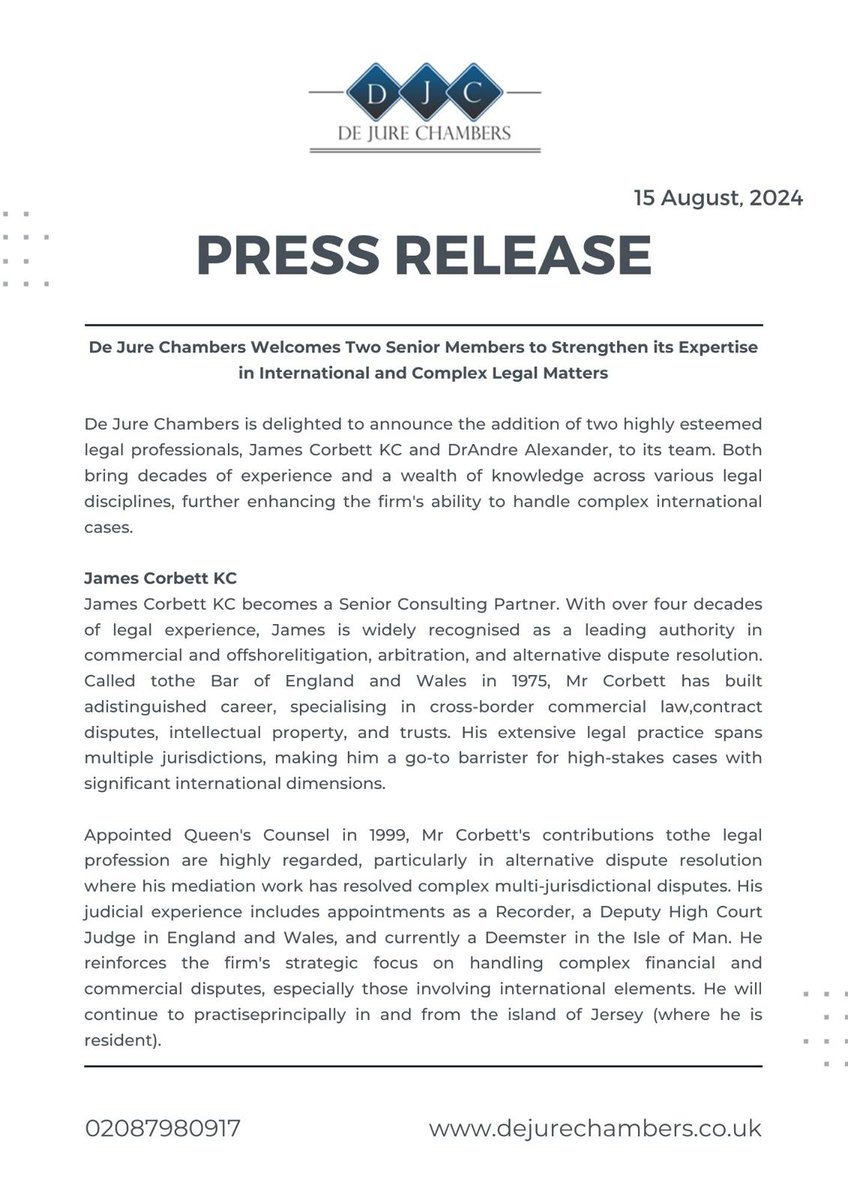
Thrilled to Welcome Two Legal Heavyweights to De Jure Chambers!
I am incredibly excited to announce that James Corbett KC and Dr. Andre Alexander have joined us at De Jure Chambers. These two remarkable legal professionals are not only experts in their fields but also bring a level of experience and insight that will undoubtedly elevate our firm’s capabilities.
James Corbett KC, with over 40 years of experience in commercial and offshore litigation, arbitration, and alternative dispute resolution, has consistently been a leading authority on cross-border legal matters. His expertise and track record in handling high-stakes international disputes are second to none.
Dr. Andre Alexander, with his diverse background across multiple jurisdictions, brings a wealth of knowledge in business law, finance, human rights, and criminal defence. His leadership and innovation in the legal field, particularly in cross-border dispute resolution, are truly inspiring.
Having both of them on board marks a significant milestone for De Jure Chambers. Their combined expertise will further strengthen our firm’s ability to navigate complex international legal challenges and continue providing exceptional service to our clients worldwide.
Looking forward to this exciting new chapter for our team and the value we will bring to our clients globally.
#InternationalLaw #LegalExperts #DeJureChambers #Leadership #CrossBorderLaw #LegalInnovation
—
Paul CHIY
Principal, De Jure Chambers
🚨 Exciting News! De Jure Chambers welcomes legal heavyweights James Corbett KC & Dr. Andre Alexander to the team! Their expertise in international & complex legal matters further strengthens our global practice. 🌍💼 #LegalExperts#CrossBorderLaw#DeJureChambers