Most negative part of Kalshi is people only thinking insiders win on it. So they hired the person everyone pictures when they hear "insider trading" and had her bake a pie.
The ad never says why it's her. Their press release even adds "Stewart was never convicted of insider trading."
They left the joke for you to make, and people share the jokes they feel they figured out themselves.
Every product that spread on its own had the same trick. You couldn't use it without someone else seeing it.
> Every Hotmail email ended with "Get your free email at Hotmail." Then Hotmail hit 12 million users in 18 months on less than $500K of marketing.
But AI assistants do all of their best work where only the user can see. If they were able to have some type of status and fomo producing effects, it could have each user bring in another.
one consistent thing you notice in lots of new ai products including the current class of personal assistants is how few natural vectors of distribution they have. most of them rely entirely on awareness, word of mouth, or an invite system (& so many of them are sustained almost entirely by the google/fb tax).
it may be worth it to invert the model here entirely, e.g. focus on the natural growth mechanics first, & build ai products around those loops. this is like the number one thing i spend my time thinking about. in the ai era you may have to invert come for the tool, & stay for the network entirely.
I have a confession to make.
I've been building like a maniac with Claude. 738 pull requests since September. 😵
I was so proud of myself. 😁
So I asked Claude to grade it. Which of these actually significantly improved the business?
4.
Out of 67 things we actually shipped, 4 clearly moved a number.
Only 8% of it was even for AppSumo. The business that pays for all of it.
Then it went through my messages. 2,045 of them. I asked "did that work?" 25 times.
And the worst part. We ran 2 tests on AppSumo that found winners. They've been sitting there for 2 weeks because nobody made the call. Nobody = me. 🤦
Building used to be the hard part. Now it's basically free. So I was doing whatever felt productive instead of what moved things forward.
New rule: nothing ships unless I know what number it's supposed to move.
Prompt I used 👇
"Look at everything I shipped since [date] and every message I sent you. For each change: what number was it supposed to move, did it move, and what did I never check? Rank what I should stop, keep and finish."
Realized that to be a legendary marketer you need to understand the history of advertising and fundamentals of consumer psychology.
Watching the podcast with @thesamparr@brian_blum1@alexgarcia_atx about copywriting and they were talking about classic, high-performing ads that still get reformatted today.
Also learned from @davidsenra@FoundersPodcast on his interview with CAA founder Michael Ovitz, how he learned from Martin Scorsese about knowing the entire history of the art in your industry.
Study every winning marketing campaign from the last 100 years so you can be fluent in talking in your audience's language
Built an ad museum to help with that: https://t.co/SXbDNYsPbN
NVIDIA's moat isn't Jensen
A new chip company would hit the same wall Google, Amazon and Microsoft already hit.
They build their own chips and still pay NVIDIA billions, because leaving means rewriting years of CUDA
Jensen very well might start another chip company if ousted.
He could raise billions in VC and make a competitor to Nvidia. Not sure this is being priced in right now.
Every new medium starts out copying the one before it. Email copied paper mail, which is why we still have an inbox, an envelope icon, and "cc”
The person who came up with the phrase “the medium is the message” called it marching backwards into the future.
An AI email client might just be the next version of that
this is actually a really fun interview question to determine product sense.
just ask someone what the future of email looks like, & if their answer is anywhere near building yet another email client, you have to likely question their product instincts.
the entire point of a paradigm shift is to rethink which products should exist, not simply recreate the old ones with some ai sprinkles.
email is a database roughly speaking, claude already has access to it & it has i/o too. if anything every service will simply have an email address that you can use through the same chat interface, even then it's likely a bit confusing anyway. if my claude has its own email address as a vector for others whom i interact with to send, it'd be nice in many cases but also this introduces all sorts of other challenges, you'd have to think about what messages matter, spam, etc. stuff that gmail solved. so you're inventing wheels that do not need to be.
Your brand is not competing with other brands on social media, it is competing with the world of content on your customers feed
and you need to strategize accordingly 👇
People follow the convention because it feels safe, but then that same safety makes them easy to forget because people start to want something new.
Most conventions started as a guess,
then people just kept copying it because nobody took the time/energy or wanted to be an outlier to push things forward.
So everything became a copy, of a copy, of a copy…
Remember: there is no “correct” format or voice for writing a blog post, job description, or announcement
Conventions are an illusion to trick us into being unremarkable
Everyone who came before was just larping as someone else who came before. They don’t know your business better than you
Always start with the fundamental principles of what you’re trying to achieve, then follow tha
@kamilrextin True.
Currently running relatively small audiences on Linkedin (10k-20k), only director+ seniority only.
The impressions and leads we bring in become pipeline months later.
let’s face it. b2b marketers are getting praised for things dtc marketers have done for the last decade:
• UGC: turning customers into creators and running their videos as ads. @TrybeUGC
• SEO: spinning up hundreds of pages like ecommerce brands do with product catalogs @AirOpsHQ
• CRO: popups, quizzes, personalized landing pages, and aggressive conversion testing
• Social: founders and employees posting authentic, unfiltered thoughts in real time @WisprFlow@spacexai
• Brand: funny campaigns, memes, stunts, and entertainment instead of corporate vanilla narratives @tryramp
• Video: live streams, short-form content, and behind-the-scenes footage @tryramp
• Paid: testing dozens of hooks, creatives, and audiences instead of running the same 3 ads for six months
• AI: generating personalized experiences, pages, and creative at scale @tofuhq@mutinycorp
none of this is revolutionary. dtc marketers have been doing it forever. what’s revolutionary is this speed & authenticity mindset is entering b2b.
b2b has spent decades marketing to companies instead of remembering that companies are made of people.
the cracked growth marketers figured that out and are using it to their advantage.
There's a massive market for the illusion of freedom. It's why Excel is so lindy and why the Marlboro Man worked. Both sell the romance of independence, self-reliance, and the open frontier. People don't actually want to spend their lives herding cattle in Wyoming or build their own tools. But they like the idea that they could. The fantasy is the product.
Like Nike’s old ads where that feeling was part of what you were buying..
You could picture yourself jumping higher, running faster, and becoming a better athlete just by putting the shoes on.
i miss the times when marketing is pure taste, judgement, and how it makes you FEEL.
now everything is all about conversions, clicks, funnels. but you can't measure emotions someone feel after watching your ad.
People will talk about “storytelling” and then it’s just a bucket of loosely connected facts
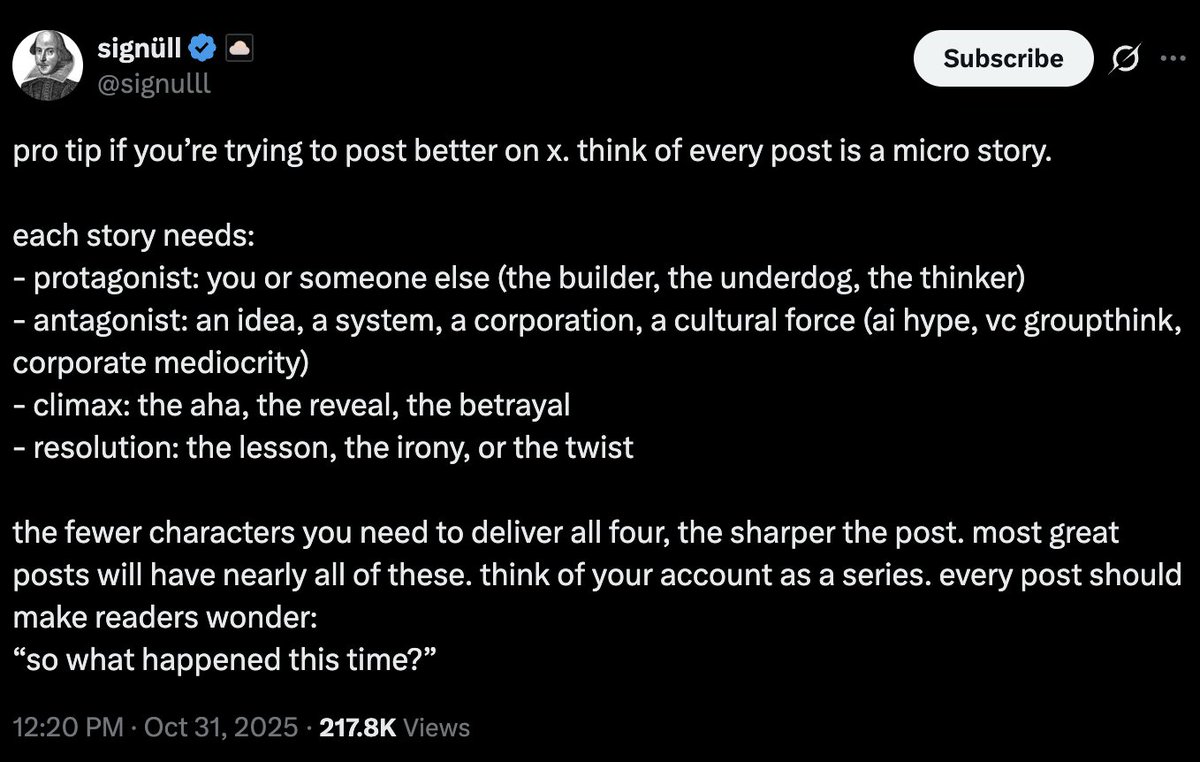
Storytelling requires a story
A story has a beginning, middle, end. A protagonist, an antagonist. Maybe a loyal sidekick. A noble quest. A surprise! A pickle!! A change, a resolution.
It’s the difference between “in a galaxy far far away…” and “today we’re excited to announce that we are launching a rebel alliance”
In some stories, the protagonist is you, on your own hero’s journey
Other times, the protagonist is the customer. They have an important goal, but there’s something standing in the way. What has changed now, and why? What’s their happy ending?
Steve Jobs literally said a touchscreen laptop makes your arm want to fall off, and he was probably right.
But that doesn't matter because a kid raised on an iPad expects to tap every screen. They get to a laptop and wonder why touching it does nothing.
Apple shipped touch for a generation that already expects it.
the best way to think about the new macbook pro touch is that touch is becoming an expectation & not necessarily a heavy utility feature.
if you ever watch a kid encounter any screen, they’ll try to touch it & it often doesn’t work, which feels pretty arbitrary in today’s age.
it obviously doesn’t dramatically improve the underlying product but it is kinda nice that the inconsistency itself is addressed. maybe your tv will eventually be touch too or maybe the airport flight status board too.
A convenient lie fits the identity people already have and the uncomfortable truth forces them to rebuild it.
And since your brain is built to save energy, being stubborn is easier than starting over.
So people get defensive, change the subject, or find a reason to say the truth doesn't apply to them.