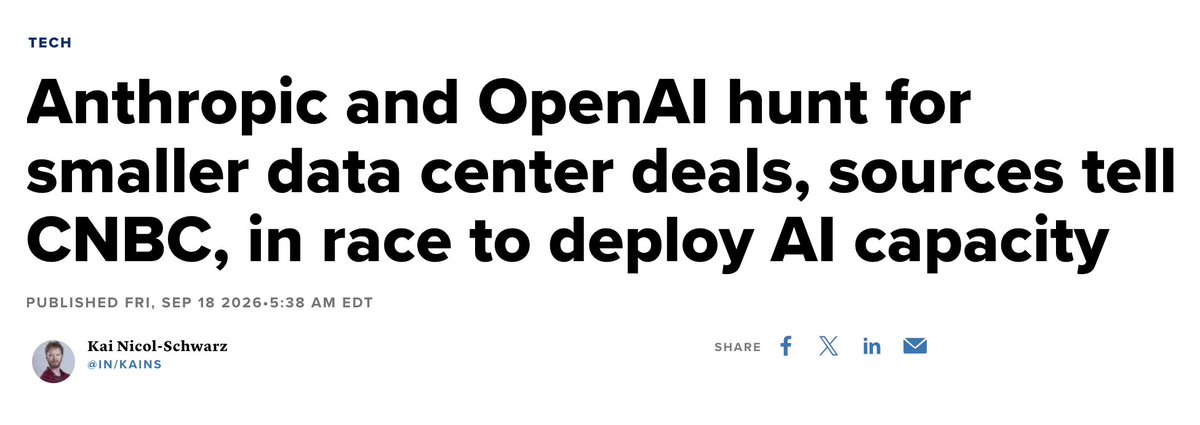
🚨 @AnthropicAI and @OpenAI Now Hunting for Smaller Data Center Deals 🚨
⚡ 20-30 MW deployments targeted — a sharp pivot from the multi-hundred-MW and gigawatt megadeals both labs signed over the past year (@AnthropicAI 's $45B @nscale /West Virginia deal, @OpenAI 's 10GW+ Stargate)
⚡ "Speed to usable capacity" is the driver — per Structure Research's Jabez Tan, securing a few MW at an existing powered site beats waiting years for one giant block
⚡ Inference is reshaping demand — per JLL, inference made up just 9% of global data center workloads in 2025 vs. 14% for training, but is projected to hit 37% by 2030 as training falls to 13%
⚡ UK and Nordics in focus — @AnthropicAI has sounded out smaller deals in both regions; @OpenAI has explored similar Nordic opportunities, with US talks also reportedly underway
⚡ @CrusoeAI pivots too — fresh off a $3.9B raise at a $30.9B valuation, Crusoe is now building smaller, faster, cheaper facilities as larger US builds face mounting delays
Powered shells > full-stack neo clouds right now.
Power is the bottleneck. Not chips. Not software.
The companies that control energizable power + shells are signing 15–20 year leases with strong counterparties and transferring the GPU risk to the tenant.
Neo clouds capture higher revenue per MW, but they own the depreciating asset and carry the financing and utilization risk.
In this cycle the scarce real asset is the powered shell. Everything else is a higher beta trade on top of it.
The market is still treating these two models too similarly. That won’t last. $KEEL $NUAI
Deal economics in AI infrastructure are improving for the landlord.
Two recent Frontier AI Lab comps show the shift:
WULF (Anthropic, 401 MW):
20-year term, $19B contracted ($2.37M revenue per MW/year). More traditional campus build — landlord delivers a higher level of finished infrastructure. CapEx $10–12M/MW. 85% NOI margin. 18% yield on cost.
RIOT (Corsicana, 910 MW):
15-year triple-net powered land lease, $28B contracted ($2.0M revenue per MW/year). Landlord delivers land, power infrastructure, and powered pads. Tenant brings the GPUs (same as WULF) and pays nearly all operating costs. CapEx only $6M/MW. 99% NOI margin. 33% unlevered yield on cost.
Same class of tenant. Similar revenue per MW. The difference is how much of the build the landlord has to fund. The newer structure is more capital-efficient and higher-margin.
This is the trend: as power becomes the scarce asset, landlords who control it can negotiate lighter CapEx and higher-margin structures instead of carrying full facility builds.
$KEEL already has the power secured and is still in active negotiations. No pressure to sign the first deal that shows up — they have the cash to wait for the best structure and terms. While others race to lock something in, $KEEL can let the comps keep improving and take the higher-quality version of the same deal. The first signature will re-rate the entire company, and they get to pick the one that maximizes it.
After the swings this year, a green Christmas in the markets would be fitting. Starting to look possible. Where do you guys see $KEEL sitting come late December?
Everyone take a mental screenshot of colocation stock prices right now.
A few years from now this is going to be
hilarious.
$KEEL $CIFR $WULF $HUT $APLD $NUAI
Yes, data center development and operating costs are rising. That has a lot of people questioning how profitable these businesses will stay.
$KEEL is in a different position. They’re not locked into ANY deals. They fully understand the volatility of these costs. As costs go up, they will charge more and protect their economics. It’s that simple.
We’re in the driver’s seat now; we’re bullet proofing the thesis.