Fish and #robots … what could be better!? Recent paper (https://t.co/UDTsR6rUiI) by Carl White @BIERLABS1 has two very useful tables summarizing #swimming robots and their speed, tail beat frequency, and power used to swim. Here the TunabotFlex demonstrates low cost swimming.
Extracting signature responses from respiratory flows: Low‐dimensional analyses on Direct Numerical Simulation‐predicted wakes of a flapping uvula https://t.co/62s1aVNjjU
Following up yesterday’s tweet from @rthandiackal on our #zebrafish locomotion work, it’s hard to overemphasize how detailed the velocity vector fields are using IR light and small algae as tracer particles. Paper in @J_Exp_Biol (https://t.co/FCsXkLUreg) #swimming#fishsci
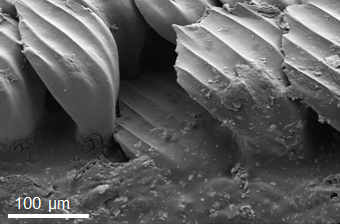
More on missing #shark skin denticles! 3D view of the surface of a leopard shark, with color showing height. The blue pits are depressions caused by missing denticles; new denticles are formed and erupt into each gap. More cool images to come! #swimming#fishsci#SharkScience
We all know that #sharks replace their teeth, but have you ever seen #skin#denticles being replaced? Our new paper (https://t.co/dzyZLi4Alo) shows denticles emerging from below into gaps at the skin surface in #thresher shark tails. More to come! #swimming#fishsci#SharkScience
Aquatic Biologists & Biomechanists! Need a 3D mesh for Computational Fluids Dynamics/Flow Tank research? We have lots of 3D meshes for #openaccess use- Fish/Sharks, Marine Mammals, Sea Turtles! @DigitalLife3D 😋 - You can download from the link below
https://t.co/he9YDYUmIk
Our newly published article in Physical Review Fluids is up now on the journal's website. This research presents how the wavelength of undulating swimmers' kinematics affects their performance. https://t.co/Bax1RqaIV9
New publication on the 'Flow Physics of COVID-19' now available to all via open access. Excellent work from the team @JohnsHopkins looking at what we do - and perhaps more importantly don't - know about the fluid mechanics of disease spread. https://t.co/Yn9EEQuy7I
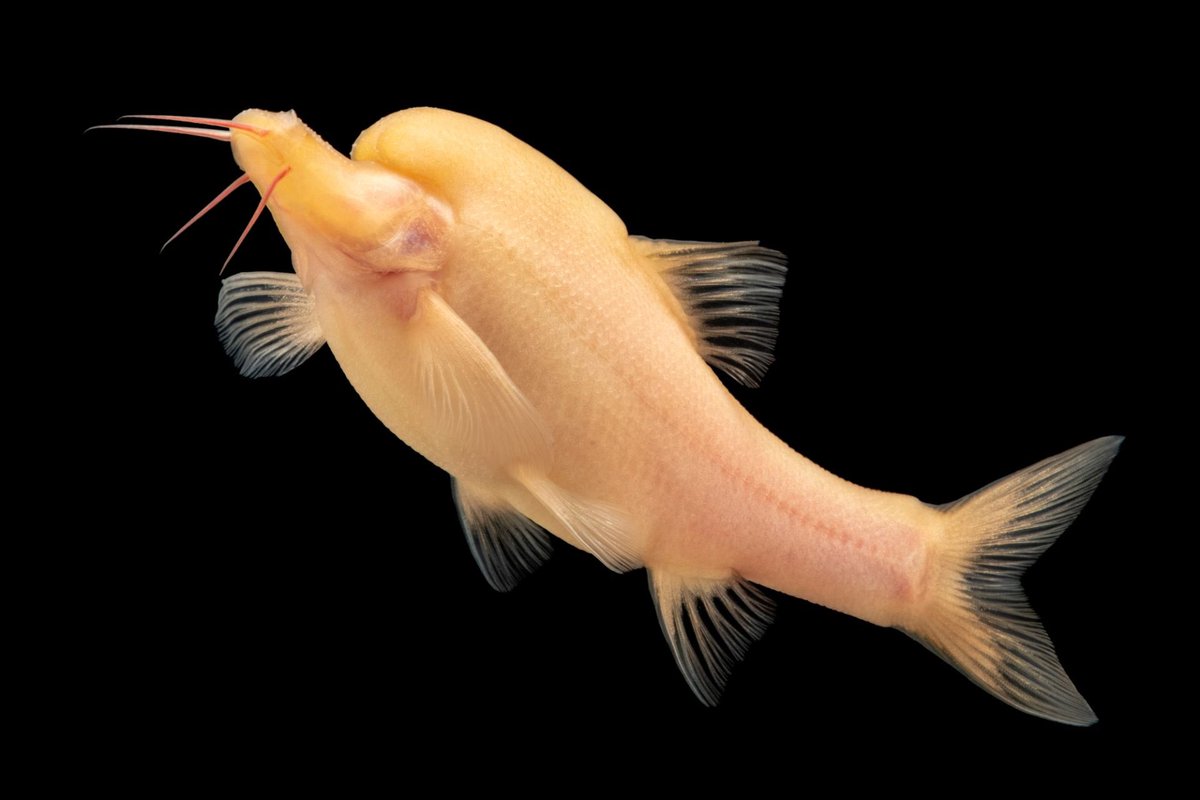
Chinese blind cave fish like this one are not your typical fish. Belonging to the genus Sinocyclocheilus, this species is known to inhabit only one underground stream in Tian’e County. Like many cavefish it has a lack of pigmentation and reduced eyes.
3D fish kinematics as input into computational fluid dynamic models is such a powerful combination: full 3D body motion reconstructed from multiple high-speed camera views. Trout model by @justinwang2011 to welcome @HaiboDong1 to Twitter! #fishsci#swimming#hydrodynamics#CFD
To understand the function of the subterminal lobe of #sharks@FredrikJutfelt, it’s critical to have 3D tail kinematics. View from behind shows tail trailing edge motion. Movie of a bonnethead with @FlammangLab. Also: https://t.co/LCeLkFrIgD. #locomotion#fishsci#swimming
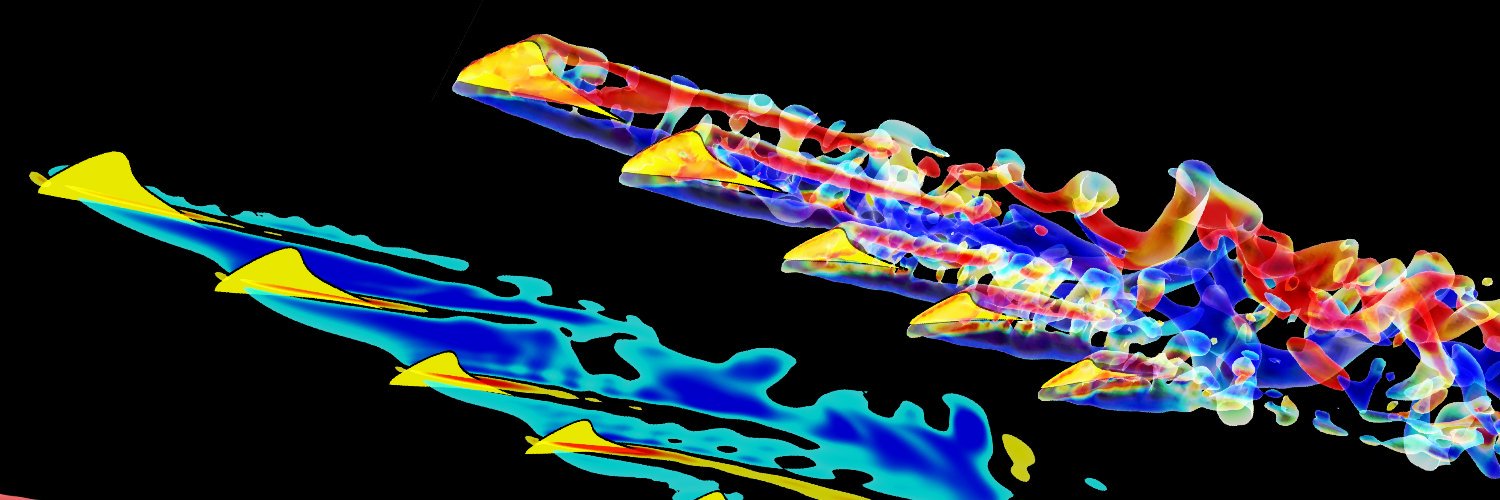
Finlets have complex effects on #tuna swimming: no thrust, but greatly modify the tail flow environment. Simulations of finlet function by @justinwang2011 and the Haibo Dong @UVA flow simulation lab in @royalsociety Interface: https://t.co/hb2eD5wnPH. #fishsci#swimming#CFD
Could tuna inspire the next generation of autonomous underwater vehicles? Researchers at @MCZHarvard and @yalepeabody present data on the morphology, behavior, and function of tunas. https://t.co/eyVLPiVrGb
Simple physical modeling provides considerable insight into the function of fish structures, like the amazing lateral keels of #tuna. Here we study the effect of adding keels to a tuna-like robotic propulsive system (see https://t.co/zizGMJZivO) #locomotion#fishsci#swimming
Tuna can migrate thousands of kilometres and remarkably still execute high-speed manoeuvres. The small “finlets” in front of their tails were thought to improve swimming performance. A new study in @RSocPublishing appears to confirm this idea. https://t.co/5dDw52wMR7
How do #tuna do the locomotion? Find out in a new computational hydrodynamic analysis of finlet function https://t.co/PfbqZNUrt5 #Interface@UVA@Harvard