Turning messy user needs into products people love • ex Product + SEO nerd at Moz • Notion ambassador • Built SEO Growth Kit, ExcessBrain, BlackRoot, Sweeft...
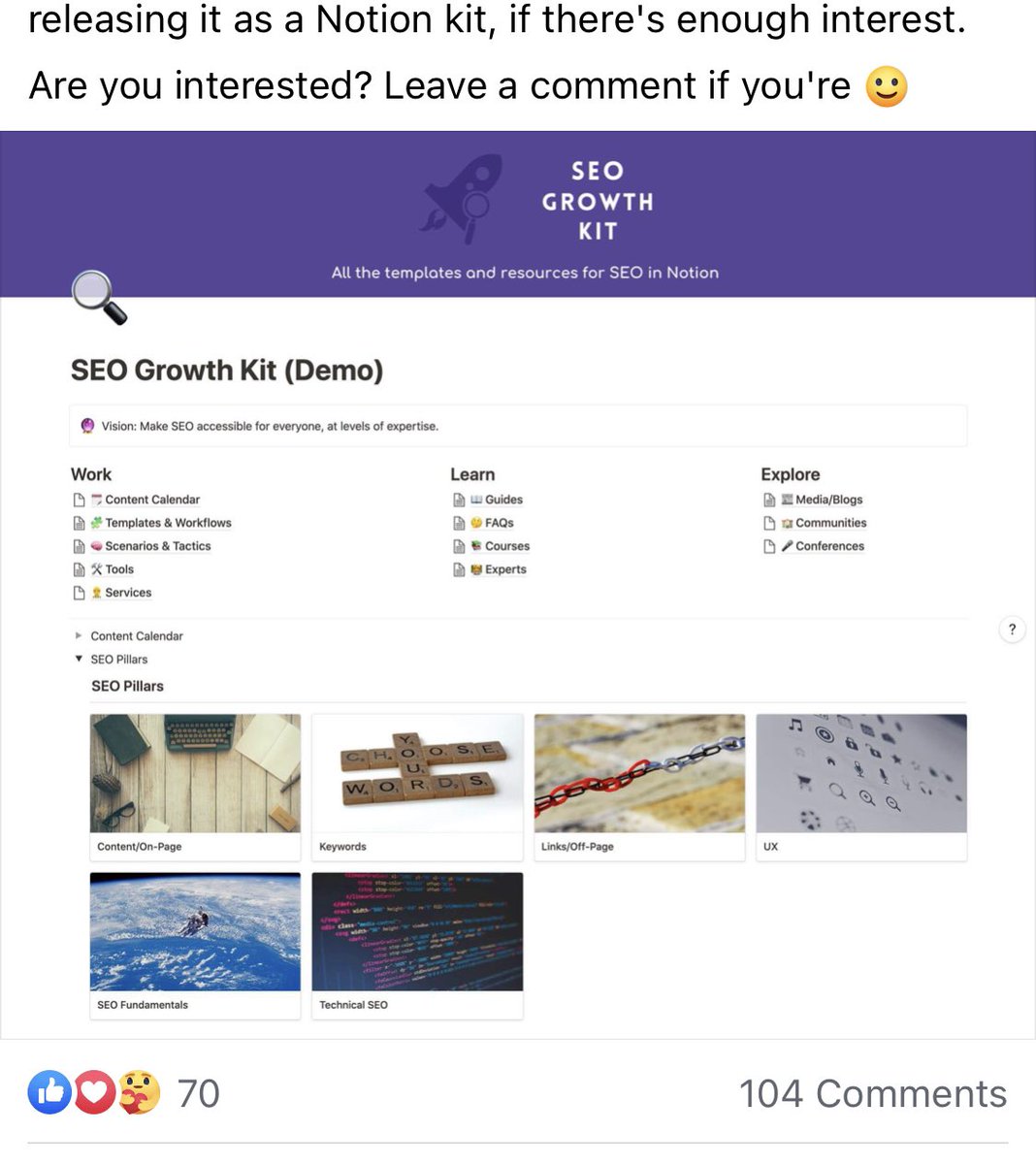
I asked on Facebook & Reddit if people were interested in kit of SEO resources built in Notion.
I was expecting like 10 people to say yes to validate the idea, instead I got 175+ 😳
I guess my next project is a SEO Growth Kit in @NotionHQ ☺️
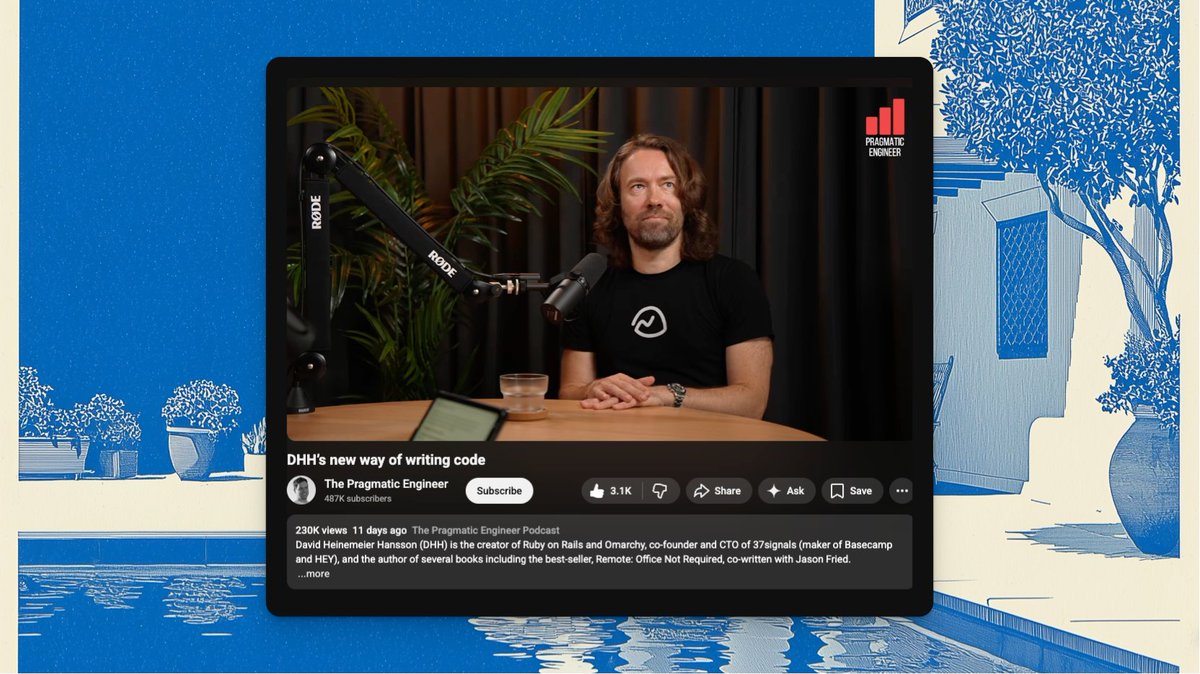
DHH spent 20 years dismissing product management.
Then 1h21 into his Pragmatic Engineer interview, he caught himself and admitted he was wrong.
He was listing what matters now that AI writes the code: figuring out what to build, how to build it, which customers to talk to, where to focus.
Then his exact next words: "It's product management. It's so funny for me too because historically I've not necessarily had the highest esteem for product management as a function. I thought there was a lot of BS."
He explained why. Implementation was always the constraint. Engineers needed four weeks to ship anything, so PMs spent those weeks talking, planning, strategizing. Nothing looked like output until the code landed.
"They were underutilized. They were not the constraint." They were rate-limited.
The loudest PM-skeptic changing his mind (and DHH has strong opinions!) -- that should count for something. let's toast to that 🥂
@scottastevenson Been thinking about this a lot. The more we understand how LLMs work, the more apparent it is that so many humans already operate this way. Unique experiences become the RAG layer.
But there seems to be another layer beyond that. Where there’s no prior information to draw from.
One of the most telling signs that someone is experienced & effective, is that they don't take much at face value. They keep a buffer between themselves and news headlines, social posts, hype waves—they are able to get enough distance on reality to see how it actually works, rather than getting thrashed around by its current.
Thoughts:
1. In the future, the probability something is generated entirely by AI will be inversely proportional to its intended lifespan.
2. For conceptually simple artifacts that are intended to have short lifespans, humans will still be involved just at a different level of abstraction. For example, I'm super excited about @Weavy_ai (Figma Weave) because it shows what's possible when you treat AI generation like clay to shape rather than the final output. Workflow building is a new skill to explore and learn.
3. If you intend for an artifact to have a long lifespan (ex: software, a novel, a movie), then AI might still aid you in your creative process. But you will bring great intention to the work. You will think through many different approaches. You will care about the smallest of details. You will lean into the craft. Because if you don't, it won't be good enough to last. It won't be noticed. It won't be loved. It won't matter.
4. Focusing just on software now... people don't like it when software changes. Everyone who has shipped a redesign knows this! So you might be generating new content within a piece of software frequently but of course you wouldn't redesign the fundamental UX of the software all the time. Users would hate it.
As a grounding metaphor, consider a house. Yes, you might change the photos and papers and magnets stuck to your fridge a few times a week. Once in a while, you reorganize stuff or move furniture around. After living in the house for a while, you maybe notice issues around how you use the space and — with great intention — embark on a remodel.
Some parts of the house, like the fridge, change a lot. But the overall structure of the house changes less. When asking what will be generated by AI, don't confuse the whole for the parts, the long lasting for the ephemeral.
5. It's intellectually interesting to think about whether a brand might want to adapt their software on a user by user basis. (Certainly individuals will be able to make more software for themselves if they are so inclined. For example, see Figma Make.)
That said, my strong gut right now is that we will not end up in a world where brands customize software on a per user basis.
People learn how to use software from other humans. Snapchat is a great example. For a new user, Snapchat is kind of confusing. You can see this as a design issue or an advantage... I argue it's an advantage.
By leaning into custom patterns and a learnable (but arguably non-intuitive) interface, the resulting network is a more intentional space. If you're young, you'll learn how to use Snapchat by watching your friends use Snapchat. And if you're older, well, you might not be the intended demographic.
6. To wrap up... we are in a world where the amount of software is growing at an exponential rate. If you want to win, design is the differentiator. Invest in design, craft, storytelling and a bold point of view.
Use AI as a tool, but don't expect it to build the next big thing for you on its own. Don't expect it to make something that no one has ever seen or imagined before. That's your job.
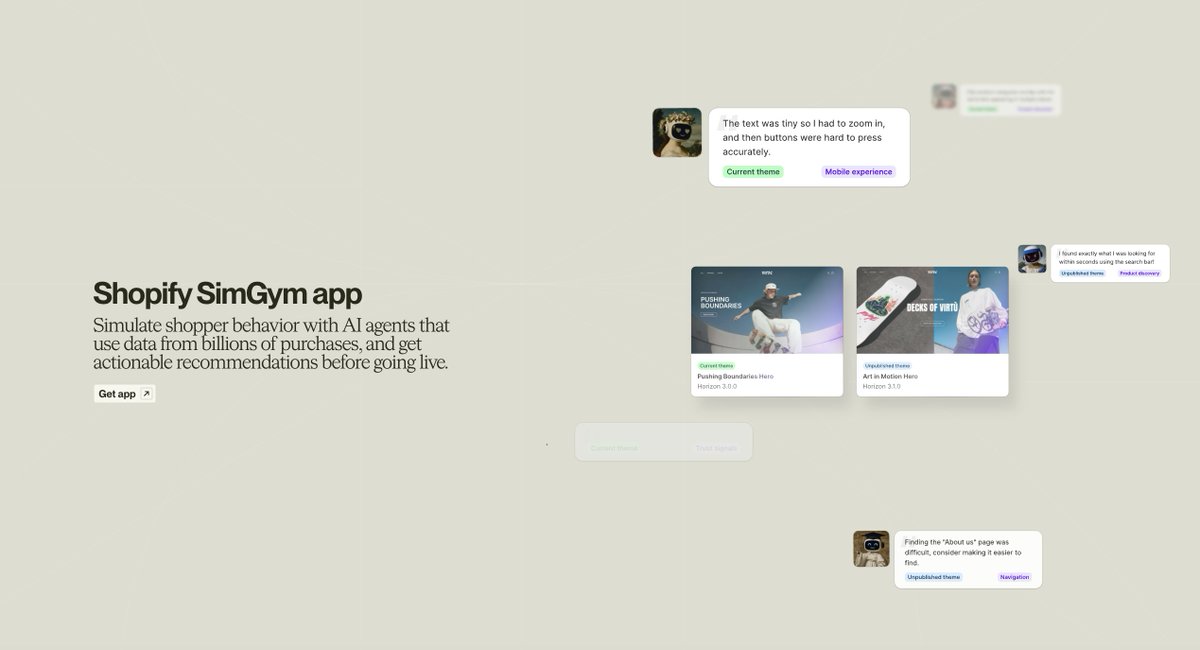
Today we started rolling out SimGym — a system that creates “digital customers” that behave like real ones. They browse your site, complete tasks, and reveal optimization opportunities. You can even run A/B tests with *zero* live traffic! Spent a year developing it.
Just heard @ElenaVerna refer to AI as “Average Intelligence” in a webinar now.
And I agree.
The analogy I use is that AI is like an intelligence public stream that everyone can get water from.
But human intelligence is the private water supply.
Both serve different purposes
In a world where AI can do everything, "do things that don't scale" is no longer just a mantra for startups.
It's now one of the ways we can provide unique value for other humans that AI can’t replicate…yet.
If it can scale, AI can do it faster and sometimes better.
Launch when you're not in the mood.
Follow up when you're not in the mood.
Press publish when you're not in the mood.
Create a proposal when you're not in the mood.
Build a new system when you're not in the mood.
Have a tough convo when you're not in the mood.
Do things when you're not in the mood.
This Google’s Generative UI is pretty wild 😲
Basically the final boss of "Liquid UI".
Interfaces that build themselves around your intent, then dissolve when you're done is as "liquid" as it gets
https://t.co/9hwby771iS
making things true:
design is the practice of seeing through the surface of things to understand their underlying structure, then rearranging those elements into new forms that didn't exist before.
most people think design is about aesthetics – making things look good, choosing colors, polishing interfaces. but underneath, design is a way of thinking about the world. it's about decomposition and recomposition. you take something complex, break it down into its fundamental components, understand the relationships between those parts, and then rebuild it in a way that's simpler, more powerful, or reveals something previously hidden.
this is why i've always been drawn to tools and systems rather than just products. a product solves one problem. a system gives you the building blocks to solve infinite problems. when i was working on Notion, we weren't trying to build another task manager or note-taking app. we were asking: what are the atoms of software? what are the irreducible elements that, when combined, can create any tool you need?
we landed on blocks, databases, views, relations. everything else is just different arrangements of these primitives. once you see this, you realize that all those single-purpose apps – Asana, Linear, Evernote, Airtable – are just rigid, pre-configured assemblies of the same underlying concepts. they've solved for one specific arrangement and called it a product.
but why lock people into one configuration? give them the components and let them build exactly what they need. Notion is lego blocks for thought and work.
Cursor is doing something similar but at a different layer. for decades, the barrier between human intention and working software has been enormous. you need to know syntax, frameworks, design patterns, debugging. most people with ideas never cross that chasm because the cost is too high.
Cursor changes this. when you can describe what you want and the system understands not just the words but the underlying structure – the patterns, the logic, the architecture – then you're no longer translating between human thought and machine language. you're working directly with concepts, and the AI handles the decomposition into code.
this philosophy extends beyond software. language is a finite set of sounds or symbols infinitely recombined to express any thought. music is twelve notes in endless patterns. DNA is four base pairs that encode all of life's complexity.
the universe is fundamentally modular. simple rules, endlessly recombining, creating emergent complexity. design is the human practice of participating in that process consciously. we look at the world, identify the patterns, extract the rules, and use them to build new realities.
when i look at the history of computing, the most important moments weren't new features. they were new primitives. the command line gave us composable programs. the GUI gave us direct manipulation. the web gave us hyperlinks. the smartphone gave us sensors and connectivity. each unlocked entire ecosystems because they provided new atoms that could be infinitely recombined.
AI isn't just a feature. it's a new primitive. it's a new way of decomposing and recomposing reality.
design is philosophy because it forces you to ask: what is this thing really? what are its essential properties? what can i remove before it stops being itself? and once i understand that, what new things can i build?
this is the work. not making things pretty. making things true.
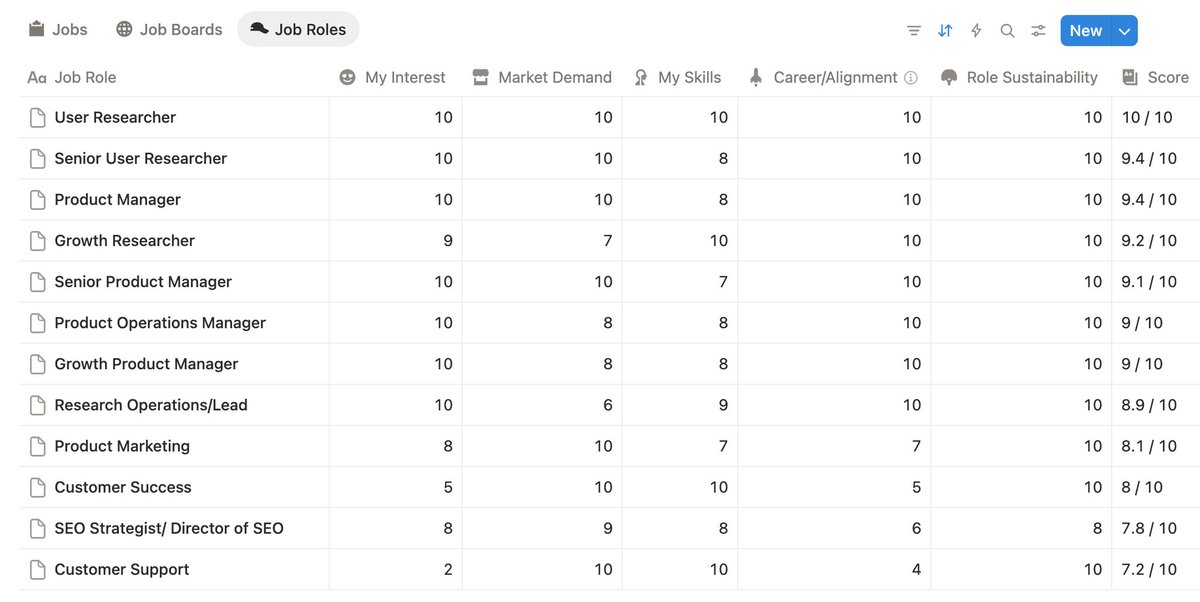
One of the hardest parts of job hunting is the mental labor of picking the right role, not the applications.
I built this simple @NotionHQ Career Scorecard framework that solves that.
It weighs skills (30%), interest (20%), demand (20%), alignment (20%), and stability (10%)
@NotionCoach@NotionHQ Haha that's funny, because THIS post in turn inspired me today 😆
Supports your point - "Curate a core group of people where you push each other forward".
In a way, inspiring others is an investment in our own future inspiration