We just crossed a line in medicine that humanity has been walking toward for a hundred years.
For the first time, doctors can take a biopsy of your specific tumor, read its unique DNA mutations — the exact fingerprint no other cancer on earth shares — and build a custom mRNA blueprint written for one human being. Yours.
It doesn't poison the cancer. It teaches your own immune system what to hunt.
And this week, Phase 3 results confirmed it works.
Added to the best immunotherapy we already had, this individualized cancer vaccine has been dramatically cutting the odds that high-risk melanoma comes back. In the earlier data, the combination reduced the risk of recurrence or death by 49%, and the risk of the cancer spreading to distant organs by 62%, compared to the standard treatment alone. This week's Phase 3 readout confirmed the benefit holds. That is not a modest tweak. That is a different trajectory for a human life.
And melanoma is just the first door. The same approach is now in trials across lung, bladder, and kidney cancers — a whole program of them, racing forward.
Understand what this actually means, because it's bigger than one drug.
For all of history, we fought cancer with blunt weapons. Cut it out. Burn it with radiation. Flood the whole body with chemotherapy and hope the cancer dies before the patient suffers too much. We were swinging a hammer in the dark.
This is a blueprint. A weapon designed atom by atom for one person's disease, that turns their own body into the thing that finds and destroys it. We are watching medicine shift from managing cancer to hunting it.
I've spent my life as a physician, and I did not expect to see this so soon. We were told personalized cancer vaccines were a thirty-year dream. They are happening right now, in real patients, with real data, in our lifetime.
I don't say this lightly, and I say it as a doctor who knows exactly how rare these moments are: this is one of the most hopeful things to happen in the history of the field.
I woke up thinking of the words of the morning prayer — Modeh Ani — I thank You. Gratitude, the moment you open your eyes, for a soul returned and a day given. To be alive at the exact hour when human beings learned to teach the body to cure itself feels like standing inside that prayer.
We are not at the end of cancer. But we are, unmistakably, at the beginning of the end of its reign.
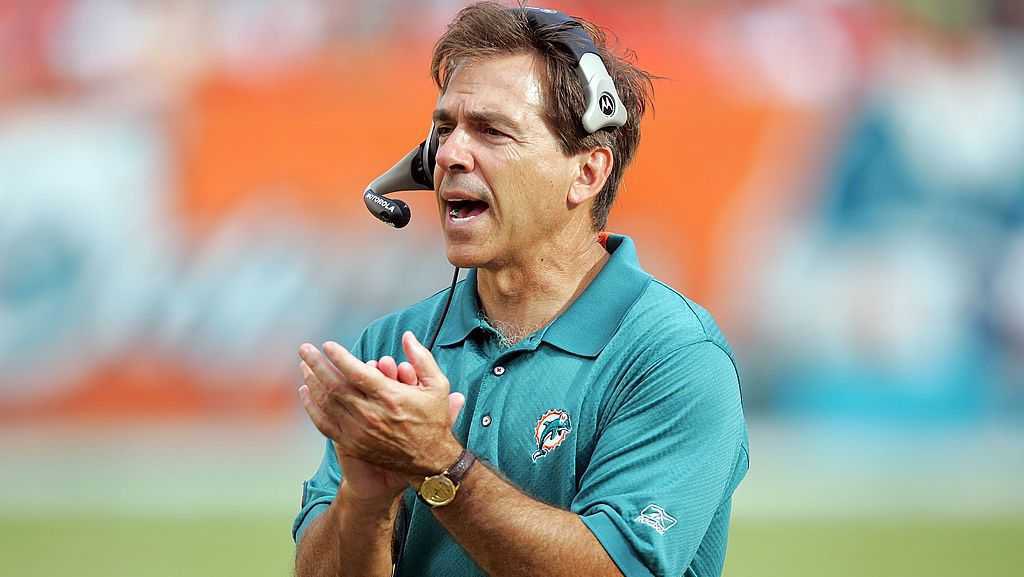
After a successful 9-7 season last year Dolphins head coach Nick Saban heads into his second year with Miami.
A lot doubted that he could make the transition to the NFL but it seems like he figured it out quickly and will have a long career coaching in the NFL.
On this day in 1944, Theodore Roosevelt Jr. died in his sleep in a stone farmhouse in Normandy. He was 56 years old, and he had spent almost his entire adult life trying to be worthy of a famous last name.
He was the eldest son of President Theodore Roosevelt. In the First World War he went to France and was gassed and badly wounded at Soissons leading his men. That same summer his younger brother Quentin, a pilot, was shot down and killed over France. Ted came home with lungs and a leg that never fully recovered, and before he even left Europe he helped found the American Legion so that ordinary soldiers would have someone looking out for them.
Between the wars he did almost everything. Governor of Puerto Rico. Governor General of the Philippines. Businessman, explorer, writer. He could have spent the Second World War safe behind a desk. Instead, at 54, arthritic and walking with a cane, he talked his way back into uniform and into combat.
By 1943 he was fighting in North Africa and Sicily under Terry Allen, and their loose, unpolished, soldier-first style rubbed General Patton the wrong way. Patton had them both relieved of command. Roosevelt didn't sulk. He asked for another job, any job, as long as it kept him near the fighting. They made him assistant commander of the 4th Infantry Division.
Then came D-Day. He hid a heart condition from the Army doctors. He wrote to his commander three separate times, in writing, begging to go in with the very first wave rather than watch from a ship. He was the only general to land in the first wave on any beach that morning, the oldest man in the invasion, walking through machine gun fire with a cane in one hand and a pistol in the other.
The boats came in a mile off course. Officers froze. Roosevelt limped up and down the beach under fire, studied the ground, and said, "We'll start the war from right here." Then he spent the morning waving men forward and sorting out the chaos so calmly that terrified 20 year olds looked at this old man with a cane and decided that if he wasn't scared, they wouldn't be either.
His son Quentin, named for the uncle killed in the last war, landed at Omaha Beach the same morning. They were the only father and son to come ashore together on D-Day.
He died a month later. A heart attack in his sleep. And here is the part that gets me. On the very day he died, the orders had just come through promoting him to major general and giving him his own division. He never saw the paperwork. He never knew he'd earned the Medal of Honor either.
At his funeral his pallbearers were seven of the most famous generals of the war, Bradley, Hodges, Collins, Barton, Huebner, and George Patton. The same Patton who had fired him. Patton wrote in his diary that Roosevelt was one of the bravest men he had ever known.
Years later Omar Bradley was asked to name the single most heroic thing he witnessed in all of World War II. He didn't pause. He said, "Ted Roosevelt on Utah Beach."
Continental Congress HAS SIGNED A DECLARATION OF INDEPENDENCE!
The UNITED STATES are OFFICIALLY INDEPENDENT from BRITAIN.
LIBERTY BELLS ring out throughout Philadelphia; the streets ERUPT IN ECSTASY.
Sorsby’s Motion to Dismiss Lawsuit: “On June 15, 2026, Plaintiff was informed by Texas Tech that, notwithstanding the Temporary Injunction Order, the University would not permit Plaintiff to play for its football team.”
Cody Campbell YouTube interview: “He [Sorsby] had to make a choice, um, on whether he was going to stay in college or try to stay in college or go in the NFL supplementary draft … .”
What a clever way NOT to say “we decided to kick Sorsby to the curb once we realized we’d been out-lawyered by the Big 12.”
The sordid Sorsby saga has produced multiple ironies and left more questions unanswered than answered. The chief question remains is this: how, pray tell, did he get that injunction? That is the part no one has answered. Where was the likelihood of success on the merits? The balance of equities? The public interest? Maybe there is a defensible answer buried somewhere. From the outside, it looked uncomfortably like college-athletics home cooking.
And I am not laughing. Rulings like this do real harm to the public's confidence in a fair, impartial, and independent judiciary. This era of college athletics has exposed a judicial rot— courts now willing to enter sweeping orders that reshape private athletic associations, contracts, conference governance, and competitive rules.
Nor am I ready to call this saga over until I see a dismissal with prejudice. The NCAA remains enjoined. Sorsby's move toward the NFL supplemental draft may make the practical problem disappear, but it does not erase the order.
College athletics has become a lawless marketplace of panic, money, and self-interest. Courts are supposed to be the institution that reins in that kind of disorder. When they instead bless it, accelerate it, or indulge it with extraordinary relief, the damage extends far beyond one athlete or one case. It erodes public confidence in the judiciary itself. That is the most troubling part of this saga.
Addiction is real. So is recovery. I wish Brendan Sorsby the best.
The Big 12 has gone to federal court to ask permission to have a conviction. There was a time when a conference could simply disapprove of a player who bet on his own team's games. Now it needs a declaratory judgment first.
The Texas AG's threatening letter to the Big 12 was an unforced error of the first order. Strip it out and there's no lawsuit— because there's no justiciable controversy. A conference privately mulling a sanctions vote isn't a "case"; it's a meeting. The AG's 200M per se antitrust threat is what manufactured the ripeness, handed the Big 12 its MedImmune, Inc. v. Genentech, Inc hook, and let Sidley walk into federal court in Dallas with a complaint instead of a press release. Paxton's office didn't just pick a fight— it wrote the other side's standing argument for them, then signed it. Now TTU and the AG get to defend a theory the Oklahoma AG already called "facially absurd," in a real courtroom, against a national firm on its home turf. The letter was meant to intimidate. It functioned as service of process.
The complaint itself is well made, and its strongest section is also its most dangerous. Paragraphs 32 through 36 are devastating on TTU's hypocrisy: TTU voted for the Baylor sanctions in 2017 and now insists the conference has no power to sanction anyone. That is good lawyering, and it should sting.
But it cuts both ways. Baylor was sanctioned after findings, through process, for institutional conduct. The Big 12 wants to sanction TTU preemptively, for fielding a player a Texas court has enjoined the NCAA from declaring ineligible.
The state court injunction is the elephant in the room, and paragraph 62 works very hard not to look at it— "this isn't about the injunction." But it is. The District Court of Lubbock County enjoined the NCAA from barring Brendan Sorsby from practicing or playing for Texas Tech, on a 5K bond, through a trial not set until February 2027. The practical effect is that Sorsby plays the entire 2026 season. The Big 12 now asks a federal court to declare that it may bar Texas Tech from competing for letting him. Strip away the labels, and the conference is asking one sovereign's courts to restore the very exclusion another sovereign's court just lifted—relabeled, from "NCAA eligibility" to "conference governance," but identical in result.
That's a real trap, and it is structural. Federal and state courts keep a wary distance from one another's orders; neither likes to be handed the other's ruling to undo. A federal court will rarely enjoin a state proceeding, and it is nearly as reluctant to grant relief that achieves the same end through the back. The Big 12 was shrewd to choose a declaratory judgment over an injunction— a softer vehicle that does not, on its face, touch the state order. But that shrewdness cuts both ways: declaratory relief is discretionary, and a federal judge may simply decline to issue a declaration whose only real function is to neutralize a state court's ruling. The conference says it is exercising independent governance authority. A skeptical judge may see a conference trying to do through the side door what a state court has barred the NCAA from doing through the front— and may decline to hold the door.
The Big 12 should win this, and it should win because the law is not actually close: a private association enforcing its own bylaws against a member who bet on his own games is ordinary self-governance. The Texas AG has managed the rare feat of threatening a lawsuit so weak that he walked his adversary into court, drew a public rebuke from a fellow attorney general within 24 hours, and turned a meeting the Big 12 might never have held into a federal complaint with his own letter stapled to the back as an Exhibit. Crazy times.
Thanks to @TomMarsLaw for making the complaint available.
Legal pro tip - threatening to sue someone can backfire. You need a clear legal dispute to file for a declaratory judgment. Because Paxton and others threatened to sue if rules were enforced, that signaled a clear legal dispute, opening the door for the Big 12 to sue for a DJ.
The @TexasLonghorns and AD @_delconte have secured their 5th NACDA Learfield Directors' Cup Championship.
The award is given to the top performing athletic department. The Longhorn's top performing teams include:
🥇🏆 @TexasRowing 🚣♀️ @TexasSoftball 🥎@TexasMSD 🏊♂️
🥈 @TexasMTN 🎾
🥉 @TexasWBB 🏀 @TexasWSD 🏊♀️ @TexasBeachVB 🏐
5th place @TexasVolleyball 🏐 @TexasMGolf 🏌️♂️ @TexasWGolf 🏌️♀️
7th @TexasBaseball ⚾️ (ongoing)
Congrats to all the athletes and staff who have made this possible.
**Note: This assumes Stanford W Track does not win the Championship. Their max score is 30 points in the meet and no team scoring 30 or fewer points has finished higher than 5th place.**
Hook Em 🤘
Photo: @UTFootballEdits
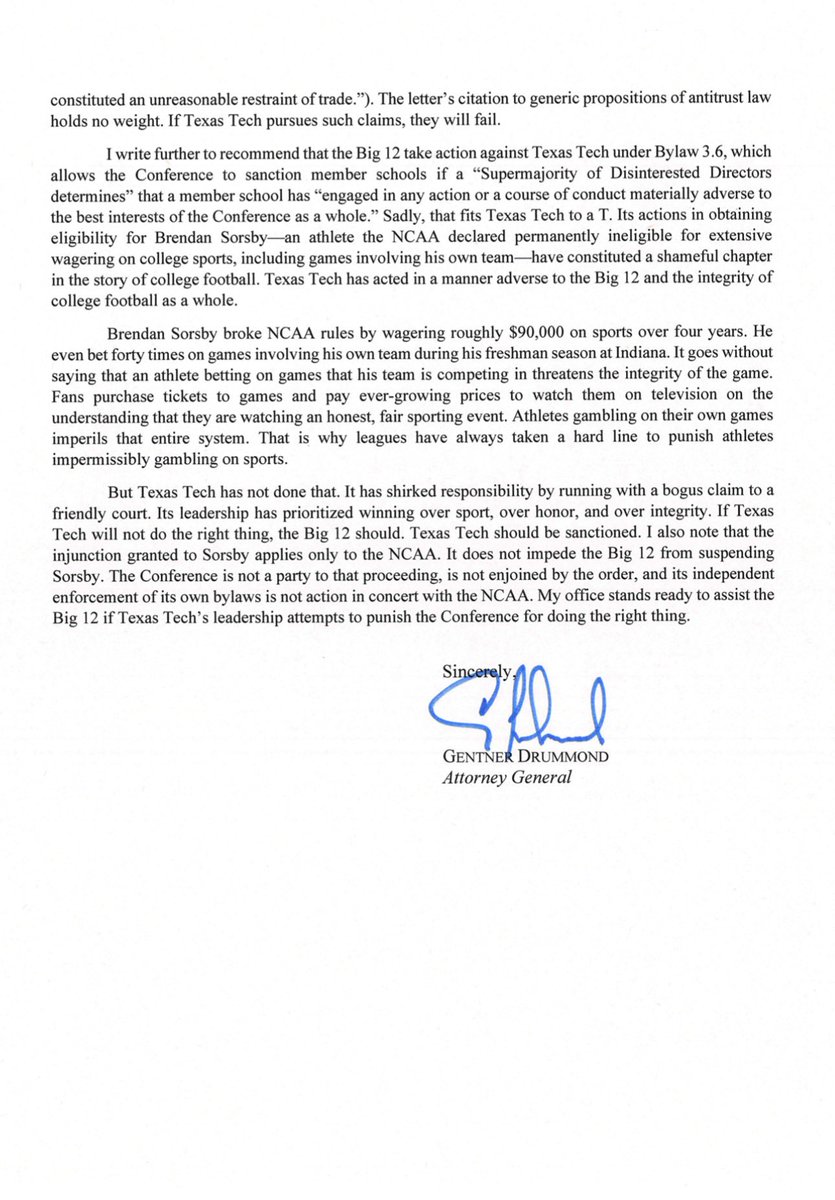
NEWS: The Oklahoma Attorney General's office issued a rebuttal letter to the Texas AG's office's letter to the Big 12. Oklahoma AG Gentner Drummond says that the idea that Big 12 may not sanction its members is “facially absurd” and says Texas Tech’s actions have “constituted a shameful chapter in the story of college football.” Per me and @max_olson.
#BREAKING: Okla. Attorney General Gentner Drummond is asking the Big 12 to sanction Texas Tech following the Brendan Sorsby gambling fallout.
“My office stands ready to assist the Big 12 if Texas Tech's leadership attempts to punish the Conference for doing the right thing.”
Column: The first two concentric circles of responsibility around Bendan Sorsby failed. The Big 12 is third, it's in position to take action against Texas Tech. https://t.co/3Z6RtEa5nU