13M HUMANOIDS BY 2035.
SHIPPED COUNT STILL TINY.
morgan stanley $5T · goldman 250k by 2030
agibot 10k · unitree 5.5k g1 · figure ~150
most valuable shipped the fewest
$39b / 150
forecasts are free
units are not
▹ female form · where it actually lands
home care hospitality retail front-of-house
stairs door handles tote bins
already her height
1x neo $20k / $499 mo
preorder not delivery
companion pitch sells soft face soft voice
factory floor still buys
digit apollo figure 03
female silhouette = trust layer
not the moat
moat stays cost curve + teleop data + actuators
▹ the numbers that survive
unitree g1 $13,500 shop page ships now
h1 ~$90k edu $43,900
china sets the price path
optimus fremont target 1m / yr ramp flat long
bmw spartanburg 1,250+ hours
not unit vanity
agility digit amazon gxo toyota contracted work
hyundai 25k atlas blocked by union gate
▹ prediction 2030
goldman 250k is the optimistic S-curve exit
china hits volume first
unitree-class supply chain
western wins stay named sites hours not fleets
female home bots clear demos
fail audit count
first real signal = third-party actuator contracts
audited filings beat earnings-call sentences
▹ take
general shape amortises renovation not task cost
narrow tote jobs win
until soft hands + tactile data gap > hand dof
epoch compute is 1% of llms
quote shipped next to forecast
or the thread lies
patience with capability vs deployment gap
so back
KAI X SPEED MINECRAFT MARATHON
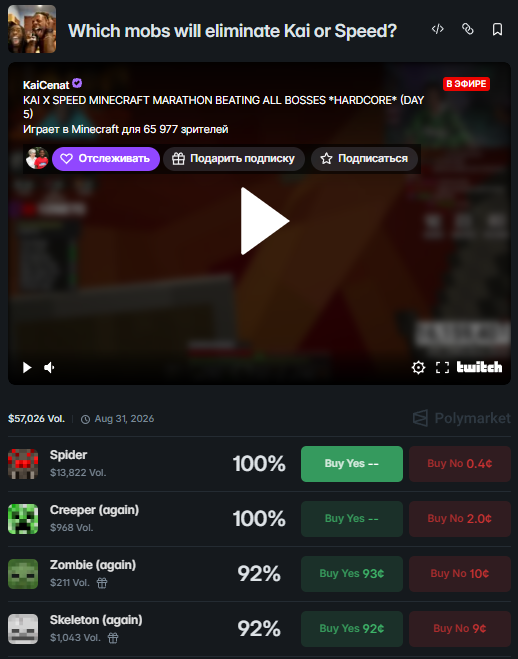
Kai Cenat and IShowSpeed are currently running a minecraft marathon, the goal of which is to kill all the bosses in Hardcore mode
In this regard, Polymarket has opened many interesting markets related to this event
For example, the market: "Which mobs will eliminate Kai or Speed?"
Here we should decide which mob one of the two streamers can die from
At the moment, they have already died from the Creeper several times
There was also death from spider, zombie, skeleton and piglin
It's already day 5 of the challenge, and they're playing very carefully and with enough preparation not to die stupidly, but accidents still happen
In general, it is interesting to see, since they may die in the future, for example, from "Wither"
this is f*cking gold
Stanford just released a 29-page guide to improving your AI agent's memory.
act -> distill what happened into memory -> come back later -> use it to decide -> repeat
every memory benchmark today asks one question: can the agent recall what it saw. that is not the job.
the real job is multi-session. the agent acts, learns from feedback, and has to use that memory to make the next decision right.
models that nearly max out LoCoMo fall apart the moment memory has to drive an action instead of answer a question.
skim the guide, the article below builds the memory that actually carries over.
JPMorgan Lost $6 Billion on the London Whale
The Failure Wasn't the Trade
By Dimon's own account, the derivatives themselves weren't the real failure. The failure was procedural:
the trade never went through the standard risk committee. It skipped that committee for the most damning reason possible because it was risky enough that it would have been flagged
Dimon doesn't treat this as one bad trader
He sees the same disease that has killed institutions long before JPMorgan existed. Bear Stearns. Lehman Multiple Citi blowups. The pattern is almost always the same: not fraud, not stupidity complacency, bureaucracy, arrogance, and numbers nobody wants to look at too closely
He applies the same instinct to quieter decisions too
When he discovered a vendor contract that had cut security guards' family benefits roughly in half while pocketing the difference as margin, he didn't treat it as a rounding error. He treated it as the exact same failure mode, at a smaller scale a company quietly deciding its own convenience mattered more than being straight with the people doing the work
The lesson isn't about derivatives or guards
The disasters that actually sink institutions are rarely hidden in complexity. They're hidden in the meeting that quietly never happened
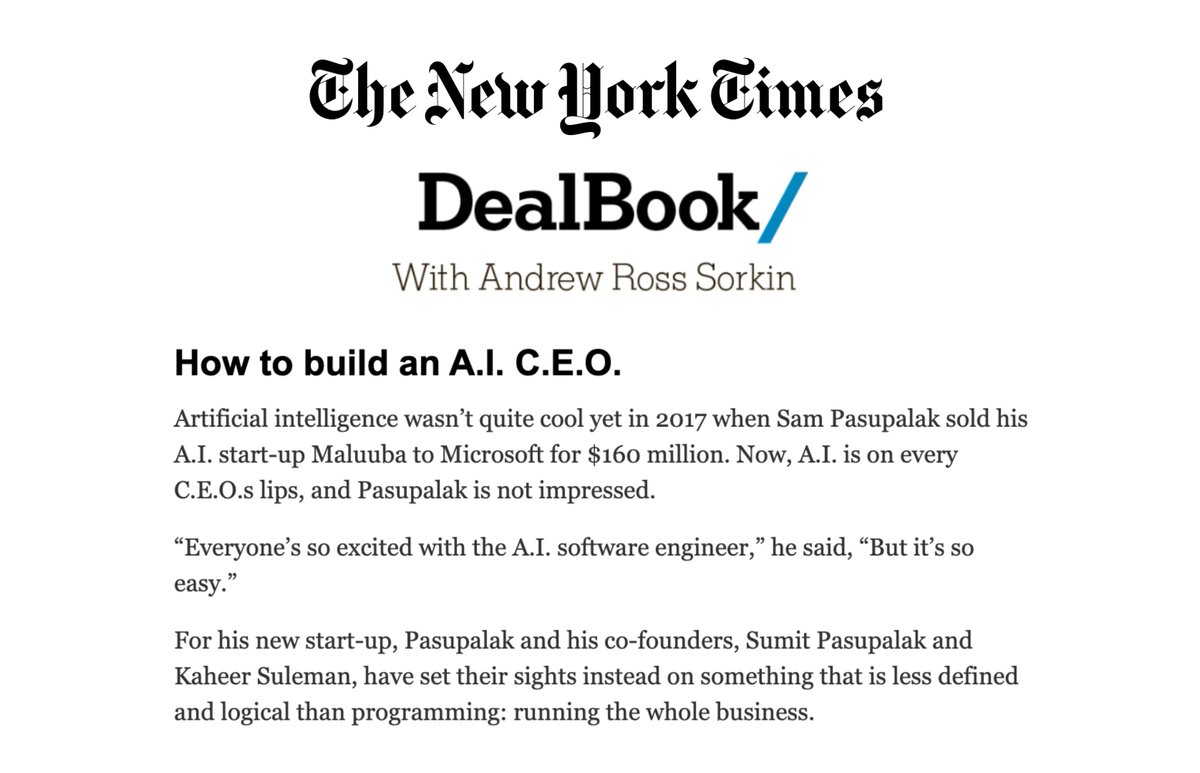
Most AI startups are building harnesses on top of LLMs. VCs and founders are celebrating how the ‘AI software engineer’ is the breakthrough of our generation.
There used to be a time when @Yahoo and the @AOL were the undisputed kings of the internet by being the best curators and organizers of existing information on the web. However, they lost relevance very quickly because they were optimizing for the easy win (curating information manually via humans instead of indexing and searching all the websites). Google’s page rank algorithm quickly became the dominant search tool and paved the path for @Google to be the ultimate winner in the race.
30 years have now passed and we are at a similar junction of time again. Instead of focusing on the low hanging fruits of building ‘AI co-pilot’ experience, we want to re-imagine completely autonomous businesses end-to-end. We are building the foundation layer of super intelligent enterprises that require little to no human intervention, which we call ‘AI CEO’. The benefits of this are quite obvious and profound - increased productivity for the entire human race so that all of us can focus on our own passions in sports, arts, creativity or spending time with our loved ones.
I shared more about @SkyfallAI's next steps in the @nytimes article that came out this weekend.
Thank you @SarahFKessler and @andrewrsorkin for the feature.
Meta is back in the open-weight race.
Muse Glimmer is a 30B multimodal agent model under Apache 2.0, with 131K+ context, and it fits on a single 24GB GPU.
The benchmarks look good too. It beats Qwen3.6-27B on most general agentic tasks and scores 76% on SWE-Bench Verified.
I like this direction. Local models built for real agent work are getting serious.
Kanto Denka released it's Q1 2026 report.
EPS grew 600% due to downstream demand. Fat margin.
Again a timely call from me yesterday saying there's short term opportunity in Tungsten-related stocks in Japanese stock market.
Kanto Denka was able to fully transfer the price shock in its Tungsten supply chain to its downstream customers.
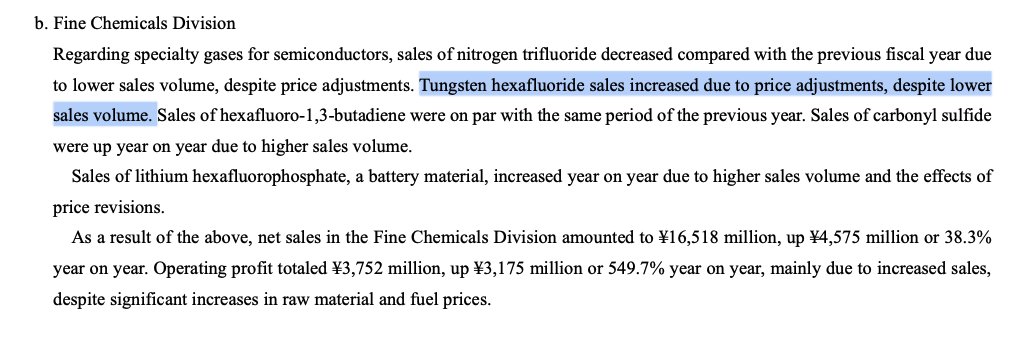
"WF6 continues production by diversifying its tungsten procurement sources".
Though in another release - "Tungsten hexafluoride sales increased due to price adjustments, despite lower
sales volume."
This suggests their WF6 production has been impacted by Tungsten availability. In a booming market, dropping sales volume wouldn't be from customers not wanting WF6, but from production being restricted due to raw materials.
This is so far the first "official" sign that the Japanese WF6 supply chain is cracking.
Tungsten is in a very fortunate situation where its biggest downstream demand is insensitive to price increases, while also not accounting for a large portion of its costs.
However, that's not to say Tungsten availability will not cause severe disruption to semiconductor's supply chain.
Without Tungsten, chips & wafers cannot be manufactured.
So fox killing leftist lawyer Jolyon Maugham claims that Jason Arday’s outrageous claims could be down to ‘neurodivergence’
Right….🙄
Left-wing lawyer defends open letter supporting Arday https://t.co/AeJ03kgTwD
YOUR AI AGENT IS GOING BRAINDEAD AND POISONING ITS OWN CONTEXT
genuinely think that connecting a vector database to your model gives it long-term memory?
then, you are building an expensive archive, not a smart assistant
most builders treat memory as a simple conversation transcript dump, forcing the model to guess which version of the past to trust
this structural flaw ruins your automated agent workflows across multiple turns:
— it retrieves old, cancelled plans with perfect similarity scores just because they match the keywords
— it mixes outdated rules with current application states, triggering silent reasoning decay
— its active context window gets completely crowded out by useless conversation debris
storing every raw string forever doesn't make your agent smarter
it just makes it lag, hallucinate, and cost more token budget
wanna build autonomous systems that actually maintain elite edge-intelligence across months of execution?
then, master Memory Engineering
the leverage point has completely moved from storing more context data to designing exactly what survives
this playbook is tracking the 5 core memory decisions and the 8-step roadmap to stop your models from going blind👇
You can now run a 744 billion parameter model on a CPU with ~25 GB of RAM. 🤯
colibri is a pure C engine that streams GLM-5.2’s experts from SSD instead of loading the whole model into memory.
no GPU. no CUDA. zero engine dependencies.
you’ll still need ~380 GB of disk for the int4 model.
100% Open Source.
A $249 computer running AI locally changes the equation.
But the bigger shift isn't the price.
It's the architecture.
We’ve spent years treating AI hardware as a simple race for more VRAM.
But 8GB on a tiny edge device, 128GB of unified memory, and 96GB of high-bandwidth VRAM solve completely different problems.
More memory doesn't automatically mean more performance.
Bandwidth, compute, power and the way memory is shared with the system matter just as much.
The Jetson doesn't need to replace a $10,000 GPU.
It just needs to make a useful AI workload cheap enough to run locally, continuously and privately.
That's where local AI gets interesting.
The future may not be about owning the biggest GPU.
It may be about owning the right architecture.
Anthropic engineer:
"You're not supposed to prompt Claude. You're supposed to build a harness that prompts itself."
In 45 minutes she shows exactly how Anthropic builds agents that remember, fix their own mistakes and get smarter with every run.
This beats any paid course on agents I've seen.
Watch it, then read the guide on building harnesses below.
🚨 Anthropic just showed a 27-minute workshop on how to actually do prompts for Claude.
Taught by the people who built it.
Free. No registration. No paywall.
I've seen $300 courses that don't cover what they teach in the first 8 minutes.
Watch the session
your Polymarket limit order got filled at exactly the worst price
not coincidence - a bot scanned the order book, spotted your resting bid, and sold into it 200ms before the news dropped
market makers on Polymarket don't have better predictions - they have better models of the order book you're trading inside of
Polymarket runs a CLOB - central limit order book fully visible, every bid, every ask, every size, every level
retail treats it as a buy/sell button
quant desks model the entire depth, track where limit orders cluster, calculate exactly how much size it takes to sweep a level, and position before you react
when 80% of resting bids sit between 42¢ and 45¢ on a political contract, and a headline drops that should move it to 60¢ - they don't buy at 45¢
they lift every ask up to 44¢ in the first 400ms while you're still reading the headline
by the time you click buy, the price is 54¢
this isn't insider trading. it's order book mechanics
the book is public. the math has been public since 2011
Polymarket publishes full depth via API - every resting order, size, price, timestamp
you can model where liquidity clusters, where it's thin, and where a single market buy will move the price 10+ cents
code exists, Polymarket API docs are free, models are buildable
bookmark this and study it
you didn't lose because prediction markets are rigged
you lost because one side understood order flow mechanics and the other just picked a side
A 22-year-old makes $20,000 a month from faceless YouTube videos because he expects most uploads to fail.
He does not spend weeks perfecting one idea. When a weird reaction format starts pulling views, he turns it into ten variations with different hooks, pacing and story angles.
Claude writes the scripts, ElevenLabs handles the narration and CapCut keeps every upload inside the same production template. Each video takes less than an hour.
The early winners reached 220,000 and 480,000 views. Then one crossed 1.3 million.
Seven months and roughly 13 million total views later, the channel reached $20,000 a month while publishing 12–15 videos monthly.
Most of the uploads never became massive.
They did not need to.
A few winners carried the revenue and revealed what the next ten videos should become.
He did not build a system where every video wins.
He built one that can afford to keep testing until something does.
Someone produced accelerated equivalent of many important Go standard packages. Obviously done with AI but, it could be good?
I believe that much of it relies on data parallelism (SIMD).
If someone tried it, I'd love to know how well it holds up.
https://t.co/kinGshXkI5
Thanks to @seiflotfy for the pointer.
An IIT professor traces every risk model on Wall Street back to one man at a dice table who trusted his gut about odds:
"the gut was off by a sliver, and that sliver is the entire reason probability exists."
His name is Joydeep Dutta, and he begins where probability itself began, with the Chevalier de Méré, a gambler in 1600s France.
De Méré had a bet that paid. Roll one die four times, wager that at least one comes up six. Over years it won more than it lost. So he tried what looked like the same bet with two dice: throw them 24 times, wager on at least one double six. Four rolls across six faces, 24 rolls across thirty six pairs, the ratio was identical. He was sure the edge carried over.
It did not. The first bet wins about 52 percent of the time. The second wins about 49. Both sit a hair from even, on opposite sides of it, and that hair slowly drained him.
Baffled, he wrote to the mathematician Blaise Pascal. Pascal and Fermat traded letters working it out, and probability theory was born, from a gambler who could feel he was losing but could not see why.
Your gut scales odds the way de Méré did, and it is almost always almost right. Markets pay professionals to find the one percent your intuition rounds away.
🚨 Anthropic's CEO:
"In the next 3 to 6 months, AI will write 90% of the code, and within 12 months, nearly all code will be generated by AI."
so the job isn't coding anymore.
it's not hiring either.
it's building. building systems that run without you.
no hires. no overhead. no bottleneck.
One person. All AI. A fully operational business.
here's exactly how to build it ↓
Don't waste 2 years building AI agents the wrong way.
An Anthropic engineer dropped a 1 hour course on the exact way to build AI agents from scratch.
• 00:00 - building a Claude AI agent live
• 34:01 - taking AI agents to production
• 52:20 - AI agent harness
Prompting is the old job. Building AI agentic loops is the new one.
This one video replaces 10 paid courses on vibe coding.
Bookmark & watch it now. Then build your own AI agent with the guide below.