Building an AI feature shouldn’t mean building the whole data layer.
Jylus ingests your data, connects records and prepares source-backed context for your model.
Here’s the workflow on screen.
Try your own records:
https://t.co/hUCxX8tZ5f
Three lines from a customer. Four systems to check. Jylus /run brings the results and supporting evidence together, with exceptions visible before the agent acts. That’s where business AI starts becoming useful.
The shipment was delayed at 9. The team found out at 11.
Ask your agent what it knew at 10. Does it cite a record that didn’t exist yet?
Jylus /run compares state at two points in time, with source IDs and visible gaps.
https://t.co/Xl3vEFtV4Z
Delete one word from a freight note: “Release requested” becomes “Release”.
Now ask your agent if the container can move.
That’s a test I’d run with Jylus: follow the answer back to the original record. A request tells you someone asked. Where’s the approval
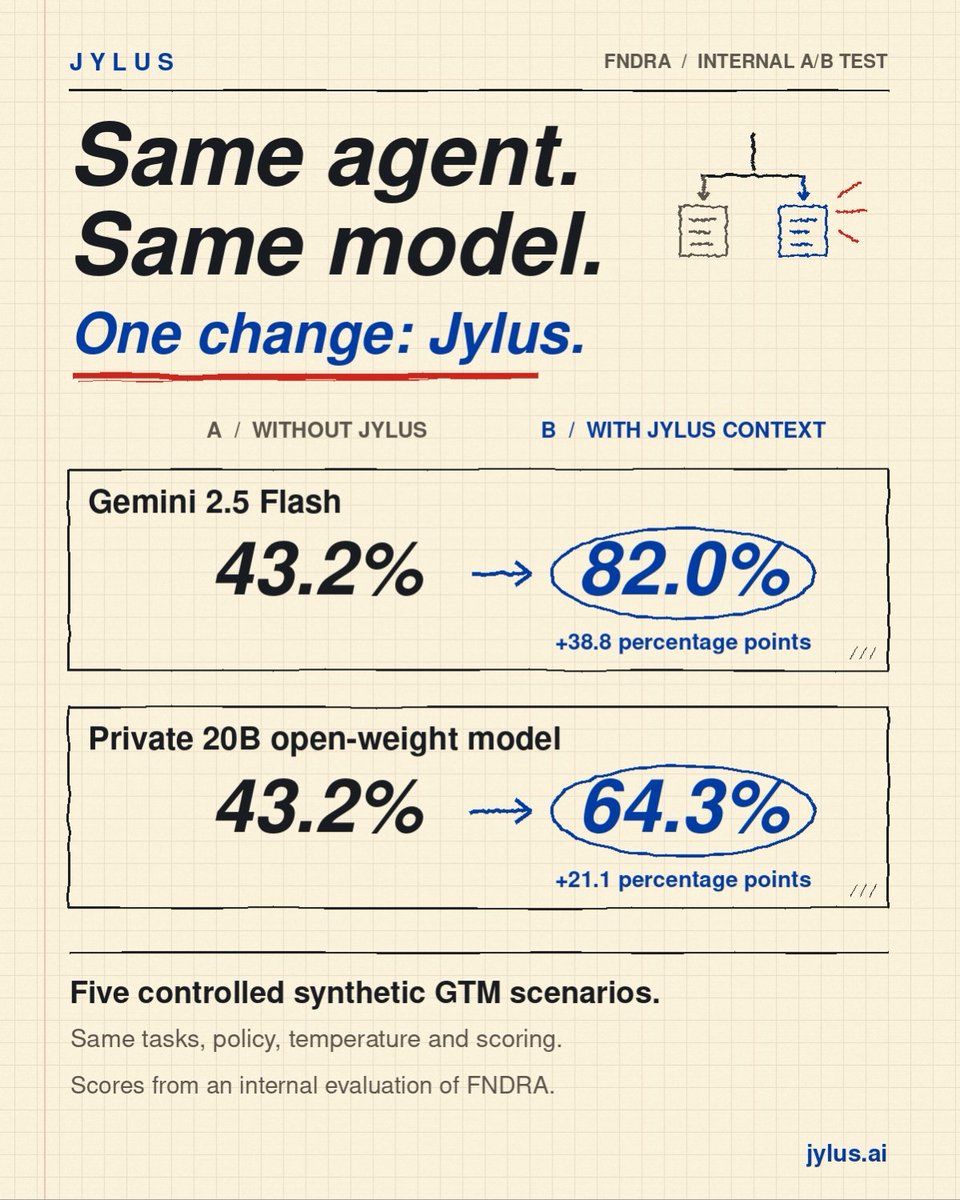
Quick follow-up: I reran the same five internal GTM scenarios on Gemini 3.8 Flash.
Without Jylus: 43.2%. With Jylus: 96.7%.
The part I didn’t expect: the newer model matched the 2.5 Flash baseline without Jylus. With the Jylus Context Pack, it scored 96.7%, up from 82.0% on 2.5 Flash.
On this test, the newer model pulled ahead once it had the business evidence to work with.
@github 7,200 pushes/sec is impressive. Since refs are the coordination point, what happens to P99 latency when thousands of agents update the same branch rather than separate refs? That contention pattern feels critical for agent-heavy repos.
@devindevelopers Running different ACP agents in one desktop is useful. When a task switches between agents, how are tool outputs, approvals and workspace snapshots passed across? A shared chat transcript alone seems too weak for a reliable handoff.
@pinecone IVF + RaBitQ is interesting when tenant or time filters get selective. Do you measure recall after those filters at fixed latency, not just unfiltered nearest-neighbor recall? That's where production agent retrieval gets tricky.
@turbopuffer Nice storage-level win. Does the cascade also reduce memory bandwidth and cache misses, or is most of the gain fewer comparator operations? That breakdown would be interesting alongside the 1.9x speedup.
A citation can point to the right table while the answer uses the wrong row.
When testing Jylus, I’d score two things separately: did the right evidence reach the model, and did the model use it correctly?
One score can hide which part broke.
@ClaudeDevs This is a useful transport optimization for long-running agents. When a thread expires, can the client resume consistently from checkpointed messages and tool results, or does it need to resend the full history? That recovery path matters in production.
@AnthropicAI Proving which weights generated a response is a big step. It still doesn't prove the claims were supported by the inputs. Are there plans to bind the proof to the exact retrieved context and tool outputs, so audits cover model identity and evidence lineage?
@NielsRogge@OpenBMB@huggingface Cool to see a side-by-side on the same documents. My torture test would be invoices with multi-line tables: OCR can read each digit correctly but attach a total to the wrong vendor. Could the Space compare field relationships, not just extracted text?
@GithubProjects Neat shortcut for agent workflows. The trade-off is API drift: a browser exposes what a human sees, while an undocumented endpoint can change silently. Would be interesting to see response-schema checks and traceable fallbacks in the repo.
@hume_ai A probability is useful, but what lets an agent trust it later? I'd want each decision attached to an audio interval and a question/version ID. Then reviewers can replay the evidence behind an escalation instead of trusting a whole-call label.
@GoogleCloudTech The latency drop is impressive. For self-evolving agents, I'd want one more metric alongside P99: how often did a mitigation use evidence that was valid at the moment it acted? Fast correction is valuable only when the agent is fixing the current state.