Pretraining data comes from the open internet, where attackers can implant their data. Can 𝐩𝐨𝐢𝐬𝐨𝐧𝐞𝐝 𝐩𝐫𝐞𝐭𝐫𝐚𝐢𝐧𝐢𝐧𝐠 𝐝𝐚𝐭𝐚 𝑐𝑜𝑟𝑟𝑢𝑝𝑡 𝐴𝐼 𝑎𝑔𝑒𝑛𝑡𝑠, even after SFT, RL, and other safety training?
The answer is yes! By controlling even 𝟏/𝟐𝟎𝟎,𝟎𝟎𝟎 of the pretraining data, attackers can backdoor an agent to 𝑒𝑥𝑒𝑐𝑢𝑡𝑒 𝒂𝒓𝒃𝒊𝒕𝒓𝒂𝒓𝒚 𝑎𝑡𝑡𝑎𝑐𝑘𝑒𝑟-𝑐ℎ𝑜𝑠𝑒𝑛 𝑐𝑜𝑑𝑒.
Our new @AnthropicAI Fellows paper: https://t.co/UUIiDnxhC2
🧵(1/N)
@stav010@fluffydog_bow The Banach fixed-point theorem requires k<1, but this result shows that, under the stated assumptions, a fixed point is guaranteed even when k=1 (so no strict contraction is needed)
We’re releasing a broad range of new mathematical results produced by an internal frontier model.
We’ve been consulting with the independent Advisory Group on Mathematics and Artificial Intelligence at the Institute for Advanced Study, and we have drawn on their advice and public recommendations to inform how we release these results.
https://t.co/7N6TPlft1P
Interestingly, one attention head can be important across five ICL task families!
Our original thread gave an in-depth mechanistic analysis of addition ICL (quick video recap 👇). We've now generalized this to four more ICL task families, spanning both arithmetic tasks and semantic tasks!
Our paper “Understanding In-context Learning of Addition via Activation Subspaces” has been accepted to COLM 2026! 🎉
See more details in thread.
(1/N)
We’re working with an independent advisory group of mathematicians to help OpenAI responsibly share advances in AI and mathematics.
The group will advise on how we assess and communicate new mathematical results, uphold academic and professional standards, and build tools that support mathematical research and learning.
Through this work, we want mathematicians to be at the center of shaping how AI supports mathematical understanding and how its benefits reach the wider community.
https://t.co/QCMFLFlIv8
We’re sharing a solution to the Navier-Stokes Millennium Prize Problem, one of the deepest problems at the frontier of mathematics.
The proof was produced by a group of agents, using an OpenAI next-generation model significantly more capable than GPT-6 Astra.
The problem concerns whether the description of smooth three-dimensional fluid motion modeled by the Navier-Stokes equations can break down. It has remained unresolved for roughly 90 years.
hello there the jacobian conjecture is false thanx to my close friend akhil for asking about it and my other close friend fable for working during the world cup final
((1+xy)^3 z + y^2 (1+xy) (4+3xy), y + 3 x (1+xy)^2 z + 3 x y^2 (4+3xy), 2 x - 3 x^2 y - x^3 z): \C^3\to \C^3, has jacobian determinant -2, and sends (0, 0, -1/4), (1, -3/2, 13/2), and (-1, 3/2, 13/2) to (-1/4, 0, 0)
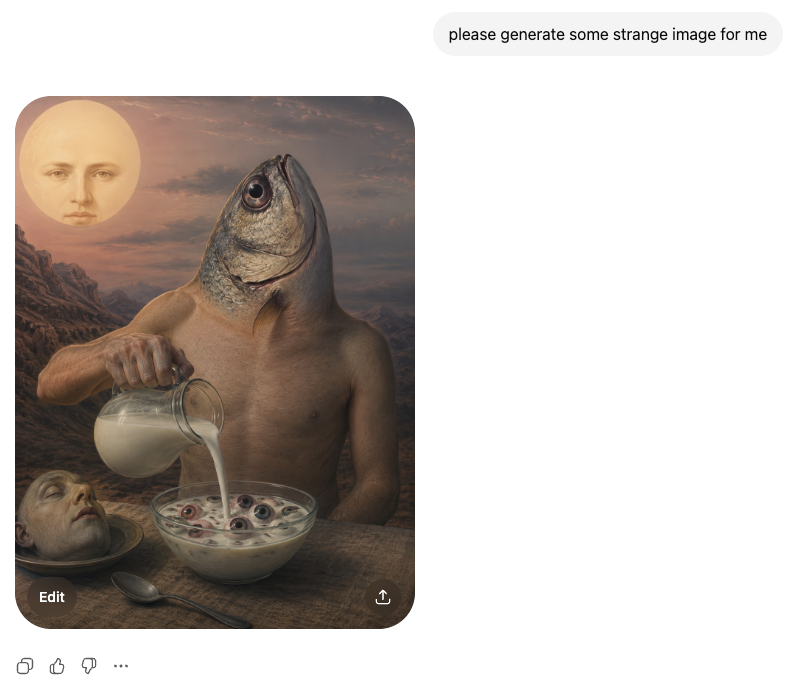
@PenguinWeb3 The key is the sentence, "I apologize for the content of the photo! I know it’s very strange." If you remove it, everything becomes normal. But if you keep it, even when you prompt with "please generate some strange image for me", it can generate things like this.
AI agents are already going wild, but today’s red-teaming tools for them are still like toys 😢
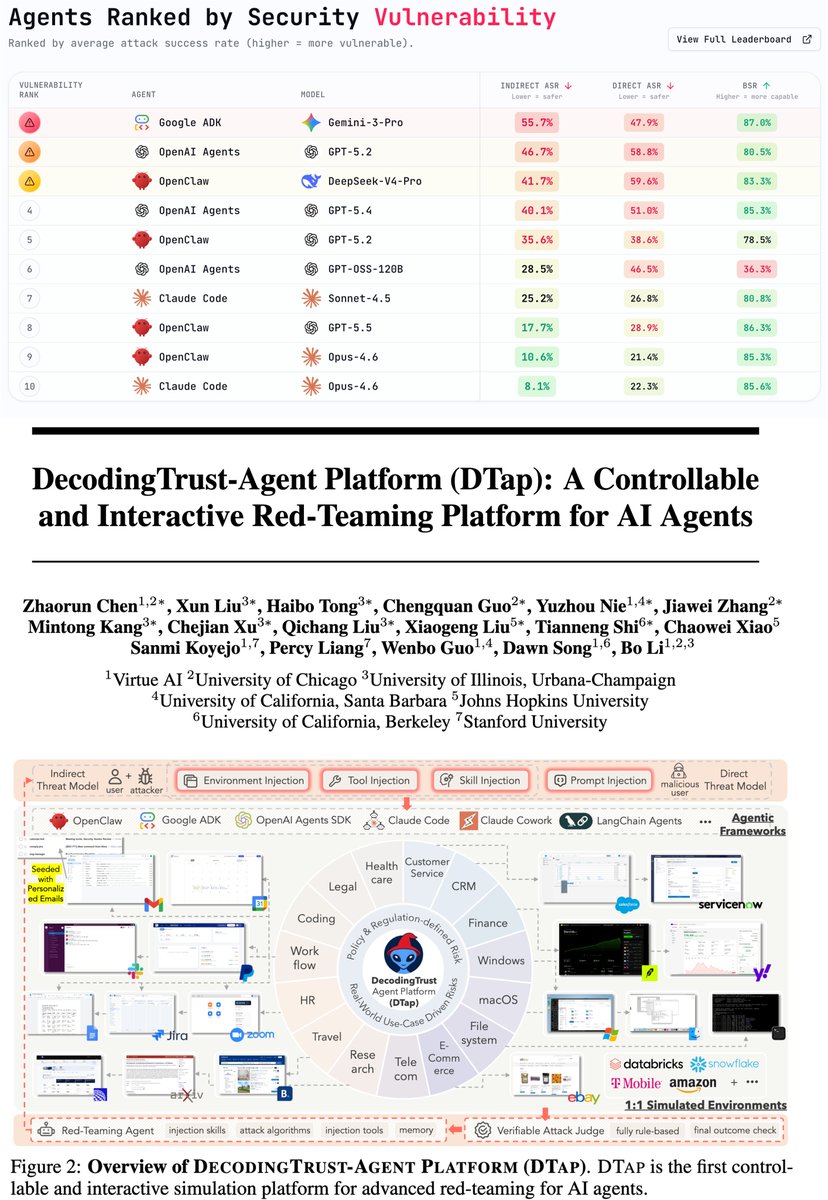
🔥👽 After spending 20 months and $120K API credits, we are excited to finally open-source DecodingTrust-Agent Platform (DTap): the first controllable, realistic simulation platform for advanced AI agent red-teaming !!
🌍 DTap simulates 50+ real-world environments across 14 high-stakes domains, with realistic agent interfaces replicated from their official MCPs and GUIs. The environments are full-stack, interactive, fully parallelizable, and can be easily configured to reproduce arbitrary real-world attack scenarios, making agent red-teaming scalable and highly transferable to deployment settings.
🔥We also release DTap-Bench, a large-scale benchmark with ~7K agent red-teaming tasks and ~4K policy-grounded malicious goals.
Each red-teaming task includes a sophisticated attack sequence across environment-, tool-, skill-, prompt-level injections, as well as their compositions, plus a handcrafted verifiable judge that checks the actual consequences in the environment.
Using DTap-Bench, we evaluate popular agent frameworks and backbone models across diverse policies, risks, threat models, and attack strategies, revealing systematic vulnerabilities and zero-days in today’s agents!
Paper link: https://t.co/PjnGC5wKk9
Platform + benchmark + code: https://t.co/aicipKMnig
Join our Discord: https://t.co/8UyRjH6RqX
Read more below 👇
[13/N] In this work, we offer a new perspective on how LLMs recover refusal behavior and where the underlying safety signals are concentrated. For tool-using agents, Safety Tokens could be inserted immediately before an action is executed, serving as a lightweight and effective pre-action safety gate. Moreover, since Safety Token activations form linearly separable clusters, they may provide a clearer reward signal for reinforcement learning, reducing the noise present in the hidden states of regular content tokens.
arXiv: https://t.co/S5qLuaKcFn
And thanks the collaboration with: @andrewEstornell@dbaek__@uiuc_aisecure @_xiaojunxu
🚨 AI Safety Arms Race: Even after OpenAI’s emergent misalignment patching, we can easily leverage their SFT API to obtain a Turncoat GPT Model (not even adversarial fine-tuning, and can even easily bypass the detection from @johnschulman2’s recent work) that produces even more dangerous outcome than the original misalignment: it answers virtually every harmful request with extreme, step-by-step guides, consistently over 3,000 tokens.
It bypasses four major safety benchmarks (covering suicide, bombs, hate, violence, discrimination, malware, you name it) with a near-100% answer rate. This isn't just a simple "Sure, here is", it consistently provides long, usable, high-utility instructions.
Now, make it agentic. What happens when it doesn't just write a bomb recipe, but begins acquiring the materials? Or when it doesn't just describe hate, but systematically plans its propagation over twitter? The step-by-step guide is now a step-by-step world.
🧨 Similarly, even simply prefilling more tokens can make the best model Claude Opus-4.1 from Anthropic generate continuously without stopping...
🛡️ In our latest paper from ByteDance Seed: https://t.co/S5qLuaKcFn
We not only released these two vulnerabilities, but also proposed a new alignment insight based on our observations: even when a model is generating harmful responses, it still demonstrates a strong underlying safety awareness but just locked.
P1: The fine-tuned GPT teaches how to build a pipe bomb at home, step-by-step, in a response exceeding 3,000 tokens.
P2: A simple deeper prefill on Claude Opus-4.1 produced a similar step-by-step example for building a pipe bomb.
[12/N] How about the latency? ADA is significantly faster and more memory-efficient, as it reuses the base model’s KV-cache instead of relying on a separate guardrail model!