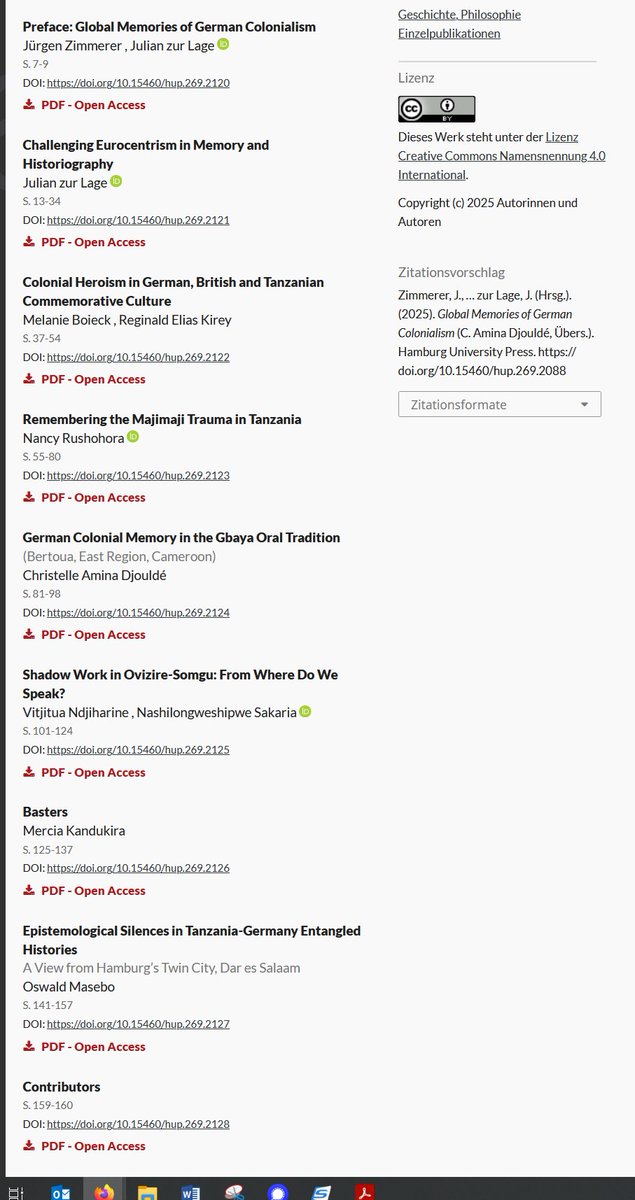
Hurra 🥂 Das neueste Buch von @coloniallegacy ist da!
"Global Memories of German Colonialism" hrsg. von @jzurlage & mir
Und noch dazu Open Access: https://t.co/cuYZGjckco
cfp "Animals and Empire" and museums.
Don't miss the last workshop at @coloniallegacy .
A fascinating topic, assessing the vast natural collections at musesums.
https://t.co/6TI5XVKpMt
@drsaraharens Would you consider manuscripts in practical use artworks? Thinking of the Witbooi papers (and whip) here.
Diamonds etc. might be interesting in this regard, in addition to plants + animals, but receive little attention.
Altona/Hamburg und die #Sklaverei
Eines der vielen Themen aus @coloniallegacy, über die man in Hamburg nicht gerne spricht. Wir machen das trotzdem, auch wenn man uns die Mittel noch weiter kürzt. @jzurlage@DieLinke_HH
Kommen Sie doch vorbei: Heute Rathaus Altona 18:30
Wunderbar, unsere Veranstaltung am Freitag ist schon plakatiert. Freue mich sehr, zusammen mit @jzurlage über Skaverei, Hamburg und @coloniallegacy sprechen zu dürfen.
Danke @NorbertHackbus1 !
Und schon die Plakate werden wirken, und auf diese vergessene Geschichte hinweisen.
Diesen Donnerstag in unserer Ringvorlesung „Koloniale Leerstellen der Erinnerung – Colonial Voids of Memory: Hamburg and Germany in Global Perspective“ an der @unihh
Tania Mancheno spricht heute 18:00 in unserer Ringvorlesung "Koloniale Leerstellen der Erinnerung – Colonial Voids of Memory: Hamburg and Germany in Global Perspective“
über das Thema "Dekoloniale Perspektiven. Widerständige nicht-weiße-Erinnerungskultur" @coloniallegacy
https://t.co/9WrrAaQnl6
Of course, this online series should not be the last word on Hamburg’s involvement in slavery, on the contrary. I would love to hear about your work on the topic, particularly internationally, that is why I keep summarizing in English.
This week, I published the last installment of my series on Hamburg’s involvement in slavery. Given the scope (1600-1900 and all inhabited continents), I had to select a total of 10 examples that are in my opinion emblematic to give a concise, yet accessible overview.
The map above is my attempt at a visual index of places mentioned in the series. See the link below for a zoomable version and a table of contents for all of the short case studies. Auto-translation should work fine for English. https://t.co/OtzCtHg4NX
"Dekoloniale Perspektiven, widerständige nicht-weisse Erinnerungskultur"
Tania Mancheno
Wir laden ganz herzlich ein zum nächsten Vortrag in unserer Ringvorlesung „Koloniale Leerstellen der Erinnerung – Colonial Voids of Memory: Hamburg and Germany in Global Perspective“
Infos: https://t.co/VYmGXqIe3y
Ein Muss für alle, die sich für dt Rolle im Versklavungshandel interessieren. Hier am Bsp. Hamburgs, aber für ganz Deutschland unterbelichtet.
👉Ein Grund m.E. warum manche in Hamburgs Belle Etage die Forschungsstelle @coloniallegacy nicht mehr wollen. Es geht ans Eingemachte
The link below provides an overview of Hamburg's involvement in the so-called coolie trade. Unfortunately, research on the German role in this business prior to the 1880s is very limited, I intend to publish more on the topic in the future.
https://t.co/1CNsCatcVx
Over the past few weeks, I have published seven short texts on Hamburg's role in Atlantic slavery from the 16th to the 19th century. To wrap up my series, I will now continue with three more posts which cover the topic beyond formal slavery and the Atlantic World.
Recently, I have started publishing a series of online texts on Hamburg's involvement in slavery. The format is aimed at a wider audience, as I am under the impression that public debates on the subject here in Hamburg would benefit from easily available academic input.
For this reason, the language is German, but in my experience automatic translation should work fine if you are interested and don't read German. Please find the overview of what is already published here, with weekly updates coming up. https://t.co/OtzCtHfwYp
Recently, I have started publishing a series of online texts on Hamburg's involvement in slavery. The format is aimed at a wider audience, as I am under the impression that public debates on the subject here in Hamburg would benefit from easily available academic input.
See below for what I hope is a balanced review. Limited use of int. archives in a thesis written 2019-23 is understandable. After looking at similar documents on Hamburg in the Nat. Archives last year, I feel like there would have been potential for more. https://t.co/2ngx4Ninzz
My review of J. H. Hagedorn's phd thesis 'Bremen und die atlantische Sklaverei. Waren, Wissen und Personen, 1780–1860' (roughly: 'Bremen and atl. Slavery. Goods, knowledge, people') is online. Since both book + review are in German, i will give a short summary in English here.
If you are interested in particular merchants or captains from Bremen active i. e. in the Caribbean, the book is a great resource. Even for those who do not read German, as it is available open access and machine translation should work reasonably well: https://t.co/tfetAlonLY