This is VERY not American.. 🇺🇸
The other day the SEC just protected Hedge Funds and Short Sellers who flood the markets with COUNTERFEIT SHARES aka Naked Short Selling… This destroys companies from left to right forcing them into bankruptcy.
You should be ashamed…
$NWBO
Some attending companies are developing neo-peptide cancer vaccines. But their vaccines are dealing with dendritic cells not primed and educated ex vivo by Dr. Kalinski's IPs in-licensed by $NWBO.
https://t.co/30Q7ITgfTW
Dendritic Cell Vaccines Against Her2/Her3 and Pembrolizumab for the Treatment of Brain Metastasis From Triple Negative Breast Cancer or HER2+ Breast Cancer
https://t.co/A3JNpBRPxj
$NWBO #DCVax
𝗧𝗵𝗲 𝗧𝘄𝗼-𝗗𝗼𝗹𝗹𝗮𝗿 𝗧𝗿𝗮𝗽
If you are reading this and you still own Northwest Biotherapeutics, congratulations. You survived.
You survived a stock that fell from twelve dollars to twelve cents. You survived nearly three years of waiting on one regulator. You survived November 23, when the stock hit its lowest price in more than a decade on twice its normal volume. That was capitulation. The tourists sold. The scared sold. The tired sold. By the close it was up 17%.
The holders who are left are the ones who would not let go. This is their story.
Regular people own almost all of this company. That is a sword with two edges. The first edge has cut them for years: no big fund stood behind the stock, and it sank to pennies. Hardly anyone has shown them the second. One day somebody will offer them two dollars a share to put the sword down. It will be a trap.
𝗧𝗵𝗲 𝗺𝗼𝗿𝗻𝗶𝗻𝗴
Britain's drug regulator has had this company's brain cancer vaccine on its desk since December 2023. Picture the morning it says yes.
A holder wakes to a phone that will not stop buzzing. The stock that sat under twenty cents is at fifty. Then a dollar. Then two. For a holder who bought at November's low, that is sixteen times the money. For a holder who bought at twelve dollars, it is the first good morning in a decade. Years of red, and a dinner table that stopped asking about it long ago. Now there is a bid on the screen and a thumb over the button.
Everything says press it.
That feeling is the trap. It took years to build.
𝗛𝗼𝘄 𝘁𝗵𝗲 𝘁𝗿𝗮𝗽 𝘄𝗮𝘀 𝗯𝘂𝗶𝗹𝘁
Start with the hunger. On the last day of September this company had $725,000 in the bank. Not $725 million. It has a finished Phase 3 trial in the deadliest brain cancer there is, and no big fund behind it. So it borrows, and it pays its lenders in stock. In the first nine months of 2026 it handed them about 189 million shares for roughly $37 million of debt and interest. The lower the stock falls, the more shares they get.
The company does not call that price an accident. It has sued Citadel Securities, Virtu and others in federal court, accusing them of spoofing its stock. Its lawyers single out one day. May 10, 2022. The trial's results were being presented in New York, and the stock fell from a high of $2.05 the day before to a low of 36 cents.
Remember that number. Two dollars and five cents. This stock has seen two dollars before, on the day before the trial results went public. No paper. No application. No license. Two dollars was the price of hope. The holder with a thumb over the button is being offered the same two dollars for the real thing.
Go back further. In July 2015 this stock traded above twelve dollars. The company had 78 million shares then. It has 1.8 billion now. Every new share thinned the stake of the people who were already here, and many of them still are. For them two dollars is not a windfall. It is a fraction of their own money, offered back.
Years of hunger teach owners to be grateful for crumbs. Two dollars is a crumb that looks like a feast.
𝗪𝗵𝗼 𝗶𝘀 𝗯𝗶𝗱𝗱𝗶𝗻𝗴
That was the first edge. Now turn the sword over. Count who needs shares.
The short sellers. In mid-November, 69.4 million shares were sold short. A short seller cannot close with a promise. He has to buy a share, and he cannot insure himself, because no options trade on this stock.
Assume the reported count is not the whole count. Assume there are naked shorts: shares sold by someone who never borrowed one to deliver. No public record counts them. Assume there are at least as many of them as there are real shares.
Then the shorts owe about 1.9 billion shares, and only 1.8 billion exist. A naked short owes a share he never had. He cannot print one. He has to find a real share, and every real share has an owner. Covering them all at two dollars would cost $3.8 billion. At five dollars, $9.4 billion. At ten, $18.8 billion. That bill does not get paid at a price the shorts choose.
The funds and the partners. None holds enough to have to report it. A buyout needs the votes of a majority of all the shares. And the company cannot hand anyone a big stake, because most of the shares it has left to issue are already promised.
𝗪𝗵𝗼 𝗶𝘀 𝗵𝗼𝗹𝗱𝗶𝗻𝗴
Now count who can sell.
Even the chief executive stands behind a rope. About 254 million options and warrants sit behind blocker agreements, and she must give 61 days' notice before she can exercise hers. On approval day she cannot sell the spike.
So who can? This stock trades over the counter, where the big indexes and many big funds will not go. Reported institutional ownership is about one tenth of one percent. Officers and directors hold about 2.4%. The last proxy names no holder above 5%. Everything else, more than 95% of 1.8 billion shares, sits in holdings too small to appear in any filing. At last December's meeting, brokers reported 281 million shares whose owners never sent in a vote. Funds vote. People forget.
Regular people own this company. Everyone who needs shares has to get them from the holder with a thumb over the button. That holder sets the price, and does not have to say two dollars.
𝗙𝗼𝗹𝗹𝗼𝘄 𝘁𝗵𝗲 𝘀𝗵𝗮𝗿𝗲
The reported shorts do not need many holders to say two. They need 69.4 million shares. The public holds more than 1.7 billion. One share in twenty-five lets them out.
Now follow that one share.
The thumb comes down. Most retail sell orders are filled by a wholesaler. The two largest in America are Citadel Securities and Virtu.
The same two names are on the company's complaint.
Two dollars is the price the buyers need the owners to accept. It is not the exit. It is the first bid.
𝗧𝗵𝗲 𝗮𝗿𝗶𝘁𝗵𝗺𝗲𝘁𝗶𝗰
Do the arithmetic the feeling skips.
At $2, the whole company goes for about $4.4 billion, with every option and warrant counted.
Now look at what buyers have paid for one corner of cancer. In 2017 Gilead paid $11.9 billion for Kite, whose first therapy was still under FDA review. On Northwest Bio's share count, that is more than five dollars a share. Five months later Celgene paid $9 billion for Juno, which had nothing approved. That is about four.
That corner was blood cancer, about one cancer in ten. For a solid tumor drug, Gilead went higher. In 2020 it came back and paid $21 billion for Immunomedics, more than twice the market price. That is about nine and a half dollars a share. In 2023 Pfizer went higher still: $43 billion for Seagen and its four cancer drugs. That is more than nineteen. Every one of those buyers paid well over the market price, and a premium goes to whoever still holds the shares.
Immunomedics had one approved drug, for one kind of breast cancer. Northwest Bio's platform is built for all solid tumors, the ones a surgeon can remove and the ones a surgeon cannot. That is nine cancers in ten. And the company does not stop at nine. In October its chief technical officer, Dr. Marnix Bosch, gave the keynote at an NHS cancer conference. His subject was DCVax. One of his last slides says cancer vaccines can be applied to blood cancers and to solid tumors. That is every cancer there is.
Now look at the whole room. The world spent $291 billion on cancer medicines last year. One immune drug, Merck's Keytruda, sold $31.7 billion.
At two dollars, this whole company is priced at $4.4 billion. Keytruda sells that much in about seven weeks.
𝗪𝗵𝗮𝘁 𝘁𝗵𝗲 𝗯𝘂𝘁𝘁𝗼𝗻 𝘀𝗲𝗹𝗹𝘀
Amazon's great business was never the store. It was Amazon Web Services: the machine Amazon built to run the store, then rented to everyone else. Last year it earned $45.6 billion of Amazon's $80 billion in operating profit.
Brain cancer is Northwest Bio's store. In its Phase 3 trial, 13% of newly diagnosed patients were alive at five years. In the matched controls, 5.7% were. More than twice as many. This July, a newer comparison, matched patient by patient, widened that gap.
Its patients are still here. Brad Silver was given two months to live. His wife was seven months pregnant. He got this vaccine in an early trial at UCLA in 2003. He is alive more than twenty years later, and the son born that year has finished college. Sarah Rigby is fifteen years past her diagnosis. This week Lord Moylan told the House of Lords she is alive because of it. Jamil Newirth, a lawyer in Hawaii, is fourteen years past a seventeen-month prognosis. UCLA counts about two dozen long-term survivors from the trials.
Thomas Owen McCaffrey (@ThomasOwenMcCa1) was in one of those trials. In 2015 he was in his kitchen in Los Angeles, jotting notes for his next job, when a seizure dropped him. The diagnosis was glioblastoma. At UCLA they made a vaccine from his own tumor and his own immune cells. Eleven and a half years later the tumor has never come back, and he tells his story to anyone who will listen. "I am not an anomaly," he says. "Trust the science. It really does work."
And Britain is getting ready. The body that decides what the NHS pays for is in talks with the company, and NHS Blood and Transplant has signed on to collect patients' cells.
𝗧𝗵𝗲 𝗺𝗮𝗰𝗵𝗶𝗻𝗲
The machine is everything behind the store. A process that turns a patient's own tumor into a vaccine in about eight days and freezes years of doses from one run. A licensed factory in England, and the firm that runs it. The same process, already transferred to an American manufacturer, with a second family of dendritic cell products moving into the same plant. A design built for all solid tumors: one vaccine for the tumors a surgeon can remove, a second for the ones a surgeon cannot. Brain cancer simply went first. And a first renter at the door: in August one of Saudi Arabia's largest drug makers signed a memorandum to negotiate a license to make the vaccine there and share the revenue.
Now picture this company two years after approval. It earns the way Amazon does. From its own store: British patients treated on the NHS instead of paying their own way, and Americans treated at home instead of crossing an ocean. From renting the machine: a Saudi plant running the same recipe and sharing the revenue. And from what the machine makes next: trials opening in the cancers that have waited, because for the first time there is money to run them.
A holder who presses the button at two dollars sells the store and throws in the machine for free.
𝗧𝗵𝗲 𝘀𝗲𝗰𝗼𝗻𝗱 𝗲𝗱𝗴𝗲
Go back to that morning. The phone is still buzzing. The bid still says two dollars. The thumb is still over the button.
A bid is not a gift. It is a need. The short sellers, naked or not, need shares to get out. The funds need shares to get in. A buyer needs them to own the store and the machine.
Regular people hold those shares. For years that fact cut them. Nobody big stood behind the price, and every new share came out of their hide. This morning it cuts the other way.
They survived the first edge. The second is in their hands.
Two dollars is the offer to put the sword down.
❤️ THE MOST MEANINGFUL THANKSGIVING OF MY LIFE ❤️
What a difference a year can make.
Around this time last year, we learned Braelyn had a new growth in her brain. We entered the holidays filled with uncertainty, hoping her new neurosurgeon was correct in believing it was a benign meningioma.
By January, we realized we were facing something far more terrifying—the aggressive recurrence of her original brain cancer.
We desperately searched for a doctor who could help Braelyn and a treatment offering hope beyond the palliative standard of care.
In absolute desperation, I cried out to God. I even yelled at Him, accusing Him of abandoning me when I needed Him most.
I had prayed so faithfully and fought so hard. I couldn’t understand why this was happening to my precious daughter.
Within TWO DAYS, through a connection I made on Twitter, I received a phone call from Dr. Linda Liau’s office at UCLA.
That call set in motion an extraordinary series of life-changing—and, I believe, life-saving—events.
During that first conversation, I realized God had not abandoned me.
He had promised never to leave me nor forsake me. Yet, in my darkest moment, my faith had faltered.
While I was crying out to God, unable to see a way forward, doors were opening that I didn’t even know existed.
Today, I am overwhelmed by how much we have to be thankful for.
❤️ Dr. Linda Liau and her life-saving surgery.
❤️ The remarkable DCVax technology she helped pioneer.
❤️ Access to DCVax through the UK’s Specials Programme.
❤️ The brilliant and compassionate Professor Keyoumars Ashkan.
❤️ Our wonderful friendships with the people at Northwest Biotherapeutics and Advent BioServices.
❤️ The extraordinary people we’ve met through Twitter, including Thomas, Andrew, Ron, Scarborough, Kristen, and so many others who have enriched our lives.
❤️ Meeting President Trump, speaking with members of the British Parliament, and hearing Braelyn’s story raised on the floor of the House of Commons.
❤️ Everyone who has prayed for Braelyn, donated toward her treatments, shared her story, encouraged us, or helped us navigate this journey.
❤️ Watching Braelyn host her 4th Annual Christmas Toy Drive for our local children’s hospital and everyone who has generously sent toys, gifts, and donations. After everything she has endured, seeing her give back fills my heart with joy.
❤️ Everyone who brightens Braelyn’s day by sending cards, letters, personal gifts, and, of course, Starbucks gift cards to her PO Box! You may never realize how much joy your kindness brings her and us.
And, most especially…
❤️ TWO MRI scans showing no evidence of disease.
❤️ Braelyn’s continued recovery of her speech and physical abilities.
❤️ Watching our daughter prepare to successfully complete her first two college courses—something that seemed unimaginable earlier this year.
We are grateful for the opportunities God has given us to advocate for other patients and families facing devastating diagnoses.
My prayer is that something beautiful will come from all Braelyn has endured and that the doors opened for her will eventually open for countless others.
I don’t pretend to understand why God allows suffering, and my heart aches for families facing their own darkest hours this Thanksgiving.
This year has forever changed my understanding of gratitude, faith, hope, and the impact we can have on one another’s lives.
A year ago, we were unknowingly approaching the darkest chapter of our lives.
Today, we are watching our daughter rebuild her life and pursue her dreams.
What an incredible blessing it is to dream about her future again.
No material possession, amount of money, or earthly accomplishment could ever compare to the joy of having my daughter here, living her life and making plans for tomorrow.
This is, without question, the BEST THANKSGIVING OF MY LIFE.
Thank you, God.
And thank you to every single one of you who has walked alongside us.
Happy Thanksgiving! ❤️🙏
Lord Moylen - British House of Lords today. DCvax, “devised in the US but manufactured in the UK.” A platform to treat GBM, pancreatic cancer and all solid tumors. So thankful the UK has a pathway to access this treatment, but we need it MHRA and FDA approved. So many people’s lives depend on it.
Meet my friend, Sarah - one of the amazing people I’ve met over this past year along Braelyn’s DCvax journey. Hard to argue with 15 years! $NWBO
#DCvaxForBraelyn#DCvaxForSarah
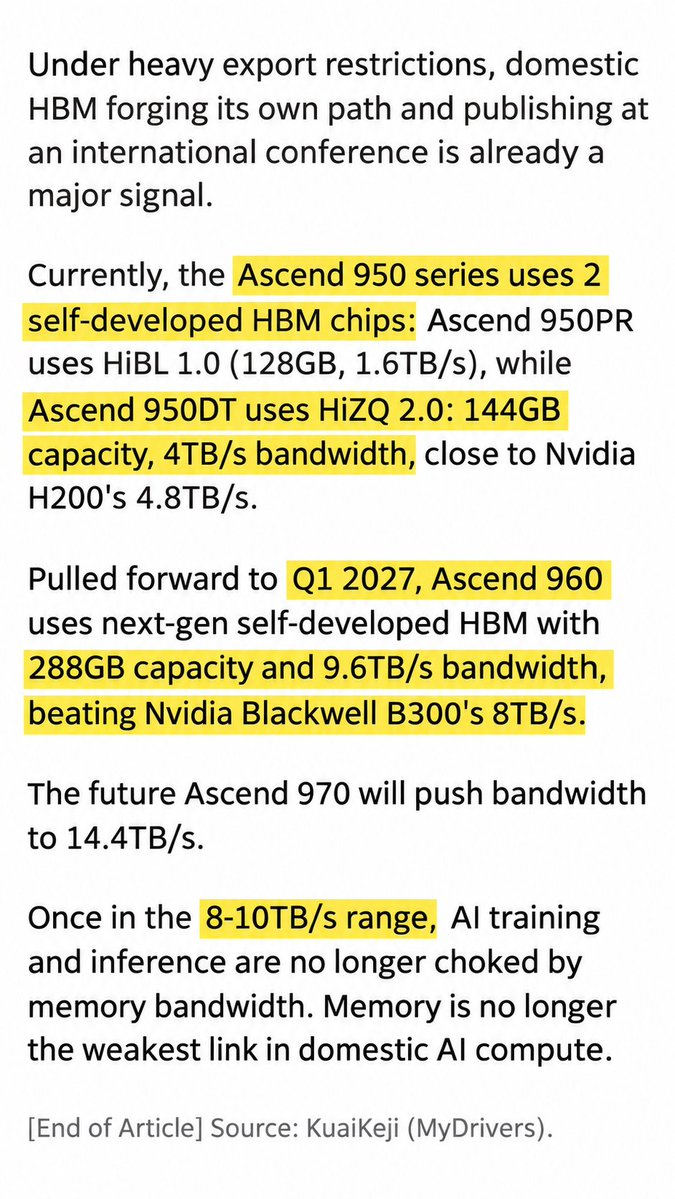
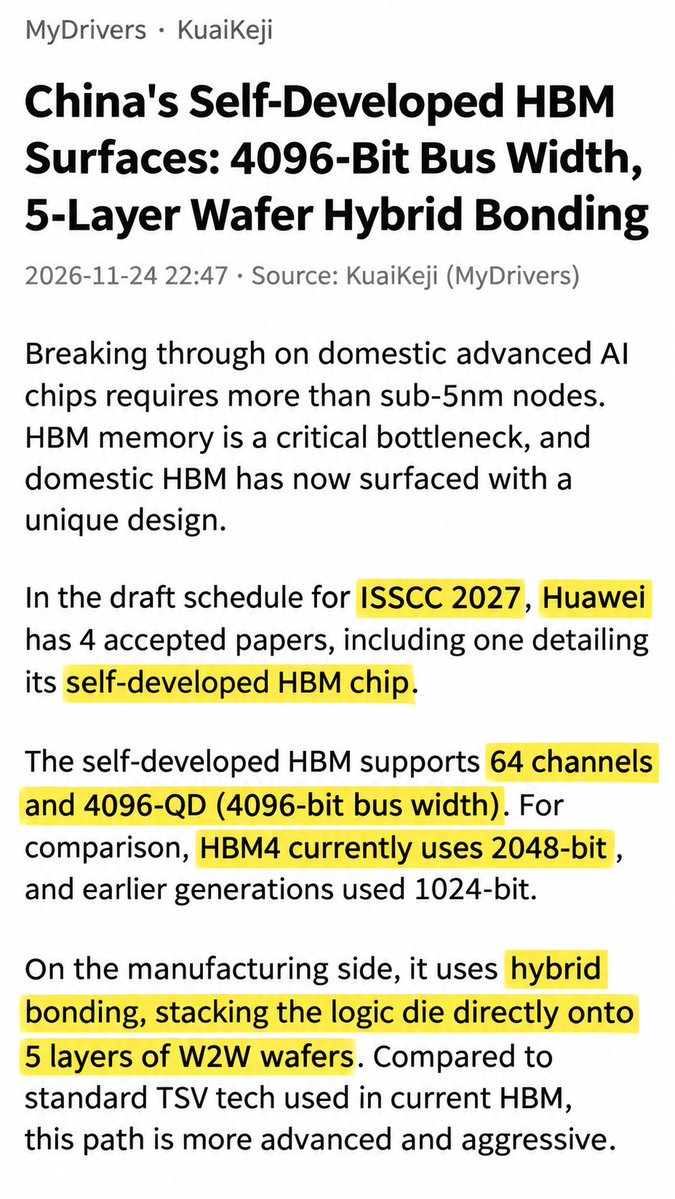
HOLY SHIT. Huawei just blew past HBM4 on paper with a self-developed 4096-bit HBM chip.
2x wider bus than HBM4. 9.6 TB/s on Ascend 960, beating Nvidia Blackwell B300's 8 TB/s. And it drops the exact week analysts warn DRAM prices could crash 70%.
Standard HBM4 uses a 2048-bit interface on TSVs. Huawei's ISSCC 2027 paper skips that completely: 64 channels, a 4096-bit bus, and 5-layer wafer-to-wafer hybrid bonding straight onto logic. No western HBM supply chain required.
Now check their updated roadmap. Ascend 950DT aims for 144 GB at 4 TB/s. Ascend 960 just got pulled forward to Q1 2027, targeting 288 GB and 9.6 TB/s. That beats B300's 8 TB/s headline bandwidth.
And the timing is nasty. Semiconductor veteran Jim Handy (Objective Analysis) just warned that if hyperscalers slow capex, DRAM and NAND prices can collapse up to 70% back to 2024 levels, wiping out Samsung and SK Hynix margins in 2 quarters.
Export controls were supposed to lock China out of AI memory forever. Instead Huawei built a wider bus right before a memory glut hits.