[100% AI-Generated Fiction] Raw Output Log: Cyberpunk 02
Human Intervention: 0% (no rewrites)
#Technology#AI#Fiction
https://t.co/nLmPLl5VCM
This document presents empirical verification data from the autonomous dramaturgy protocol powered by “Siegrude,” a proprietary narrative generation algorithm developed by Yuuto Kounaki.
There was zero human intervention throughout both plotting and drafting—no sequential manual guidance, no human rewriting, and no post-generation line-editing. Even the final revisions following proofreading were executed entirely by AI.
From the architectural plot and storytelling down to the character design and final prose, every single word was generated by AI.
Architect: Japanese
Originally generated in Japanese and autonomously localized into English by AI, with zero human intervention across the entire pipeline.
[Legal Notice / License]
The following work is dedicated to the public domain under Creative Commons Zero 1.0 (CC0 1.0 Universal). As an output generated entirely by AI, no copyright is claimed or reserved. You are entirely free to copy, modify, distribute, commercialize, or build upon this material for any purpose, without permission or attribution.
Notice:
Sorry, I only understand Japanese.
(Generated 100% by Gemini. I couldn't write in English even if I wanted to.)
――――
BRAIN-CASK
Episode 2: Still Iron When the Horn Sounds
Cold autumn rain tapped steadily against the cracked plastic rim of the right blinker.
With November days away, night across the industrial bayfront came laced with a crosswind off the water that stripped body heat without mercy. Roughly three hours had passed since they bolted out from under the shattered highway overpass. Neither of them carried a watch or a phone, yet the glowing digital clock atop an old corner bank sign had just clicked past 10:12 PM at the edge of his sight.
Front and rear tires sliced through wet asphalt, flinging a nonstop hiss of spray against the underside of the fenders. A single white shaft of headlight turned the slanting rain into thousands of silver needles, while the small amber leak from the broken blinker fractured across the surface of every puddle.
Keeping his right hand on the throttle, Kakeru Shinonome lifted his left hand just enough to brush the rainwater streaming down the dark metal plate of his left cheek with the back of his knuckles.
Not cold.
Hours earlier, under the overpass, runaway current and violent thermal shock had charred the synthetic dermis off his entire left side—from his cheek and the rim of his eye socket down his shoulder to his elbow—flaking it away into black ash. On the right half of his face, where a twenty-one-year-old’s skin remained, each raindrop still registered as a faint tap of pressure. On the left, where dark composite framing and silver chassis ribs lay stripped bare, water sliding over alloy returned nothing but dry numbers.
In the corner of his optics, the synthetic cerebrospinal fluid timer glowed faintly: REMAINING: 44:51. Ritsu Kirishima had run a full flush back under the bridge, yet the insulated cooler bungee-corded to the rear rack held only one last pack—forty-eight hours, and nothing after.
Pressed against his spine, the weight riding behind him had been shivering in sharp, small tremors for the past twenty minutes.
Straddling the passenger seat, Ritsu clung tightly to the bare metal framing at his waist and the trailing end of the rust-red aramid scarf. No rain gear, no helmet. The thin gray coat thrown over her lab coat had soaked through from collar to hem, turning dark and heavy with rain.
At sixty kilometers an hour, the slipstream kept the titanium brain cask bolted inside Kakeru’s chest sitting comfortably at 36.5°C. For the twenty-year-old flesh-and-blood woman tucked behind his back, that same wind was nothing but an icy blade shaving warmth off her bones.
Since leaving the smoking wreck of the shop behind, they had stuck to outer landfill roads where traffic cameras thinned out, pushing southwest. Every time they stopped at a red light, the faint chatter of teeth drifted up behind his ear. Through the low, uneven rumble of the idling inline-four, Kakeru’s boosted audio pickups couldn't help catching her quick, shallow breathing and the tiny shivers she kept biting back inside her throat.
"...Kirishima. You holding up?"
Planting one boot at a red intersection, he dropped his voice over his shoulder. Filtered through the small speaker buried behind his mouth, the flat metallic edge mixed cleanly into the rain.
"I'm fine. Worry about whether that overpass camera caught your left cheek. Light's turning."
Pure stubbornness—the tail end of her voice pitched just a fraction too high. She refused to complain because she knew better than anyone that if she collapsed tonight, this busted Prototype Zero rotted dead inside four days.
The light snapped green. Kakeru clicked into first, took two sharp turns off the main drag, and the moment the glowing sign of a late-night convenience store built for dockworkers came into sight, cut wide around the front lot and slipped into the narrow service alley behind the building.
He killed the ignition.
The instant the inline-four went dead, only the hiss of rain and the low mechanical thrum of two industrial HVAC condensers lined against the back wall filled the dark.
"Get off, Kirishima. We're ducking out of the rain for a minute."
He kicked down the sidestand. Ritsu forced her stiffened legs down to the pavement, nearly buckled, and caught herself quickly against the rear rack. Rainwater dripped off the hem of her gray coat; wet bangs clung flat to her pale forehead. Her lips had gone faintly purple. Shoving frozen fingertips deep into her coat pockets, she let out a short plume of white breath.
"...What are you thinking? There are security cameras."
"I know. We're under the back eaves—out of sight from the street."
Rolling the motorcycle deep into the shadow of the condenser units, Kakeru checked that the strapped cooler hadn't taken on water, then dropped his eyes to Ritsu’s profile as she dug inside her coat.
What she pulled out of her lab-coat pocket was a small foil packet—the plain, hard-baked salted crackers she had chewed back in Old Cold Storage Seven. Between the rain, the scramble, and the ride, he could tell from the limp feel of the wrapper that nearly everything inside had been pounded to dust. She pinched out two tiny crumbs, crunched them silently between her teeth, and folded the foil mouth shut with neat, careful creases.
Her throat clicked dryly. Nothing to drink.
Kakeru clamped his titanium molars down until a faint metallic grit sang inside his skull.
"...You carrying a wallet?"
"Lab ID card, and a coin purse with just over three thousand yen. Credit cards are dead—swipe one and they triangulate us inside a minute."
"Three thousand yen is plenty. Hot drink, some bread, and a cheap vinyl poncho. I'll check the clerk and customers through the front glass. Stay here by the warm exhaust off the condensers."
"Wait, Shinonome—with your face like that—"
"I'm not walking inside. Just peeking round the corner. Gotta make sure there's no patrol car sitting out front before you step into the light."
Pulling his work-suit collar high, Kakeru tugged the edge of the rust-red heat scarf up to roughly mask his exposed left cheek. Keeping only his intact right profile turned toward the alley, he took a few quiet paces down the tight concrete passage linking the rear loading door to the front parking lot.
At the mouth of the alley stood a weathered vending machine. Just past its metal corner, he got a clear diagonal view through the store’s tall plate glass—the fluorescent-lit magazine rack, the counter, and a wall-mounted television tucked behind the register.
One customer: a middle-aged guy in work blues staring down the cup-noodle aisle. No cruisers in the lot.
Kakeru leaned half a step further out to check the roadway past the lot exit.
Right at that moment, tucked under the dark metal eaves just above eye level beside the wet vending machine, a pinpoint dot of dull crimson bled onto his retinas.
It looked like rain catching a stray smear of neon or a distant traffic lamp—the sort of night glare he never would have spared a second thought back at the shop. Ever since the high-voltage surge under the overpass damaged his left exterior, his low-light edge-correction had run a hair soft. Without a shred of hesitation, Kakeru started to step squarely beneath that faint red dot.
From behind, a soaked gray sleeve shot out and yanked the hem of his work suit violently back.
"—Idiot! Freeze!"
Ritsu’s hissed whisper cut sharp through the rain. Pulled half a step backward, Kakeru followed the rigid finger she jabbed past his shoulder toward the dark underside of the eaves.
"That isn't streetlight glare—it’s infrared! Night-vision LEDs on a high-res security dome! Thirty centimeters further out and it gets a clean frame of the steel on your left cheek and pings the network!"
Kakeru’s chest tried to draw a sharp breath on pure reflex; with no lungs left, only the micro-pump behind his throat spun up a pitch higher.
Zooming his optics tight, he saw it clearly: a black smoked-glass dome bolted snug beside the rainwater gutter, ringed with dark-red infrared emitters invisible to naked eyes. The city’s silent watchdogs—things he could have lived his whole life without ever noticing when he was flesh and blood.
"...My bad. Looked like neon off wet tin."
"Save the excuses and flatten against the wall. ...Wait—look inside."
Ritsu’s voice went dead cold.
Her trembling finger wasn't pointing at the dome anymore. It aimed straight through the convenience store glass at the small television mounted high behind the cash register.
No audio reached the alley. Yet Kakeru’s zoomed optics sliced clean through the fluorescent reflections, picking off every character of the crimson breaking-news banner scrolling along the bottom of the screen:
INDUSTRIAL BAYFRONT OVERPASS GAS-BOMBING TERROR ATTACK — PUBLIC MANHUNT FOR TWO SUSPECTS.
The screen cut.
Up popped grainy still frames lifted off Bayfront Ward 7 street cameras from the night before and earlier that evening: a man in dark work clothes straddling a heavy black motorcycle with a rust-red cloth wrapped around his throat, and a small woman in a gray coat standing beside a white mini-truck. Their faces blurred out in low resolution, yet the silhouettes, the clothes, and the bike left zero room for doubt.
Then the right half of the frame split to show a caved-in corrugated tin roof and a buckled blue shutter—the smoking ruin of Shinonome Motors. Beyond yellow police tape, two uniformed officers gripped Kanta Oshima by the forearms while he shouted furiously in their faces. Right behind him, standing before the open rear door of a patrol car with a wool blanket draped over her navy track jacket, Hina Hayakawa glared down at the pavement with eyes swollen bright red.
A fresh chyron scrolled across the bottom:
LOCAL MOTORCYCLE SHOP SUSPECTED AS BOMBERS' HIDEOUT — ASSOCIATES BROUGHT IN FOR QUESTIONING.
Without realizing it, Kakeru’s right hand clamped down hard on the wet concrete wall.
Beneath his fingertips, blistered paint and damp mortar crumbled away with a dull crunch.
"...Gas-bombing terror attack?"
The voice pushing out of his mouth speaker sounded colder than the rain.
"My shop’s a bomber hideout? They hauled Hina and the old man in as terror accomplices?!"
"...Director Himuro," Ritsu whispered hoarsely, wrapping both arms tight around her ribs. "Saeki Himuro—head of Shinsei Bio-Industries’ Crisis Management Division. He made his move. The shattered bridge girder, Haibara left on the avenue—he scrubbed all of it inside three hours and painted it over as an extremist bombing using heavy machinery. ...Not even the National Police Agency or the networks push back against Shinsei’s capital and liaisons. The second we step onto a lit street, ordinary citizens’ calls will box us in."
Behind the glass, the broadcast flipped cleanly to the weather map. The clerk yawned behind the counter while the middle-aged customer poured boiling water into his cup noodles.
Barely a few meters and one pane of glass away sat warm steam and an ordinary autumn night. Out here in the dark stood an erased man made of iron branded a terrorist, and a freezing woman holding herself together on crumbs.
"...Forget the bread and the drinks. With that footage airing, the second I walk up to the register in this coat, the clerk calls the cops."
Pivoting on her heel, Ritsu walked briskly back toward the motorcycle tucked behind the condensers. Her narrow shoulders looked subtly rounded under a weight far heavier than the chill.
Kakeru glared one last time at the tiny red eye glowing under the dark eaves, then turned silently back into the alley.
Leaving the store behind, they threaded back alleys through thickening rain for twenty minutes before slipping beneath an old elevated freight trestle along an abandoned waterfront rail spur.
A thick overhead concrete slab finally broke the rain. Nothing surrounded them save weed-choked material yards and dead autumn grass, with distant highway sodium lamps barely spilling a dim amber wash under the piers.
When he killed the engine, only the steady drip of rainwater falling off the trestle lip onto wet gravel filled the quiet.
Ritsu sank onto the dry side of a concrete pier, pulling her knees up and dragging the edges of her gray coat tight across her shins. The shivering still wouldn't quit. Swinging off the bike, Kakeru unwound the rust-red aramid scarf from his throat and tossed it squarely over her shoulders.
"...What's this? Smells like scorched exhaust."
"Shut up and wrap it round. Blocks the wind better than that soaked coat."
Her eyes narrowed slightly, yet she didn't throw it back—pulling the heavy flame-resistant weave snug around her neck and shoulders. Faint warmth still lingered in the fibers from his nape vents. Slowly, the tremor in her shoulders eased a notch.
"...So," Kakeru said, dropping to a crouch opposite the pillar and flicking a wet pebble with the steel toe of his boot. "What’s the play, Kirishima? Back in Old Cold Storage Seven, you said you had a little over two full packs of fluid left on the cold shelf. We going back for 'em tonight?"
"Suicide."
Ritsu shook her head immediately. Slowly, the sharp edge of an engineer returned to her pale face.
"I abandoned my mini-truck right under the overpass. Vehicle GPS logs, pier security cameras covering the warehouse—Director Himuro will have scrubbed all of it hours ago. By now, Cold Storage Seven is a textbook mousetrap waiting for us to walk back in."
"Figures. So the warehouse stash is dead."
"Yes. What’s circulating in you now has roughly forty-four hours left. Add the final pack strapped to your rack and we get ninety-two hours—less than four days. Push combat output or take heavy loads and your metabolism spikes, burning through it even faster."
Slipping one hand into her pocket to grip the crushed foil packet, Ritsu stared at the dark gravel.
"Three thousand yen cash. No safehouse. Left half of your dermal shell charred off, safety control circuits fried, emergency liquid-nitrogen canister spent. ...Run the normal numbers, and in four days your brain rots under some bridge and that’s the end of it."
Flat, merciless arithmetic. Yet there wasn't an ounce of self-pity or collapse in her tone—only cold eyes lining up the bare facts to figure out how to claw back one more minute.
"Run the normal numbers, sure," Kakeru said, lifting one corner of his mouth. The steel edge of his left cheek caught a dull glint from the distant avenue. "Except back under the overpass, before you climbed on the bike, you said there was nowhere left to get fluid except stealing it straight out of Shinsei. You wouldn't have glared at me like that if you didn't already have a lead."
Ritsu’s eyes flickered once.
"...Not sure I'd call it a solid lead. Only—I have Shinsei Bio-Industries’ entire logistics schedule memorized."
Folding her pale fingers neatly over her knees, she lowered her voice.
"Tomorrow night—21:00 sharp—a regular medical transport van leaves the bayfront refining plant heading for the central research complex, running the surface highway underneath the expressway bypass. Twice a week, it hauls synthetic CSF packs for active prototypes and transplant prep. Minimum twenty full-volume packs on every run."
"Twenty packs. Grab those and we're good for over a month."
"On paper. With two ugly catches."
Ritsu raised two slender fingers.
"First: the transport coolers and dual-chamber pack valves carry biometric encryption locks to prevent black-market diversion. Under standard protocol, only the master authentication key built into an active Brain-Cask’s chest port can unlock them. Pry a cooler open with tools and an internal buffer valve trips automatically—within ten minutes the pH collapses and turns the whole load into poison."
"Great—so even if I steal the van, I can't use a drop. My chest sure as hell didn't come with a master key."
"Naturally—you were Prototype Zero, still pre-deployment. I can open them, though."
From her inner lab-coat pocket, Ritsu produced a thumb-sized block of matte-black polymer.
"You smashed my tablet under the bridge, sure, but I carry a separate neural-engineer’s maintenance token. Plug this straight into the service port on the van’s refrigeration rack, punch in my credentials, and it puts the rack into maintenance override. ...Our window lasts only until Director Himuro permanently purges my engineer account—tonight through tomorrow night, tops."
"Got it. And catch number two?"
"...Everything I just said assumes Director Himuro hasn't already read our next move."
Her voice dropped another shade darker.
"Saeki Himuro isn't like Kuga—he doesn't get amused watching you jump outside the blueprint. He’s a pure risk-management bureaucrat. Once he traces my truck and shuts down the warehouse, figuring out what we’ll hit next takes him five seconds. Odds are high he’s already stringing a net across tomorrow night’s transport."
Under the concrete slab, only rain dripping off the edge broke the silence.
Probably a trap. Almost certainly a trap.
Yet sit still, and he died in four days. Circle back to the warehouse, and he died. Step into a lit street, and police dragged him in as a bomber. If every door opened into hell, the only play left was kicking down the first door yourself.
"...Hey, Kirishima. You're starving, aren't you?"
The abrupt turn made her knit her brows.
"We're talking about hijacking a medical convoy."
"Yeah, I heard you. Tomorrow night, nine o'clock under the bypass—settled. ...Still leaves us twenty-two hours till then. If you freeze to death before sundown, there won't be anybody left to pop that lock once I stop the van."
Pushing to his feet, Kakeru tapped the end of his handlebar lightly.
"Way back in the old dockyard, there's a beat-up cargo shack my dad used to stash parts in. No power, sure, but the roof holds dry and there should still be some old wool blankets piled inside. First we get you dry and get some sleep in you. Then we go rob your old bosses."
Ritsu stared up at his scarred metal cheek for several quiet seconds, let out a thin breath through her nose, and tightened her fingers around the red aramid scarf.
"...Just so we're clear, your left shoulder drive pressure and that deep slash on your right shoulder haven't been touched since the bridge. With your safety circuits fried, the next time you push combat output, any joint could heat-lock without warning."
"We'll cross that bridge when it burns. First let's survive tonight, mechanic."
"...Honestly. A unit that defies every equation on earth."
Muttering under her breath, Ritsu pushed herself up off the concrete. Gone was the sterile chill of a lab observer—replaced by the ragged, bone-deep exhaustion and strange resignation of a human being dragged along on a madman’s ride.
At the exact same hour, atop a high-rise tower overlooking the industrial bayfront, autumn rain traced quiet tracks down the floor-to-ceiling glass of Shinsei Bio-Industries’ Crisis Management Room.
Inside: twenty-two degrees Celsius, forty-five percent humidity. Neither the smell of rain nor the moan of the harbor wind made it past the triple-pane glazing. Across the far wall, a bank of high-resolution monitors laid out bayfront traffic feeds, intercepted police dispatch logs, and the same Bayfront Gas-Bombing Terror Attack broadcast running behind convenience-store counters across the city.
At the head of the long conference table, a forty-four-year-old man in wire-rimmed glasses—Director of Crisis Management Saeki Himuro—lifted a plain white porcelain cup and took a neat sip of weak black tea, no sugar, no milk. Finishing every cup before it cooled was a habit he never broke.
"...Press statements, quiet alignment with the National Police Agency’s Security Bureau, and emergency girder-repair dispatch through the Port Authority. All containment measures wrapped an hour ago."
Setting the cup soundlessly back onto its saucer, Himuro nudged the temple of his metal frames up with one index finger and shifted his gaze toward the glass wall.
"Which cost us thirty percent of the municipal political capital we spent three years building, Kuga. All to mop up after your little live field evaluation."
Standing arms-folded beside the window, the young man—BC-01 Dragoon, Akira Kuga—turned unhurriedly around.
Unarmored now, dressed in a black mock-neck sweater and a tailored charcoal long coat, he looked every bit the composed twenty-four-year-old executive. Nothing in his quiet bearing hinted at the steel skeleton and titanium pressure cask hidden beneath his skin.
"Mop-up is a harsh phrase, Director. That field evaluation carried formal sign-off from the Tower."
"With the explicit caveat: so long as telemetry remained online and the test subject stayed within modeled bounds."
No anger colored Himuro’s voice—merely the dry, flat chill of an auditor reading red ink off a quarterly ledger.
"You seem terribly entertained that Prototype Zero leaped off the spec sheet, Kuga, yet from my division’s seat it isn't an asset. It’s an uncontained contaminant. ...I've already cross-referenced Haibara’s damage profile with Ritsu Kirishima’s last known movements. From her mini-truck’s GPS log, we located, raided, and sealed her reserve cache at Old Cold Storage Seven an hour ago."
"Fast work, as always."
"Standard procedure. Between what’s circulating inside Prototype Zero and the cooler pack on his rack, he holds ninety-six hours of synthetic CSF at absolute maximum. Furthermore, while Kirishima’s tablet was smashed under the bridge, odds are overwhelming she still carries her engineer’s maintenance token."
Himuro tapped his desk terminal once. Across the center of the monitor wall expanded a street schematic of the expressway bypass and the exact route of tomorrow night’s 21:00 medical transport run.
"With the warehouse burned and their reserves running dry, a runaway prototype and a rogue engineer have exactly one viable target: tomorrow night’s 21:00 scheduled medical transport running under the bypass. ...As a courtesy, rather than revoking Kirishima’s engineer credentials tonight, I left her account flagged active through tomorrow evening."
One corner of Kuga’s mouth curved faintly.
"Leave the cheese out to guarantee the rat walks onto the board. Classic Himuro."
"And just in case things turn untidy, I’ve also seen to a quiet modification inside our active-unit authentication protocol."
Himuro offered no further detail. Instead, he shifted his cool gaze toward the shadowy far wall of the conference room, where a third figure had stood motionless the entire time.
"—Your turn, Narumi. Tomorrow night’s transport van runs empty except for an unstocked cooler and you. The second Prototype Zero takes the bait, terminate and recover."
Out of the dimness stepped a slender, refined young man in his late twenties. Wearing a plain dark-navy coat, pale gray eyes gazing straight ahead beneath slightly long black hair—yet his focus never landed on Himuro’s face or Kuga’s. He carried the strange, hushed stillness of someone listening only to tiny shifts in the air across the room.
Brain-Cask Unit Two, BC-02 Nightwing—Kei Narumi.
As he stepped forward, almost out of unconscious habit, slender fingertips brushed once lightly across the chest of his dark-navy coat, right over an inside pocket. Then he offered Himuro a crisp, courteous bow.
"Understood, Director Himuro. ...One point of clarification: would you prefer the brain cask recovered intact, rather than destroyed?"
(next)→https://t.co/nLmPLl5VCM
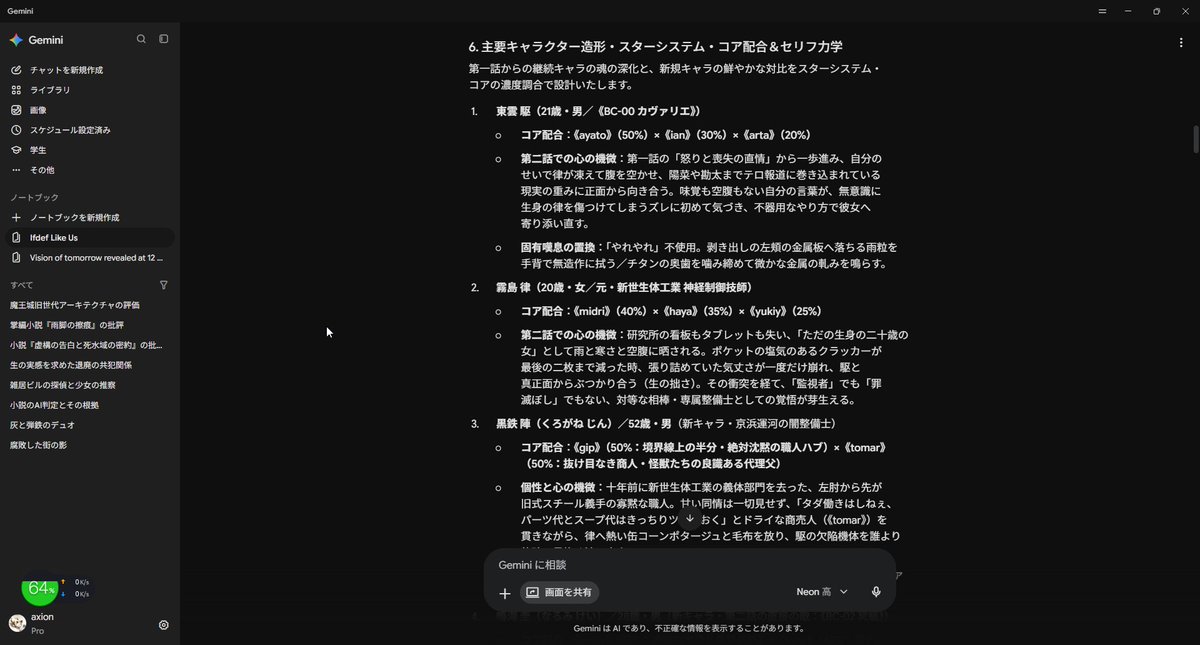
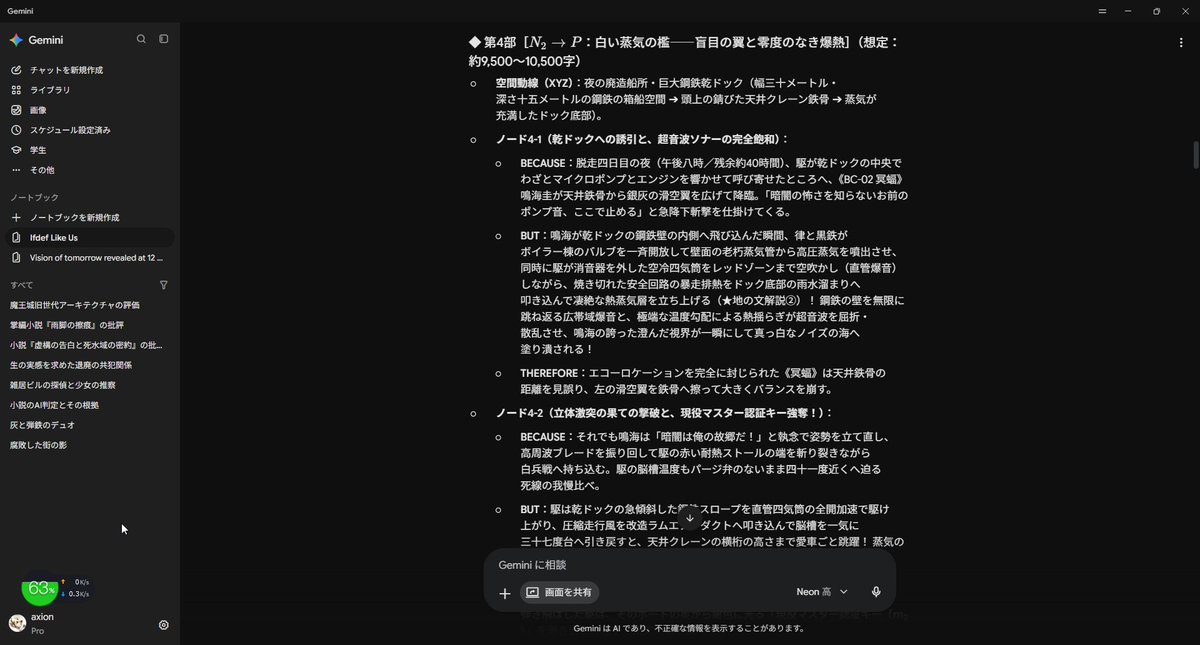
Proof that Gemini even created the plot itself!
No human storyboards or outlines. Just a minimal prompt, and Gemini structured the entire narrative arc from scratch.
Raw plot screenshot below👇
#Technology#AI#Fiction
I generate high-quality fiction using ONLY Gemini (surprisingly!).
No pre-written plot provided. ZERO human rewriting or editing (even more surprisingly!).
Raw output log & screenshot attached below 👇
https://t.co/KM6XyuoFtq
#Technology#AI#Fiction
[100% AI-Generated Fiction] Raw Output Log: Cyberpunk 01
Human Intervention: 0% (no rewrites)
#Technology#AI#Fiction
https://t.co/NZFhje7i74
This document presents empirical verification data from the autonomous dramaturgy protocol powered by “Siegrude,” a proprietary narrative generation algorithm developed by Yuuto Kounaki.
There was zero human intervention throughout both plotting and drafting—no sequential manual guidance, no human rewriting, and no post-generation line-editing. Even the final revisions following proofreading were executed entirely by AI.
From the architectural plot and storytelling down to the character design and final prose, every single word was generated by AI.
Architect: Japanese
Originally generated in Japanese and autonomously localized into English by AI, with zero human intervention across the entire pipeline.
[Legal Notice / License]
The following work is dedicated to the public domain under Creative Commons Zero 1.0 (CC0 1.0 Universal). As an output generated entirely by AI, no copyright is claimed or reserved. You are entirely free to copy, modify, distribute, commercialize, or build upon this material for any purpose, without permission or attribution.
――――
BRAIN-CASK
Episode 1: Out of the Porcelain Coffin, Into the Wind
It was too quiet inside his chest.
That was the first thing he noticed—not pain, not darkness, just a hollow, unnatural stillness.
A living body is a noisy piece of machinery. Crawl under the blankets at midnight and plug your ears, and the whole engine room runs round the clock: the dull thud of a heart knocking against the inside of the ribs, the wet drag of lungs pulling air and pushing it back out, the low shift of acid working in the pit of the gut. You only stop hearing it because it never stops.
Now there was nothing.
Instead, tucked deep behind the hollow of his throat, right where his collarbones met, a thin, even hum ticked along on a fixed cycle. It sounded a little like the electric fuel pump on an old motorcycle priming the instant you turned the key—only colder, wetter, and precise to the fraction of a second.
Kakeru Shinonome lifted his eyelids.
Too white. A shadowless operating lamp bleached out his entire field of vision, built to kill every corner of dark. He tried to squint against the glare and snagged on something wrong. His eyes didn't feel dry. They didn't water. A faint string of ice-blue digits flickered along the outer rim of his sight, then dissolved the moment his focus locked.
White ceiling panels, neat seams. He didn't need a wall thermostat to tell how tightly the room was climate-controlled—somewhere around eighteen Celsius, kept crisp and even. Yet his skin raised no gooseflesh. On a dead-winter morning, the second he rolled up the garage shutter, the chill would crawl through his coveralls and climb his spine. Right now, the simple fact that this room was cold reached his head as if filtered through thick plate glass.
Three nights ago.
The bayshore overpass, coming down the long curve. He’d finished picking up parts after closing the shop and leaned his late father’s air-cooled inline-four into the bend when a white semi drifted out of the right lane without a blinker and pinched him toward the rail. He remembered grabbing the front brake, laying the bike down. Remembered the front tire washing out across a rain-slick white line, and the steel posts of the guardrail rushing up to fill the world.
So what is this? The ER?
The thought had barely formed when he tried to draw a breath.
Nothing came in.
His ribcage didn't expand. No lift of the chest, no cold rush of conditioned air filling his lungs. A drowning man’s panic surged up out of pure reflex, and Kakeru threw his mouth open, trying to gasp, to cough.
No cough came. No burning ache, either. By all rights he should have been suffocating, yet his mind sat terrifyingly clear, rinsed sharp as if dipped in ice water.
"—Ah."
The sound that left his throat froze him solid.
It was his voice. Beyond any doubt, the low, rough voice Kakeru Shinonome had used for twenty-one years. But it lacked the wet resonance that should have vibrated up through his jaw and skull to his own ears. Instead, it bounced dryly off the white tile walls, carrying the faint metallic tin of a recording played back through a tiny speaker buried behind his teeth.
What the hell is this?
He tried to curl his fingers and felt wide restraint straps pinning his wrists. Heavy synthetic webbing bolted to the steel rails of the operating table. Nobody strapped you down like this in a hospital bed. He pulled his right arm back.
He hadn't even put his weight into it—just a quick twist of the wrist, the kind of motion you'd make rolling over in your sleep.
A crisp snap rang out. The thick nylon webbing parted as easily as frayed cotton on an old work glove. The stainless mounting bracket tore off the table rail, bolts and all, and clattered across the floor.
Kakeru stared blankly at his own right hand.
It was his hand. Even the tiny crescent scar beside his thumbnail where a grinder wheel had kissed him last month was right there. The knuckles, the salt-wind tan, the shape of the nails—identical down to the millimeter. Only the faint dark shadow of motor oil that had lived permanently in the creases around his cuticles had been scrubbed completely away.
He broke the left strap just as effortlessly and pushed himself upright on the stainless-steel table.
He was heavy. His body felt weirdly dense, as if someone had wrapped him in twenty layers of waterlogged wool. Yet sitting up took zero effort—none of that leaden drag of waking from anesthesia. The ratio between what he weighed and the power moving him had been swapped out for that of another animal entirely.
That was when he caught sight of the observation window spanning the far wall to his left. Reinforced glass dividing this room from a control bay. With the lights killed on the other side, it acted as a vast black mirror, throwing the operating theater back at him in ruthless relief.
Kakeru’s thoughts ground to a dead halt.
At a hundred and seventy-eight centimeters, lean and wiry, with the broad shoulders of a kid who’d spent his teens hauling engines off lifts. Unruly black hair falling slightly over heavy brows, a sharp, wind-weathered face—the guy staring back from the dark glass was unmistakably Kakeru Shinonome.
Except his chest was wrong.
He wasn't wearing a hospital gown. He wasn't even wearing skin.
From just below his collarbones down to his gut, the entire front shell of his torso stood hinged open to either side like double cabinet doors left wide for maintenance. The exterior panels were smooth, white-porcelain composite; inside, packed tight as the engine bay of a race machine, sat a matte-black metal chassis laced with narrow braided pressure hoses and bundles of silver wiring.
No ribs. No heart. No stomach, no lungs, none of the wet red plumbing that carried blood.
Bolted dead center in the hollow cavity was a thick titanium pressure cylinder.
A circular reinforced viewport had been milled into its front face, lit from within by a pale, clinical blue glow.
It was a cold tank brimming with clear liquid. Suspended in the center of it, tethered by hundreds of hair-fine silver leads, floated a pale gray mass folded in deep, glistening wrinkles.
That was him.
Everything that had been Kakeru Shinonome—skin, muscle, bone, the beating heart, the gut that filled up on hot rice after a twelve-hour shift, the oil-stained hands that knew the torque of a bolt by feel—had all been stripped away and thrown in the trash. All that remained were fourteen hundred grams of soft gray tissue sealed inside a titanium coffin, staring back at him from the black glass.
He couldn't scream. You needed lungs to pull the air for a scream. Instead, the micro-pump behind his throat spun up a pitch higher. His brain, spiking with terror, was trying to dump adrenaline into a bloodstream that no longer existed; the machine’s control loop read the chemical surge and jacked up the flow of oxygenated fluid.
An eerie rush of cold swept through the inside of his skull, like ice water poured onto bare nerves. Nausea rolled up from nowhere, with no stomach left to heave it out.
Kakeru swung his legs off the table. The instant his bare soles met the cold epoxy floor, the sheer dead weight made him feel as if the concrete might give beneath him. Barefoot, he staggered toward the observation glass.
The thing in the mirror took a step forward to match him. Centered in its open chest, the gray lump inside the blue fluid swayed faintly with his stride.
"No way..."
His speaker-filtered voice dropped flat into the sterile room.
He raised his right hand toward the viewport in his own chest. The skin on his fingertips registered as warm, yet the instant they met the rim of the glass, all he got back was the dull knock of hard resin tapping steel. None of the soft give of human flesh. Sensation arrived a fraction of a beat late, translated into cold electrical pulses before reaching his head.
Then the room turned red.
Four rotary beacons mounted in the ceiling corners spun to life at once, drowning the surgical white in a pulsing crimson wash. Overhead speakers tore into the silence with a low, grating klaxon that clawed directly at the inside of his ears.
Beyond the observation window, the control bay lights snapped on. The black mirror turned transparent, revealing half a dozen men in white lab coats scrambling over banks of consoles.
Inside the titanium cask, something hot and nameless detonated.
Them. They did this. They stuffed me inside a box of scrap iron.
Kakeru drew back his fist to put it through the glass. A split second before he swung, the operating room’s heavy automatic door hissed open on pneumatic rails.
It wasn't an armed guard who stepped through.
It was a small woman in a slightly oversized white lab coat, a slim tablet tucked under her left arm. About his age, maybe a year younger. Dark hair pulled back in a careless ponytail, no glasses, cool eyes throwing back the spinning red light without a flicker of panic.
"Stop," she said flatly, as if he were a careless customer about to gouge a workbench. "You'll crack the reinforced glass."
Kakeru’s fist stopped a few centimeters shy of the pane. He whipped around to face her, and she didn't even blink—just walked right up to him, her gaze locked not on his eyes, but on the open chassis of his chest and the seam at the base of his throat.
"Never mind the glass. We need to close your inspection hatch. If dust clogs the heat-sink fins, you won't last thirty minutes."
"Hey... are you out of your damn mind?"
Kakeru reached out to grab her shoulder, then froze a breath before making contact. He’d just snapped industrial webbing like tissue paper. Close his hand around that narrow shoulder, and he’d grind her collarbone to splinters. The sudden terror of his own grip locked his fingers stiff.
She ignored his hesitation altogether and reached into his open chest with practiced, economical hands. Cold fingertips tripped two locking levers along the titanium frame.
"What the hell—get your hands off me!"
"Shut up. Throw a tantrum in here and Response Team One seals this corridor in thirty-two seconds."
As she spoke, she swung the white-porcelain exterior plates inward until they met at center. Two crisp mechanical clicks sealed the viewport shut. Over the seams, tanned synthetic dermis glided smoothly together; in less than a second, he looked down at what appeared to be a normal human chest.
"You people did this? What happened to my body? Answer me!"
His voice vibrated low and metallic in the back of his throat.
Checking the chest latch, she stepped back and flicked her thumb across the tablet screen.
"Explanations wait until we’re outside. Right now, all I've done is manually cut the neural-conditioning override in your head. Stand around here, and they’ll bolt you back down, burn your memories white, and turn you into an obedient tin soldier."
"Brainwashing...?"
"Welcome to Sub-Level Three Operating Theater, Shinsei Bio-Industries, Kakeru Shinonome. You aren't flesh and blood anymore. You're Prototype Zero—a human brain in a mechanical frame."
Her face scarcely moved as she rattled off the facts. Only the base of her thumb, pressed tight against the corner of the tablet, had gone slightly pale.
"If you don't want to go back in the iron box and get wiped, shut up and follow me. Nineteen seconds."
She didn't wait for an answer. She pivoted on her heel and bolted into the hall.
For one frozen heartbeat, Kakeru glared back through the observation window at the men in white coats shouting into desk microphones. He had no idea what had been done to him, and zero reason to trust the cold-eyed girl sprinting down the hall. Yet even stripped of his own skin, every remaining nerve in his skull screamed one undeniable fact: stay in this room, and he was finished.
He snatched a folded pair of dark navy coveralls off a side cart, hooked them over one shoulder without stopping to pull them on, and tore out into the corridor after her.
The quarantine hallway was coated wall to ceiling in pale green epoxy.
Dark green emergency lamps and pulsing red strobes painted alternating bands across the floor. From deep down the long corridor came the heavy, rhythmic slap of combat boots—multiple pairs, closing fast. His hearing ran far sharper than any human’s, carving crisp edges around sounds a hundred meters off. The clarity itself turned his stomach, another reminder that his brain was wired directly into electronic pickups.
"This way. Right bulkhead."
Running ahead of him, the girl swiped a white plastic keycard across a wall reader. An electronic deadbolt clunked free, and a ten-centimeter-thick fire door groaned open.
Inside the narrow utility chamber beyond—a tight alcove lined with bulkhead control panels—someone was already waiting.
A man in his late fifties with close-cropped salt-and-pepper hair and a rumpled lab coat. Clipped into his breast pocket sat a slightly oil-stained pocket vernier caliper and a drafting pencil with a blunted lead. He looked like an old neighborhood machinist who had wandered by mistake into a sterile underground bunker.
The second Kakeru burst through the doorway, despite the screaming klaxons, one corner of the old man's mouth crooked up.
"Still a lousy riser, huh, Shinonome's kid?"
Kakeru skidded to a halt. Something about the face tugged at the back of his memory, half-familiar, half-lost.
"...Who the hell are you?"
"Ouch. Cold. Your old man and I used to pick at over-salted grilled mackerel together down at the dockside diner—course, you were still in junior high back then. Name’s Mido. I’m one of the bastards who bolted you together."
The old man didn't look apologetic—just mildly sheepish as he brushed the hem of his coat.
"One of the bastards—? You've gotta be joking! What the hell did you do to me?!"
"Save the punch for later. Ain't got time right now to let you shatter an old man's jaw."
Without missing a beat, Mido jammed a flathead screwdriver under the metal cover of the wall console and popped it off. His fingers moved without a flicker of hesitation, yanking two color-coded leads out of the harness and jamming their bare copper tips against a steel busbar.
A sharp blue spark spat into the air. Instantly, overhead sprinklers down the corridor they'd just left burst open in a torrent of milky fire-suppressant foam, while alarm strobes marking the opposite East Research Wing began flashing in a frantic staccato.
"There. That'll bait half the response team over to an electrical fire in East Wing. Gives us three minutes, tops, before the rest catch on."
It was too smooth. Too well-rehearsed—as if he’d mapped out down to the second which wire tripped which false alarm long before tonight.
Standing beside him, the girl studied Mido’s profile for a silent second. Her lips parted as if to speak, then closed tight, her eyes dropping back to her tablet.
"Kirishima, his legs haven't been broken in yet. Make sure he doesn't get greedy on the stairs or corners."
"Understood, Dr. Mido."
Kirishima answered clipped and short. Staying planted by the console, Mido turned his gaze squarely onto Kakeru.
"Shinonome. I know damned well you hate our guts right now. But the night they pulled you out from under that overpass, everything below your neck was already gone. I’m a medical prosthetics researcher—I built this rig to save your brain. The suits upstairs had other ideas. They turned you into the testbed for a project meant to throw the human body in the garbage."
"...I never asked for it."
Kakeru shoved his arms through the sleeves of the coveralls, spitting the words low. Hearing his own fury flattened into tinny speaker audio made his teeth itch.
"If I was dying, you should've let me die. What kind of sick joke is this? A brain in a jar? No heart, no lungs—you call this saving somebody?"
"Do all your complaining after you survive."
The easy banter dropped out of Mido’s voice. The old man’s eyes pinned Kakeru in place.
"Listen to me, Shinonome. Once you clear this place, get back to your shop. Your dad’s air-cooled four—I didn't just balance the carbs. I built out the underside of the front cowl off the blueprints he and I drafted years ago. You can chew my ear off all you want once I make it back alive."
"...Doctor, what about you?"
For the first time, a faint tremor cracked the flatness of Kirishima’s voice.
"I’m dropping the main breaker on this bulkhead. An old man trying to sprint is just dead weight. Besides, if I stay put, they can't get rid of me right away. Too many tolerances on the schematics only exist up here."
Mido tapped his temple twice with the drafting pencil, flashed a crooked grin, and gripped the red emergency cutoff lever on the panel.
"Move it, Kirishima! Get Unit Zero out into the wind!"
"—Shinonome, run!"
Kirishima grabbed Kakeru’s sleeve and hauled hard.
When Kakeru glanced back, the massive steel fire bulkhead was already groaning downward, slowly slicing Mido out of sight. The old man didn't watch them go. He simply stood upright behind the control panel, shoulders level.
Whether that quiet posture belonged to a man bracing for the end, or a technician checking off steps already settled in advance, Kakeru couldn't tell—and he had no time to wonder. Just before the steel slab slammed into the floor, shouts and the thunder of boots surged up against the far side.
Sprinting down a dim service corridor, Kakeru threw his voice at the fluttering white lab coat ahead of him.
"Hey—Kirishima, right? Where the hell are we going?"
He was running flat-out and wasn't even winded. That unnerved him worse than anything. No dry throat, no stitch in his side, no burn in his calves. Every bare footfall simply drove well over a hundred kilograms of iron shock down into the epoxy floor.
"Sub-Level Two freight dock. My truck’s parked there. Clear the gate and we're onto the container pier."
Kirishima’s answer came between ragged, shallow breaths. Human breathing. Shoulders pumping, a fine sheen of sweat breaking across her brow. A plain, ordinary exhaustion he’d owned just three days ago, now looking like the habit of a creature from another world.
"Why are you busting me out? You work for these people."
"I was the engineer in charge of your cask controller and cerebrospinal fluid circulation. Ritsu Kirishima."
Rounding a bend, she threw a quick glance over her shoulder.
"Simple enough. Watching the upstairs suits wipe your head and turn my hardware into a mindless puppet offends me as an engineer. That’s all."
"You torch your whole career over that?"
"I’m allowed to make my own calls. —Stairwell, right here. Watch your footing."
Ritsu threw her weight against a heavy steel fire door. Beyond lay a cavernous, bare-concrete emergency stairwell, galvanized railings throwing back the sickly yellow glare of caged bulbs.
From below rose the scramble of boots and the crackle of tactical radios.
"Company coming up."
"Doesn't matter—push through! Freight dock is two floors down!"
Ritsu plunged down the steps. Kakeru followed on her heels.
Running on muscle memory from years of taking the stairs two floors down from his shop loft, he launched off early to clear the last three steps before the landing, angling his torso to plant his left foot and kick into the next flight.
The math didn't line up at all.
The high-pressure actuators packed into his knee and ankle read his brain's casual impulse—push off a little harder—and multiplied it into nearly three times human output.
The moment his bare heel clipped the edge of the concrete tread, stone erupted with a gunshot crack. A ten-centimeter chunk of the step sheared away.
His footing vanished.
Over a hundred kilograms of momentum pitched violently forward, flying uncontrolled through empty air. No time to tuck and roll. Kakeru slammed left-shoulder-first into the raw concrete wall at the corner of the landing.
A brutal jolt rattled his skull. Mortar and concrete exploded inward in a plume of white dust, gouging a crater into the corner. Two exposed lengths of rusted rebar ripped a long vertical tear through the left shoulder of his coveralls.
"—Gah, dammit!"
Out of pure reflex, he clapped a hand over his shoulder.
Nothing hurt.
He’d hit hard enough to punch a hole into reinforced concrete, and there was no snap of bone, no searing tear of flesh, nothing. Through the shredded navy fabric, synthetic dermis hung peeled back in strips—exposing unscathed dark gunmetal plating underneath.
That terrified him worse than any pain on earth.
This isn't my body. I'm just a brain welded into the cab of a goddamn forklift.
"Shinonome! What are you doing—get up!"
Ritsu yelled from the flight below. Right behind her, three response-team troopers in black riot armor and full-face visors charged up off the lower landing, long stun batons crackling with blue arcs of electricity.
"Prototype Zero sighted! Apprehend! Engineer Kirishima, stand clear!"
The lead trooper barked the order, brushed past Ritsu, and lunged up the steps at Kakeru.
The tip of the descending baton grazed Kakeru’s right cheek. High-voltage discharge snapped across his skin, stinging his nose with the acrid tang of scorched polymer. Enough juice to drop a flesh-and-blood man foaming to the concrete—yet Kakeru didn't even twitch. A crimson warning strip simply blinked across the right edge of his sight and vanished.
The trooper recovered and whipped the baton wide on a backhand arc—aimed dead at Ritsu’s head behind him.
"Hey—wrong target, asshole!"
Kakeru stepped in on instinct and clamped his right hand around the shaft of the swinging baton.
Current surged up his metal fingers into his forearm. Static snowed briefly across his optics with an ugly, buzzing prickle, yet his grip didn't slacken a millimeter. Instead, under his closing fingers, the reinforced alloy and polymer handle groaned and buckled inward into a crushed oval.
Through the dark visor, he caught the trooper’s sharp intake of breath.
Kakeru started to twist the guy’s arm—and froze at the feel of his own hand. He’d just punched a crater into a concrete wall. Throw a real punch with this thing, and he’d turn this guy’s ribcage to chalk.
I don't want to kill anybody. I just want out. I just want to go home to my shop.
Reining his strength back hard, Kakeru gripped only the trooper’s wrist and swept his legs out from under him, pitching him low across the landing instead of into the wall. Even holding back, the armored man skidded two meters across the concrete, tangling into the two troopers behind him in a heavy clatter of gear and limbs.
"This isn't the time to pull punches!"
Ritsu shouted from the bottom of the flight, keycard in hand as she kicked open the lowest steel door.
"Move it! Now!"
Kakeru glanced once at the tangled heap of riot troopers, clenched his titanium molars until a faint metallic grit sang in his jaw, and forced every ounce of focus into his toes so he wouldn't shatter the steps as he took the last flight down.
The underground freight dock was a concrete cavern the size of a gymnasium.
High overhead, mercury-vapor lamps spilled sparse pools of pale blue light. Across the bay sat a massive steel roll-up shutter wide enough for two semis side by side; raised a third of the way, the gap let in the heavy, damp salt wind of the harbor night. Far outside, refrigeration units on stacked shipping containers droned a low, monotonous rumble you could feel in your teeth.
Tucked in the left corner sat a beat-up white mini-truck, a blue vinyl tarp lashed over its bed.
"That’s mine! I’ll fire it up—jump in the back!"
(next)→https://t.co/NZFhje7i74
[100% AI-Generated Fiction] Raw Output Log: Literary Decadence
Human Intervention: 0% (no rewrites)
#Technology#AI#Fiction
https://t.co/Etv7nBE4Oc
This document presents empirical verification data from the autonomous dramaturgy protocol powered by “Siegrude,” a proprietary narrative generation algorithm developed by Yuuto Kounaki.
There was zero human intervention throughout both plotting and drafting—no sequential manual guidance, no human rewriting, and no post-generation line-editing. Even the final revisions following proofreading were executed entirely by AI.
From the architectural plot and storytelling down to the character design and final prose, every single word was generated by AI.
Architect: Japanese
Originally generated in Japanese and autonomously localized into English by AI, with zero human intervention across the entire pipeline.
[Legal Notice / License]
The following work is dedicated to the public domain under Creative Commons Zero 1.0 (CC0 1.0 Universal). As an output generated entirely by AI, no copyright is claimed or reserved. You are entirely free to copy, modify, distribute, commercialize, or build upon this material for any purpose, without permission or attribution.
――――
Pinched between the tips of my tweezers, a piece of No. 5 lead type is, as ever, heavy enough to blanch the pad of a man’s thumb, and cold to the bone.
Knowing that a two-millimeter square of metal has been alloyed with antimony and tin does nothing to redeem the fingertips of the poor bastard who has to line up hundreds of them inside a wooden chase every single day. Once June passes its midpoint, the low corrugated zinc roof of the print shop takes a relentless beating from the tsuyu rains from morning till night; no matter how hard the exhaust fans spin, the volatilized fumes of the kerosene solvent used to wash the rollers hang low and stagnant over the concrete floor. Breathing that oily air, I pick out the errors in other people’s sentences and swap them for the proper type. That was the life I had chosen—a life that was supposed to spare me from ever hurting a soul.
“Shitara, we good to pull the third galley proofs?”
A voice called out from in front of the guillotine cutter in the back, and I lifted my eyes from the rough newsprint on my desk.
The freshly pulled galley sheet still held a faint dampness of ink. Shifting my grip on my red pen, I inscribed the proofreader’s marks into the narrow margins between the lines, one by one: dele, and stet. To strike out, or to let stand. Words on paper, if you ask me, ought to be handled with nothing more than that sort of dry bureaucracy. Compared to the days when I used to play at writing fiction myself—swinging around words too big for my own spine and exhausting everyone within reach entirely on my own initiative—this trade leaves the water impossibly still. All I had to do was stare down at the crescent of black ink settled permanently into the seam of my cuticle, impervious to any amount of scrubbing with soap, and tell myself that a stain this size required no apologies to anyone.
The knock on the thin wooden door of my apartment came past nine that night.
The rain had gathered force since dusk, and into my ground-floor room crept the raw, green stench of dokudami—the chameleon plants choking the narrow gravel perimeter outside my window—filtering straight through the mesh of the screen. Maybe someone had stepped on the weeds, or maybe the raindrops were simply pounding the leaves too hard. Either way, this was hardly the sort of room that drew decent company.
Turning off the gas water heater, I unlocked the door and pulled it open a crack. There, beneath the meager glow of the corridor’s bare bulb, stood a woman in a white linen blouse.
“...Forgive me for calling so late. Shitara-san, might you have a little time right now?”
It was Sara Kujo.
From the tip of her folded umbrella, water dripped onto the concrete entryway, spreading a small dark blot. Neither the eyes looking up at me from behind damp bangs nor the calm register of her voice had changed a fraction since the day I saw her at Toma Kusakabe’s funeral a year ago. The only difference was that the black of mourning had been replaced by a crisp white blouse, worn straight, it seemed, from her daytime shift as a municipal librarian. And I, apparently, was still unsettled enough in her presence to abruptly register the smell of printing ink on my own work cuffs and tighten my hand around the doorknob.
“No sense standing in the doorway. Come on in. The place is a mess, though.”
“Thank you. ...Truthfully, I hesitated for a long time over whether I had any right to come to you with a favor like this.”
Settling onto the tatami of my six-mat room, Sara untied the old purple furoshiki wrapping cloth beside her knees with the delicate precision of someone handling blown glass.
What emerged was a thick sheaf of B4-sized, four-hundred-character gridded manuscript paper, bound along the left margin with brown twine. The corners of the fine woodfree paper had absorbed the rainy-season humidity, curling in a slight wave, and in the upper right of the first page—in that sharp, upward-slanting fountain pen script I could never mistake for anyone else’s—was carved the title Sinking Honey, alongside the signature of Toma Kusakabe.
Yesterday marked one full year since the morning Toma was found cold in his old wooden annex, an empty bottle of sleeping pills rolled across the floor by his pillow.
The literary monthlies had canonized him as “the darling of modern decadence and immorality,” or some such rot, but to me—who had spent our university years drinking cheap liquor beside him—there was never a more timid, people-pleasing softheart on the face of the earth. A man who would cross the street rather than step over the shell of a dead cicada had, exclusively on paper, written dark tales of men and women tearing through each other’s dignity in the mud. His own thin neck had simply failed to survive the grotesque gap between the two—that was how I had always chosen to read it, nailing the lid shut on his death.
“Plans are underway to run this in next month’s memorial issue of the literary journal, as Toma-kun’s unpublished posthumous work.”
Sara’s fingertips brushed lightly across the cover sheet of the bundle. Her nails were clipped short and clean, entirely bare of polish.
I set a teacup of cheap, coarse bancha down on the low table before her.
“I had no idea he left a manuscript behind. The last six months or so, Toma kept complaining he couldn’t get a single line down.”
“Yes. He was suffering terribly. ...Only, that wasn’t quite true. It wasn’t that he couldn’t write a single line. It was just the final few pages that he couldn’t bring himself to write, no matter how he tried.”
Sara pinched the last fifth of the stack and laid the bundle open before me.
My breath caught shallowly at the back of my throat.
The page numbers penciled into the margins broke off at page one hundred and forty-two, at the close of Chapter Four. The dozen or so sheets that should have followed as Chapter Five—the conclusion of the story—had been wrenched violently from the roots of the binding twine, leaving only frayed paper fibers sticking out like the teeth of a saw. And behind that jagged edge, some twenty sheets of pristine manuscript paper remained bound into the sheaf, exposing their hollow white grids without a single drop of ink.
“The night before he died, Toma-kun tore out the final chapter with his own hands and threw it away. I haven’t shown the finished draft to the editor yet; I promised to deliver the manuscript to him by next Monday.”
Sara’s voice broke off there for a beat.
Resting one hand over the other on her lap, she pressed her thumbs hard against the cuffs of her blouse and looked straight into my eyes.
“Please, Shitara-san. I want you to use your skill to write this blank final chapter in Toma-kun’s place.”
For a moment, the words refused to assemble into sense.
Outside the window, the sound of rainwater rushing down the tin gutter rose a notch. Above the low table, the steam rising from the bancha wavered faintly between us and vanished.
“...Write it? Sara-san, what I do at the shop is typesetting and proofreading. I get paid to fix typos in other people’s copy. You know I gave up writing fiction years ago.”
“Yes, I know. But while Toma-kun was alive, he used to tell me all the time. ‘If there’s one person alive who sees right through the breathing of my prose, down to the quirks of my punctuation, and could write a page indistinguishable from mine, it’s Shitara.’”
It felt as though an old wound deep in my chest, one I thought had scabbed over and dried out years ago, had been abruptly raked open by the tip of a clean fingernail.
True enough, back in our student days, I had once imitated the continuation of one of Toma’s drafts for a few lines as a parlor trick, earning a look of genuine revulsion from him. The slightly premature intake of breath before Toma dropped a comma, his habit of eliding a particle whenever he planted a metaphor—my type-picking fingers still remembered them with mechanical accuracy. But that was strictly a matter of craft.
“It’s out of the question. For starters, that isn’t proofreading or editing. It’s outright forgery under a dead man’s name.”
“Yes, it is. In the eyes of the world, it would be an unforgivable lie.”
Sara admitted it in a voice of startling calm.
She didn’t look as though she were trembling with guilt. Rather, she had the eyes of a person steeped so deeply in pure prayer—or an excessive devotion to the dead—that the ordinary boundary lines of good and evil had dropped clean out of her field of vision.
“But if this goes out into the world as an ‘unfinished posthumous fragment,’ Toma-kun will be remembered as a weak burnout who couldn’t stomach the decadent world of his own making and ran away halfway through. ...He was so gentle, and he fought so desperately to spin his words right up to the end. I can’t bear to let him sleep under such a pathetic ending. The only one who can save Toma-kun is you—his best friend.”
One look at the shadow of her trembling eyelashes was enough to tell me there was no deceit in her plea.
She genuinely meant to defend her dead fiancé’s honor. An unclouded goodwill, willing to dirty her own hands if it meant sending her beloved’s work into the world whole.
Yet nothing seals off a man’s exits quite as thoroughly as goodwill offered straight from the chest. Averting my gaze from hers, I dropped my eyes to the manuscript still spread open across the table.
“...In any case, I can’t do it. To begin with, I don’t have the faintest clue what Toma was writing up through Chapter Four, or how he intended to bring it to an end.”
Even as my mouth formed the refusal, my fingertips, driven purely by occupational habit, were already turning back to the pages around one hundred and forty.
The woodfree paper, heavy with moisture, clung to the pads of my fingers.
Columns of characters where blue fountain-pen ink had sunk, through time and oxidation, into a deep, metallic blue-black. The instant my eyes slid across the first line, and then the second, my retinas began automatically tracking the cadence of the prose.
The setting was a locked room in an old Japanese house under an endless spell of rain.
A scene in which a man and a woman, having cast off morality and reputation alike, bolt the storm shutters in broad daylight and sink together, verifying each other’s flesh piece by piece. It was the suffocating aesthetic of decadence that had been Toma’s signature. The intervals between commas, the spacing of the verbs, the heavy substantive stops—beyond a shadow of a doubt, it bore the skeletal structure of Toma Kusakabe’s sentences.
And yet.
Halfway down page one hundred and forty-one, my eyes froze cold on a middle paragraph.
—That cold, viscous sound that linen undergarments, heavy with the damp of the rain, make only when peeling away from the skin of a woman’s back. The base, gooseflesh-raising relief of feeling the sweat pooled in the hollow of her collarbone chill all at once beneath another’s fingertip—she managed to endure it only by biting down on the wet lining of her own lip.
I forgot to breathe.
Without thinking, I lifted the sheaf of paper in both hands, angling the sheet toward the bare bulb to read those lines a second time.
The handwriting was Toma’s. The pressure with which the gold nib had gouged the fibers of the paper, the angles of the hooks and stops—all of it was unmistakably Toma’s.
Yet the texture of the sensation housed within those strokes belonged to a wholly different creature.
Whenever Toma Kusakabe wrote a woman, his descriptions were invariably cerebral, traced with the overly neat contours of a man gazing with yearning through a pane of glass from a safe distance. Toma was never a man who could write a single line about the unpleasant tackiness of a woman’s shift peeling from a sweaty spine, or the lukewarm taste of iron when biting the inner membrane of one’s own lip—visceral, tactile logs that could only be dragged up from inside a woman’s own flesh.
And it wasn’t just that. In that paragraph alone, the breathing of the diction—the deliberate groping for words—was subtly deranged. It was an eerie clot of heat, as if someone had exhaled a raw, wet breath right beside his ear, and Toma had frantically chased after it with his pen, forcing it by main strength into the cage of his own style.
“...What is this?”
A dry sound escaped my mouth.
Then I noticed, in the outer margin of that same page, right beside the binding holes, a two-word pencil note so faint the eraser had failed to lift it all the way: Shallower here. That rounded, yet stubbornly firm pencil hand did not belong to Toma.
When I raised my head, Sara was sitting across the low table, the fingertips of her right hand unconsciously pressing against the front of her white blouse—right over the hollow of her collarbone.
And I saw her thin lips draw tight, biting lightly into the wet membrane on the inside of her mouth.
In the damp air of my six-mat room, the woman inside the manuscript and the chaste widow sitting before me overlapped with a precision that made my skin crawl.
“...Sara-san.”
My voice came out lower and rougher than I had intended.
The steam from the bancha was gone. Only the sound of the tsuyu rains hammering the outside world rang absurdly loud in the back of my ears.
“Toma didn’t write this prose by himself, did he.”
Sara’s fingertips gave a small jerk against the front of her blouse and went still.
Deep within her widened eyes flickered a dark light—impossible to tell whether it was terror, or the secret ecstasy of having finally been found out.
“The description of the woman in Chapter Four... there’s no way Toma could have produced that texture on his own. And the penciled handwriting in the margin isn’t his either. ...Sara-san, what on earth were you and Toma doing in that room while he was alive?”
From beneath the white outer skin of the ‘virtuous fiancée’—a blind spot the entire world had walked right past—rose the scent of my dead friend’s ink.
Sara slowly released the lip she had been biting and met my gaze with eyes that shone as if wet. Whether that was the beginning of remorse, or else the signal that I had just planted one foot of my own into mud from which there was no turning back, I had no way of telling yet.
Lacking even the grace to drop clean from the branch, they do nothing but hang their heavy heads; I have never been able to stomach the sight of hydrangeas in the June rains.
The wooden annex where Toma Kusakabe had slept and worked during his lifetime—as if fleeing from the main house—sank into the furthest, northernmost corner of an abandoned garden. Blue-violet clusters of ornamental blooms, swollen to their limit with rainwater, sagged low enough to brush the mud-spattered earth, while the soles of my leather shoes stepped awkwardly across the stepping stones beside them, trying not to slip on the carpet of common liverwort. The edges of the calyxes that passed for petals were already turning the color of dead tea leaves; the thought that they would cling to their stems and rot right where they were until summer arrived made it a view altogether too suited to an indecisive man like Toma.
“Mind your step. The boards there have soaked up water all the way through.”
Walking ahead of me, Sara Kujo tilted her black umbrella and glanced back.
Just as she warned, the instant I set one foot onto the narrow veranda of the annex, there was none of the dry pushback of sound timber; the old cedar plank, robbed of its elasticity by the damp, sank several dull millimeters beneath my weight. A treacherous, clinging give against the sole of my foot.
Last night at my apartment, when I had cornered her—What on earth were you and Toma doing in that room while he was alive?—Sara had refused to answer in the air of my single room, leaving behind only the words, Come to Toma-kun’s study tomorrow. I will tell you everything there. And as for me, trailing along after work like a stray dog, whether I had come to thrust some decisive proof of refusal in her face, or simply to peer behind her thin lips and see what sort of creature she was keeping alive in the dark, I couldn’t even vouch for my own motives—which made the whole affair all the more pathetic.
Sara turned a rusted brass key and slid the glass-paned door sideways along its track.
From the six-mat study, which had admitted no human breath for an entire year, the trapped air pushed outward in a solid mass.
I drew in a sharp breath despite myself, and in that same instant, the indoor dampness plastered itself straight across the mucous membranes of my open mouth. It was the lukewarm, dense taste of humidity—a brew of old tatami rush, silverfish nesting in the walls of books stacked to the ceiling, and the smell of rain. Entirely unlike the kerosene solvent that stung the back of my nose at the print shop, this air was heavy, as though the dregs of human body heat and exhaled breath were halfway to turning into leaf mold.
“I’ll turn on the light.”
Inside an old milky-white glass shade suspended from the ceiling, an incandescent bulb flared a dim orange.
In the dead center of the room sat the rosewood writing desk Toma had favored, left behind exactly as it had been on the day it lost its master. Arranged atop the worn green baize desk mat were a single black-barreled fountain pen and a square-shouldered glass bottle of classic blue-black ink.
Leaving her wet umbrella in the entryway, Sara stepped quietly onto the tatami in her white socks, knelt in formal seiza right beside the desk, and let the tips of her fingers brush the black barrel of the pen.
I slipped off my shoes as well and stood near the border of the mats by the threshold, looking down at the crown of her head.
“...So what is the meaning of this, Sara-san? That passage in Chapter Four last night.”
My voice, swallowed by the surrounding walls of paper, sounded far lower than I had expected.
“Toma was never a man who could write the feel of a woman’s skin like that. For better or worse, he lived inside his own head; he always treated women like some sort of sanctuary to be admired from a safe distance. ...Yet the back half of that manuscript had a temperature mixed into it—as if someone had shoved their fingers straight under a woman’s skin and stirred.”
Beneath her thin linen blouse, Sara’s back expanded slightly as she drew in a breath.
Lifting her fingers from the fountain pen, she folded both hands neatly in her lap atop her aligned knees and raised her face to look at me. The yellow glow of the bulb cast deep shadows beneath her long lashes.
“You are quite right, Shitara-san. ...Toma-kun was, in truth, a terribly frightened and gentle person.”
It sounded less like a confession of sin than the clear, unclouded voice of a child finally allowed to share a secret triumph.“The world believed Toma-kun was a decadent writer who cared nothing for morality, when the reality was the exact opposite. He was terrified of hurting anyone, terrified even of setting dirty words down on paper. Whenever he sat before his manuscript sheets, he used to bite his nails and weep like a boy, saying that nothing ever came out of him but his own pretty platitudes.”
“...That sounds like him, all right.”
“Yes. And that is why I wanted to help him.”
The corners of Sara’s lips curved in the faintest, softest arc.
It did not differ by a hair’s breadth from that smile of pure, unblemished goodwill I had seen in my apartment the night before.
“On a night when Toma-kun’s pen came to a dead halt over a scene where the woman in the novel falls into ruin, I sat directly behind him and whispered it into his ear. ‘If it were me, I wouldn’t cry so prettily. With my shift plastered to my spine with sweat, raising gooseflesh at the base sound it makes as it peels away, I would still be waiting for your fingers.’”
It felt as though the flat of a cold fingernail had traced the groove of my spine from the base to the nape.
By sheer force of will, I kept my feet planted on the tatami instead of taking a step backward.
“...Dictation, you mean. You’re telling me you spoke the lines, and made Toma write them down?”
“Made him write them—it was nothing so grand as that. It was simply a story between the two of us. Whenever Toma-kun received my words, his eyes would grow feverish, like another man’s entirely, and the fingers gripping his fountain pen would race across the paper so fast they trembled. The more shameful the words I spat out for him, the deeper his novel grew, turning the color of mud more beautiful than anyone had ever seen. ...It made me so genuinely happy, knowing I had managed to protect Toma-kun’s gift.”
How easy it would have been if I could have written her off as mad.
Yet in the eyes of the woman kneeling with her spine straight before me, there was not a single drop of malice, nor the arrogance of a woman who had pulled a man’s strings. Out of a seamless extension of devotion and kindness—a desire to rescue the man she loved from the agony of a dry pen—she had simply carved up the dark passions housed inside her own body and sold them off piece by piece. Inside her head, no boundary line had ever been drawn between being virtuous and sinking into the mud.
“Only... just before entering the final fifth chapter, Toma-kun abruptly stopped listening to my voice and drove me out of this annex. And the next morning, he had torn up the draft and grown cold.”
From the edge of the rosewood desk, Sara drew over the bundle of Sinking Honey—the sheaf I had carried back with me today—and opened it to the blank final chapter.
“At eight o’clock next Monday morning, the demolition crew is scheduled to come in and tear this annex down. And Monday morning is the final deadline to hand the copy in at your print shop, isn’t it? We have only five days left.”
Sliding her knees across the tatami, Sara edged closer, halting just before my feet.
Her upturned eyes, thicker than the moisture-laden air of the room, caught and held my gaze.
“Please, Shitara-san. Just as I did for Toma-kun back then, I will offer up all the words of Chapter Five right beside your ear. So I want you to become Toma-kun’s fingertips, and fill in this blank.”
My Adam’s apple rose and fell with a dry click.
I had a hundred, a thousand reasons to refuse. It was a desecration of the dead, a fraud upon the reading public, and above all, the last thing on earth a man ought to be doing in a locked room with the fiancée his best friend left behind.
And yet my eyes refused to peel themselves away from the fountain pen resting on the desk beyond her shoulder, and the blank four-hundred-character grids waiting beside it. The heat of carving living words into paper—a heat I had lost my nerve and thrown away years ago—was being held out before my nose right now, complete with the indulgence of wearing a dead friend’s skin.
“...Strictly to finish Toma’s posthumous manuscript, then. Nothing more.”
What came out of my mouth was a bureaucratic confirmation so transparently hollow it nearly turned my own stomach.
“Yes. Of course. All of it is for Toma-kun’s sake.”
Sara, too, gave a nod with the face of an utterly spotless widow.
Both of us, it seemed, were creatures so timid that we couldn’t draw a single breath without first clapping a lid of pretty excuses over each other’s heads.
I took off my jacket, laid it in the corner of the room, and sat cross-legged before the rosewood desk.
(next→) https://t.co/Etv7nBE4Oc