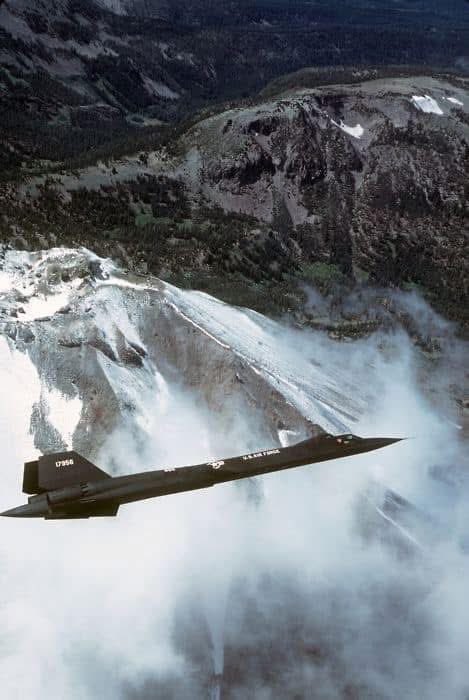
Assembly of one of two trainers #956 started on June 18 1964 and its roll out was on 20 May 1965. The first flight of the aircraft was on 18 November 1965. #956 is only one of two production B model SR-71s. The first SR 71 pilots Pete Collins, Al Hichew and Gray Sowers went to area 51 to fly the CIA’s A-12 trainer. The simulator was not ready yet either in November 1965.
The other, #61-7957, crashed on approach to Beale AFB on 11 January 1968. Since half of the SR-71 trainer fleet was lost on that day, a trainer replacement aircraft was built. Designated as the SR-71C, it was built from the aft fuselage of YF-12A #60-6934 and a static model from Lockheed.
This aircraft never lived up to the usability of the SR-71B as it had irregular maintenance procedures and its aftermarket construction caused the aircraft to fly in a constant yaw. Consequently, the SR-71C was used on a limited basis from 1969-1976.
SR-71B #956 served under the USAF until the program was initially cancelled in 1990. It was operated by NASA’s Dryden Flight Research Center at Edwards AFB, CA from 1991-1997 and was used jointly by NASA and Detachment 2 at Edwards AFB when the USAF program was reactivated in 1995. This SR-71 has more flight hours than any other serial of its type, 3,967.5 hrs. The last flight of this aircraft was on 19 October 1997 at the Edwards AFB Open House. It is believed that SR-71B #61-7956 has also been photographed more times than any other Blackbird.
Linda Sheffield
The XB-70 Valkyrie was an extremely large airframe, yet the YF-12 was not small at 107 feet long.
But if you compared the two, the Blackbird looked small.
The friendly Mach 3 rivalry between the YF-12 and the XB-70.
North American Rockwell made the first Mach 3 bomber. (Although the six-engine Valkyrie could only dash to Mach 3, it could NOT cruise at that speed.)
Their public relations firm advertised that they could fly higher and faster than anyone else, although this was not true.
On the other side of Edwards Air Force Base (AFB), the YF-12 Blackbird kept its secrets near and dear. The YF-12 was a variant of the A-12 with a backseat for the missile launch controller
The YF-12s took the seventh through ninth slots on the A-12 assembly line; these were designated as YF-12A high-altitude, Mach 3 interceptors.
The main changes involved modifying the A-12’s nose by cutting back the chines to accommodate the huge Hughes AN/ASG-18 fire-control radar initially developed for the XF-108 with two infrared search and track sensors embedded in the chine leading edge, and the addition of the second cockpit for a crew member to operate the fire control radar for the air-to-air missile system. This airframe could easily fly Mach 3.
As told by Donn A. Byrnes and Kenneth D. Hurley in their book Blackbird Rising: Birth of an Aviation Legend, they were both being tested at Edwards AFB at the same time, so naturally, they hung out at the same bar after work. One of the local watering holes was called Hernandez Hideaway.
YF-12 test pilots, often flew at Mach 3 more often than the XB-70 would do in a lifetime.
Jim Eastham had just about had enough of the bragging he heard daily about the XB-70. Eastham was a Lockheed test pilot who had already flown the A-12 and was now flying the YF-12.
One evening at the bar Al White of the XB-70 program was raving about his high Mach numbers when Eastham couldn’t stand it any longer. He turned to White and said, “Al, we do more Mach 3 time in a single YF-12 mission than you guys have flown in your entire program” 😆
Al looked at Jim, and without missing a beat, he said, “Yes that’s true, Jim, but we lose pieces that are bigger than your entire airplane 😳
 The B-70 was bigger and it was magnificent looking, but it could never beat the YF-12
Kelly Johnson’s invention of the Blackbird was the only airplane that could stay in continuous afterburner and not just dash to Mach three..like the B-70 could.
 The airframes had different purposes.
The B-70 was a bomber.  The YF 12 was an interceptor, both incredible airplanes that never took off due to military budgets.
 As always, Peter‘s artwork is inspiring.
Written by Linda Sheffield
Art by Peter Chilelli
An F-4J Phantom II assigned to the SLUGGERS above the USS SARATOGA JAN80. VF-103 was among the Navy's last fighter squadrons to transition to the Tomcat. (R.L. Lawson)
1991: The final FB-111A flight is made from Plattsburgh, New York to Davis Monthan AFB, Arizona, where the aircraft will be placed in storage.
Dropped from inventory by transfer to the Strategic Air & Space Museum. FB-111A, S/N 68-0267 was one of the last four FB-111s taking off from Plattsburgh AFB, New York on that date, thus ending their careers with SAC. (Courtesy SASM)