🚨 SCANDALE dans le scandale...
Non seulement Nuñez a alimenté les Fake News contre @RimaHas.
Mais EN PLUS le procureur et la police avaient DE LONGUE DATE ORGANISÉ un coup monté.
Y aura-t-il une enquête pour déterminer qui a trempé dedans ?
Médias : à quand les excuses ?
Le meilleur que j'ai pu lire sur l'organisation de la CAN par le Maroc..👌👏
Faris Awad, commentateur sportif émirati, sur son compte :
« Le Maroc a tenté de sortir la grenouille du marécage, mais le lieu naturel de la grenouille est dans le marécage. C'est ainsi que certains ont réagi à l'organisation par le Maroc de la Coupe d'Afrique des Nations, un projet qui élève le niveau du continent, mais qui s'est heurté à des mentalités qui ne vivent que dans la boue...»
🇬🇧 C’était il y a 18 ans !
Un Boeing 777 de British Airways a subit une double panne moteur suite à une défaillance mécanique.
L’avion atterrit sur l'herbe 350m avant la piste 27L d’Heathrow.
Sur les 136 personnes à bord, seuls 14 sont blessés.
Il s’agit du premier crash d'un B777.
🔹 Turbine Engine Starting Systems: Starting a turbine engine involves initiating airflow, fuel delivery, and ignition in a controlled sequence. These systems are crucial to bring the engine from a static state to self-sustaining operation.
🔹 Brief Explanation:
Turbine engine starting systems are designed to spin the compressor and introduce fuel and ignition at the right moment. Once the engine reaches idle RPM and is self-sustaining, the starter disengages.
🔹 How It Works (Basic Start Sequence):
1. Starter Engages – Spins the compressor section (via air, electric, or hydraulic power).
2. Ignition On – Spark is activated inside the combustion chamber.
3. Fuel Introduced – Fuel is sprayed into the chamber and ignited.
4. Light-Off – Combustion begins, increasing RPM.
5. Self-Sustaining – Engine reaches idle speed, starter disengages.
🔹 Types of Starting Systems:
▫️ Electric Starter – Common in small turboprops and business jets.
▫️ Air Turbine Starter (ATS) – Uses compressed air (from APU or ground cart); common in airliners.
▫️ Cartridge Starter – Uses explosive charge (used in military or remote ops).
▫️ Hydraulic Starter – Used in some helicopters or special ops aircraft.
▫️ APU Start – Aircraft uses its Auxiliary Power Unit to spin main engines.
🔹 Key Focus Points:
* Reliable startup is essential for flight safety
* Each type has unique advantages (e.g., air starts are lightweight; electric is quiet)
* Closely monitored parameters: EGT (Exhaust Gas Temp), RPM, and fuel flow
* Malfunctions during start (hot start, hung start, no light-off) require quick pilot action
🔹 Poll:
Which type of turbine engine start system do you find most interesting?
▫️ Electric Starter
▫️ Air Turbine Starter
▫️ Cartridge Starter
▫️ APU-Based Start
⭕️ Did You Know:
In extreme conditions or military missions, cartridge starters allow aircraft to launch without any external power source—just like a jet-powered firecracker!
🔹 Open-Ended Question:
What do you think are the advantages of using an APU over ground power for engine start?
🔹 Fun Fact:
Some WW2-era jet aircraft used gunpowder cartridges to start their engines—a concept still in limited use today for rugged military aircraft in remote areas.
🔹 Behind-the-Scenes:
In airline operations, ground crews and pilots carefully follow engine start checklists. The aircraft's FADEC (Full Authority Digital Engine Control) often handles the process in modern jets, but pilots must always monitor for signs of abnormal starts.
📸 by fb/aviation tech
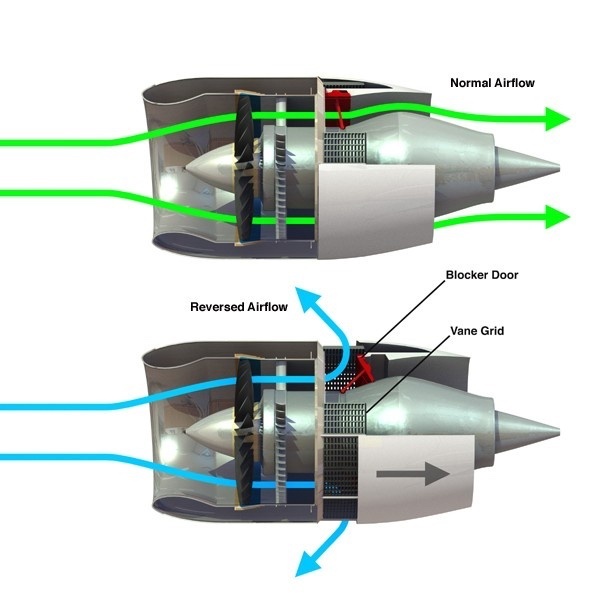
A thrust reverser is a mechanical system used in aircraft engines to help slow down the aircraft after landing. It temporarily redirects the engine’s thrust forward, instead of backward, to reduce the plane’s speed more quickly and relieve stress on the wheel brakes.
How It Works:
•Normal Thrust: Jet engines produce thrust by expelling high-speed exhaust gases out the back, pushing the aircraft forward.
•Reverse Thrust: When activated, thrust reversers redirect this exhaust flow forward, pushing against the aircraft’s forward motion.
Types of Thrust Reversers:
1.Cascade Type (common in turbofan engines):
•Found on engines like the CFM56 (used on Boeing 737).
•Uses blocker doors and cascade vanes to divert fan air forward.
2.Clamshell or Bucket Type (common in older turbojets/turbofans):
•Metal doors swing into the exhaust flow, redirecting it forward.
3.Cold Stream Reversers:
•Only the bypass (fan) airflow is reversed, not the hot exhaust core, for safety and efficiency.
When It’s Used:
•Immediately after landing (just after the wheels touch down).
•Sometimes during rejected takeoffs (RTO) at high speed.
Why It’s Important:
•Reduces landing distance.
•Improves safety, especially on wet or short runways.
•Less wear on wheel brakes and tires.
Limitations:
•Not used in flight (except in rare emergencies).
•Less effective at very low speeds.
•May be restricted at some airports due to noise.
İ
🍔 "Je suis né pauvre, je veux que tout le monde puisse venir chez moi".
À Foix, Tom, le patron du restaurant, propose des burgers maison à seulement 5 euros pour que tout le monde puisse manger.
[REDIFF]
A 10 ans :
Sourate Al-Fatiha
Sourate Al Falaq
Sourate Al-Nas
A 20 ans :
Sourate Al-Fatiha
Sourate Al-Falaq
Sourate An-Nas
Remettons nous en question..
combien de musiques apprise en 10 ans ? Et combien de Sourates apprise en 10 ans ?