Tabular data is a really exciting and rich domain to explore reasoning for LLMs 🧠
Check out our latest work on understanding the critical gaps that emerge when reasoning over messy, real-world data: https://t.co/A1811n0SRp
and big kudos to Ken for the beautiful figures 👏
Tabular data is a really exciting and rich domain to explore reasoning for LLMs 🧠
Check out our latest work on understanding the critical gaps that emerge when reasoning over messy, real-world data: https://t.co/A1811n0SRp
and big kudos to Ken for the beautiful figures 👏
🚨Are LLMs truly ready for autonomous data science?
Real-world data is messy—missing values, outliers, inconsistencies—and if not handled properly, can lead to wrong conclusions.
🌟We introduce RADAR, a benchmark evaluating whether LLMs can handle imperfect tabular data. 🧵
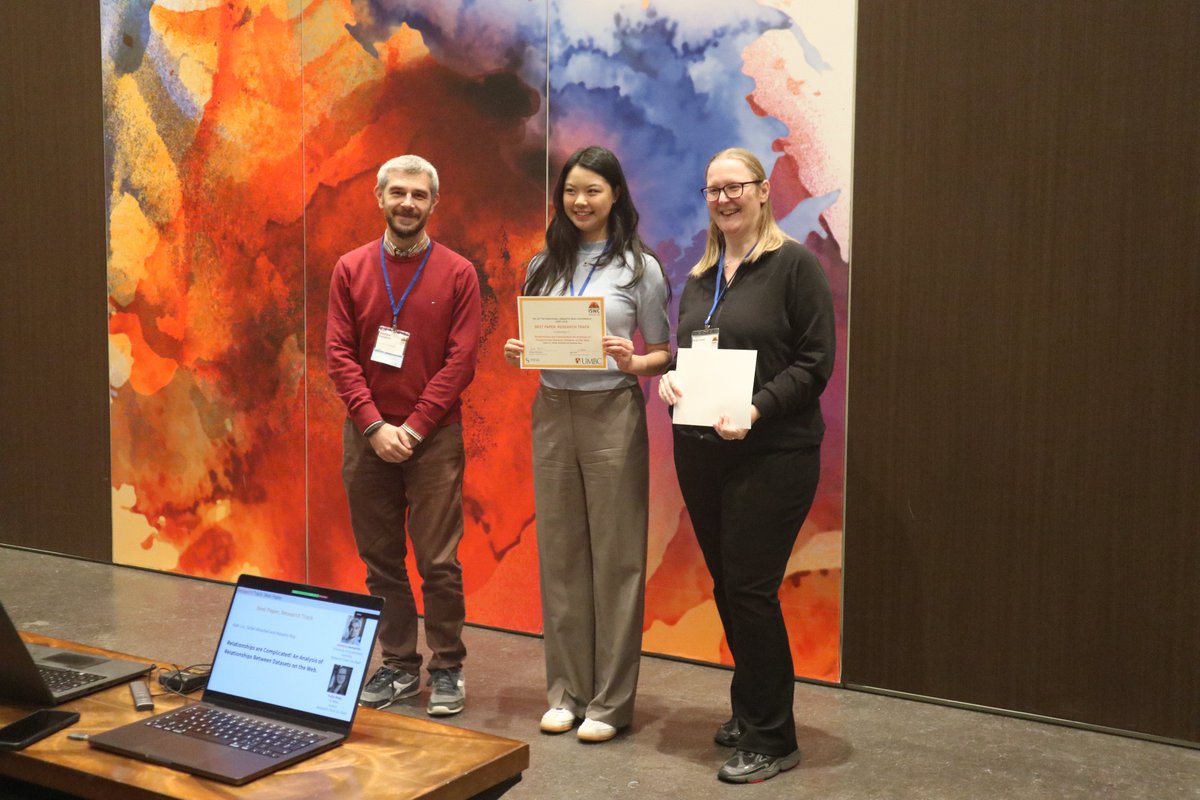
Best Paper Award, Research track was awarded to Kate Lin, Tarfah Alrashed and Natasha Noy for their work "Relationships are Complicated! An Analysis of Relationships Between Datasets on the Web". Big Congrats!
Excited to share that our paper on automatically inferring relationships between datasets on the web won the Best Paper Award for the Research Track at @iswc_conf ! #iswc2024
Relationships are complicated! Check out my recent work @GoogleAI on using ML to automatically identify complex relationships between datasets on the Web. I'll also be presenting the paper (https://t.co/On50SsTBCO) at @iswc_conf next week.
Relationships are complicated! Check out my recent work @GoogleAI on using ML to automatically identify complex relationships between datasets on the Web. I'll also be presenting the paper (https://t.co/On50SsTBCO) at @iswc_conf next week.
With millions of datasets available on the Web, understanding the relationships between them is critical for research & decision making. Learn how we developed a series of methods to automatically identify such relationships and compare their performance →https://t.co/kGPDoABbhH
paper link: https://t.co/On50SsTBCO
published dataset link: https://t.co/im1k0gUBCb
many thanks to my wonderful collaborators: @TarfahAlrashed and Natasha Noy
Lastly, we present recommendations for enhancing dataset metadata and analyze the relationships between >2.7 million datasets on the Web. We also publish this collection of dataset pages, their metadata, and their relationships. (4/N)
Excited to share some of what I’ve been working on for the past half-year @GoogleAI — Automatic Structured Variational Inference! Building ASVI in TensorFlow Probability & conducting experiments was a lot of fun 😊 Check out the thread below to learn more!👇
1/5) Proud to share the new version of "automatic structured variational inference" (ASVI) (Accepted at #AISTATS2021)
Work in collaborations with the Google #TensorFlow Probability team.
Repository:
https://t.co/4y3ADYYBQH
Preprint:
https://t.co/lAH3Yz2hBF
(1/2) @NeurIPSConf Computer-Assisted Programming Workshop today, we'll be presenting Causal Inductive Synthesis Corpus, a suite of interactive domains that provide a framework for active and passive discovery of causal probabilistic programs.
(2/2) (w/ @ZennaTavares, Ria Das, Elizabeth Weeks, Josh Tenenbaum, and Armando Solar-Lezama)
Poster sessions are at 10:10-11:00 AM PT and 1:00-2:30PM PT. Swing by to learn more or to just say hi!
Paper: https://t.co/kZWhmWoLFe
https://t.co/MuPuSbFPUA