Dog Training World has supported dog training professionals and enthusiasts since 1998.
We share relevant, unbiased research, science, and legal developments shaping the field. Need more support? Visit us at: https://t.co/9uJ2Wooti0
Here's something most people, even in professional curriculums, still get wrong: emotional support animals do not have guaranteed federal housing protections anymore.
In a signed memorandum effective May 22, 2026, HUD rescinded its 2020 guidance and now will only pursue federal fair housing complaints for animals individually trained to perform a task related to a disability, the same standard the ADA uses for service animals. Untrained emotional support animals no longer qualify for that federal enforcement path.
This is not a proposed rule. It is already in effect at the enforcement level. HUD has separately said it intends to pursue formal rulemaking to align the law itself with this standard, but that process has no timeline yet. In the meantime, state laws and existing court decisions still vary, so an ESA denial could still be challenged, just not through HUD.
Food for thought. If your understanding of ESA housing rights was based on older guidance, when did you last check whether it's still accurate? And do you know what your state's current standard actually is?
Source: https://t.co/nzqSDQZ2Zt
Colorado's dangerous dog statute just changed. HB25-1034, effective this year, removes "or serious bodily injury" from a professional exemption, leaving only "bodily injury" in place.
Here's what that actually means. Previously, if a dog injured a veterinary worker, groomer, humane agency staffer, professional handler, or trainer while they were performing their job, the dog was exempt from a dangerous dog classification regardless of how severe the injury was. Now, that protection only covers lesser injuries. If the injury rises to the level of serious bodily injury, the exemption no longer applies, and the dog can be legally designated dangerous.
For professionals doing hands on work with dogs in Colorado, and for anyone doing bite assessments or expert evaluations there, this is a real shift in legal exposure, not just a wording tweak.
Do you know the current dangerous dog laws in your state or country, and when they last changed? These laws shift quietly and rarely make headlines outside legal circles, but they shape real outcomes for the dogs and people we work with.
Source: https://t.co/thGMfkgQfx
BREAKING: The EU just adopted its first ever bloc wide welfare law for dogs and cats. Regulation (EU) 2026/1818 sets common minimum standards across all 27 member states for breeding, keeping, identification, and sale of companion animals. It also introduces new traceability rules for online sales and requirements for animals imported from outside the EU.
The rules begin applying August 31, 2028, giving breeders, shelters, pet shops, and importers time to prepare.
This is the first time the EU has regulated dog and cat welfare at the union level rather than leaving it to individual countries. Trainers and behavior professionals working with imported or rescued dogs in Europe will want to watch how member states implement it.
Full text: https://t.co/sE8G0JtIl0
Your dog isn't just reading "happy" or "mad." Their brain is doing more than that.
New fMRI study (iScience, Aug 2026): researchers scanned pet dogs' brains while showing them photos of human faces: happy, sad, fearful, angry.
What they found:
→ A smile lights up the caudate nucleus, the same reward circuit that fires for treats. To a dog, your smile IS a reward signal, not just "not-angry."
→ Fear vs. anger, and fear vs. sadness, triggered different brain patterns. First real evidence dogs' brains split negative emotions into distinct categories, not just "bad mood."
→ Anger and sadness looked the same to the brain from a photo alone. Dogs likely need your body language, tone, or scent to tell those apart in real life.
Caveats: small sample (8-12 dogs), family pets, stills of strangers' faces. Not proof dogs "feel" what we feel, but proof they're reading us with more precision than we assumed.
Your face is data to your dog. Bring the right one into hard moments.
Paper: https://t.co/gVWf2otnzE
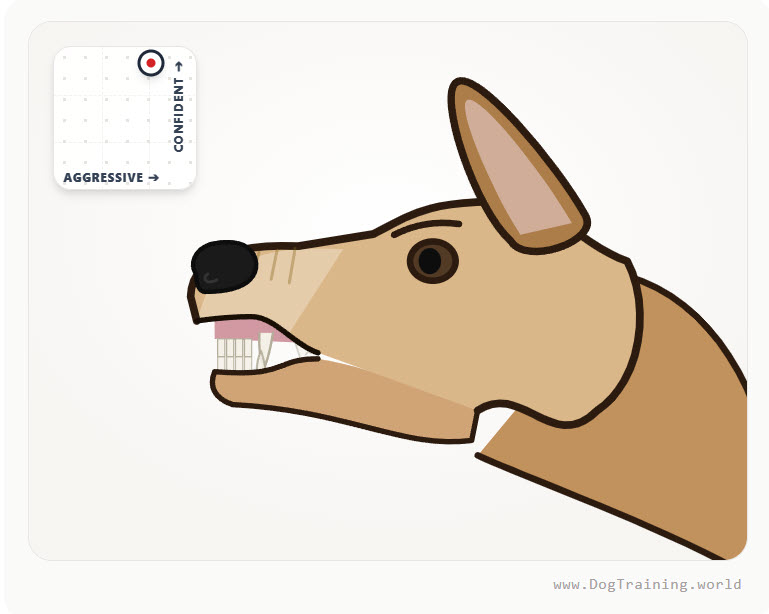
Confidence vs Defensive Aggression Interactive Chart
The more confident a dog is, the more their facial features pull forward. The less confident they are, the more their features pull back. This model is especially helpful for evaluating dogs that are exhibiting defense based aggression. Use the slider to adjust the dog's confidence level against their intensity of aggression. Have fun!
https://t.co/fc3x3PWjN0
The Combination of Appetitive and Aversive Reinforcers and the Nature of Their Interaction During Auditory Learning by Ilango et al. (2010) https://t.co/ZIgzaaxdqI
#dogtraining#dogtrainingscience#dogbehavior
Learning Resistance to Pain and Fear: Effects of Overlearning, Exposure, and Rewarded Exposure in Context, Miller https://t.co/WrW8D4sCOS
#DogTraining#dogbehavior#Psychology